
睡眠并不影响图式促进的运动记忆巩固。
Sleep does not influence schema-facilitated motor memory consolidation.
机构信息
Department of Movement Sciences, Motor Control and Neural Plasticity Research Group, KU Leuven, Leuven, Belgium.
LBI-KU Leuven Brain Institute, KU Leuven, Leuven, Belgium.
出版信息
PLoS One. 2023 Jan 19;18(1):e0280591. doi: 10.1371/journal.pone.0280591. eCollection 2023.
STUDY OBJECTIVES
Novel information is rapidly learned when it is compatible with previous knowledge. This "schema" effect, initially described for declarative memories, was recently extended to the motor memory domain. Importantly, this beneficial effect was only observed 24 hours-but not immediately-following motor schema acquisition. Given the established role of sleep in memory consolidation, we hypothesized that sleep following the initial learning of a schema is necessary for the subsequent rapid integration of novel motor information.
METHODS
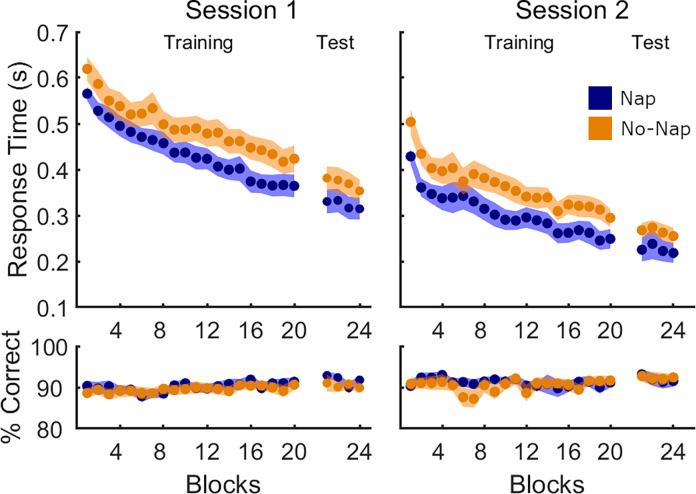
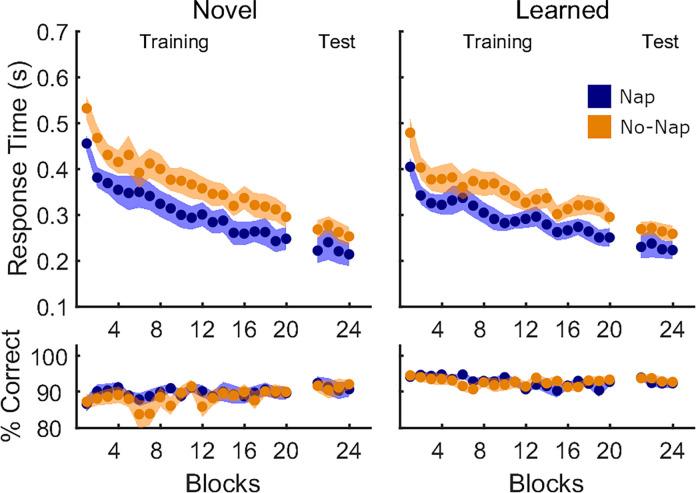
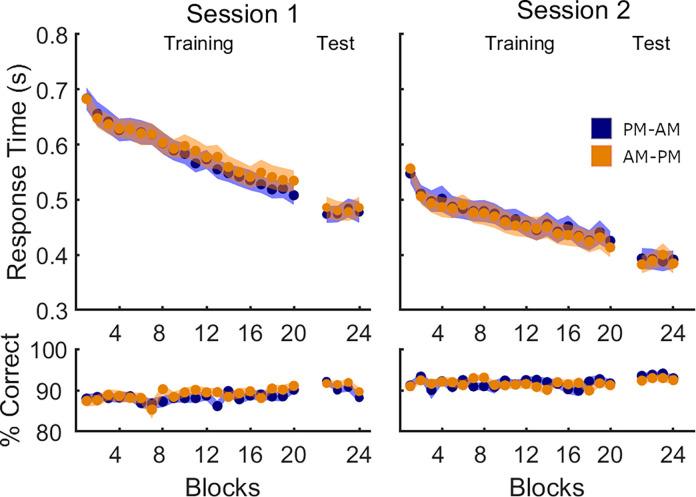
Two experiments were conducted to investigate the effect of diurnal and nocturnal sleep on schema-mediated motor sequence memory consolidation. In Experiment 1, participants first learned an 8-element motor sequence through repeated practice (Session 1). They were then afforded a 90-minute nap opportunity (N = 25) or remained awake (N = 25) before learning a second motor sequence (Session 2) which was highly compatible with that learned prior to the sleep/wake interval. Experiment 2 was similar; however, Sessions 1 and 2 were separated by a 12-hour interval that included nocturnal sleep (N = 28) or only wakefulness (N = 29).
RESULTS
For both experiments, we found no group differences in motor sequence performance (reaction time and accuracy) following the sleep/wake interval. Furthermore, in Experiment 1, we found no correlation between sleep features (non-REM sleep duration, spindle and slow wave activity) and post-sleep behavioral performance.
CONCLUSIONS
The results of this research suggest that integration of novel motor information into a cognitive-motor schema does not specifically benefit from post-learning sleep.
研究目的
当新信息与先前知识兼容时,新知识会被迅速学习。这种“图式”效应最初在陈述性记忆中被描述,最近已扩展到运动记忆领域。重要的是,这种有益的影响仅在运动图式习得后 24 小时观察到——而不是立即观察到。鉴于睡眠在记忆巩固中的既定作用,我们假设在最初学习图式后,睡眠是随后快速整合新运动信息所必需的。
方法
进行了两项实验来研究日间和夜间睡眠对图式介导的运动序列记忆巩固的影响。在实验 1 中,参与者首先通过反复练习学习 8 个元素的运动序列(第 1 节)。然后,他们有 90 分钟的午睡机会(N = 25)或保持清醒(N = 25),然后再学习与睡眠/清醒间隔之前学习的第二运动序列高度兼容的运动序列(第 2 节)。实验 2 类似;然而,第 1 节和第 2 节之间的间隔为 12 小时,包括夜间睡眠(N = 28)或仅清醒(N = 29)。
结果
对于这两个实验,我们在睡眠/清醒间隔后,在运动序列表现(反应时间和准确性)方面没有发现组间差异。此外,在实验 1 中,我们发现睡眠特征(非快速眼动睡眠持续时间、纺锤波和慢波活动)与睡眠后行为表现之间没有相关性。
结论
这项研究的结果表明,将新的运动信息整合到认知运动图式中不一定受益于学习后的睡眠。


 Zotero 插件