Bönstrup Marlene, Iturrate Iñaki, Hebart Martin N, Censor Nitzan, Cohen Leonardo G
Human Cortical Physiology and Neurorehabilitation Section, National Institute of Neurological Disorders and Stroke, Bethesda, MD 20814 USA.
Laboratory of Brain and Cognition, National Institute of Mental Health, Bethesda, MD 20814 USA.
NPJ Sci Learn. 2020 Jun 4;5:7. doi: 10.1038/s41539-020-0066-9. eCollection 2020.
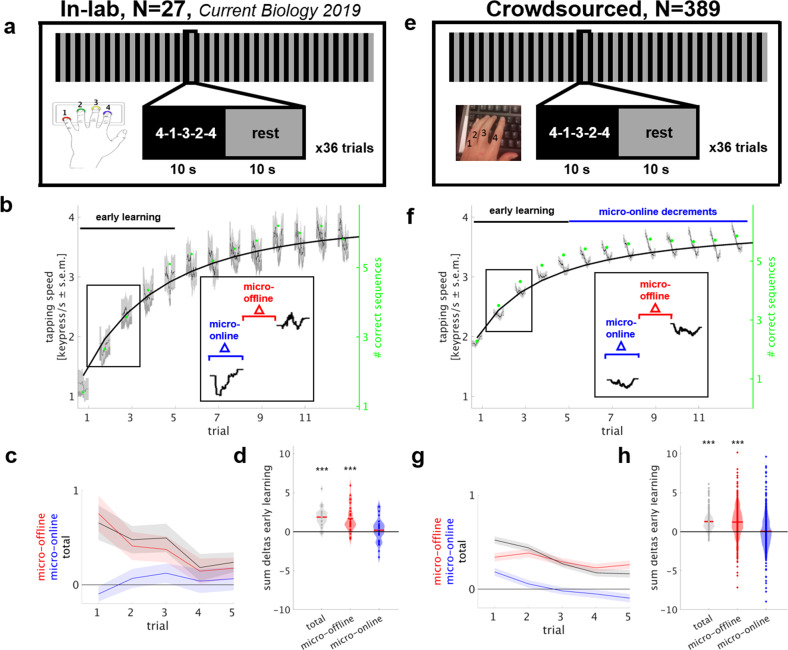
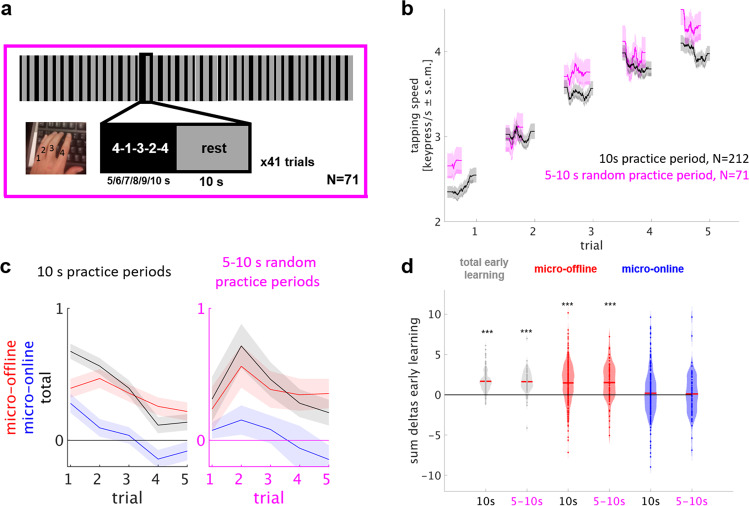
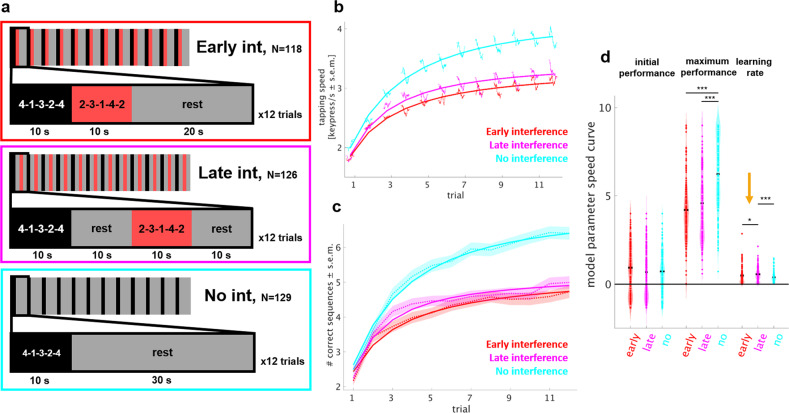
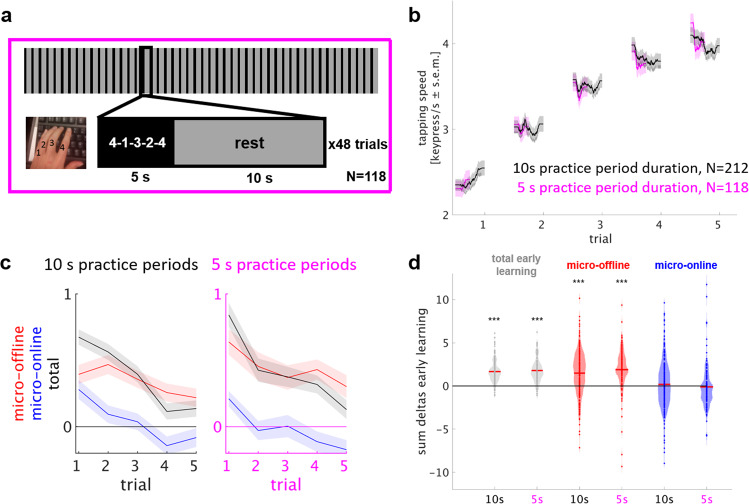
Performance improvements during early human motor skill learning are suggested to be driven by short periods of rest during practice, at the scale of seconds. To reveal the unknown mechanisms behind these "micro-offline" gains, we leveraged the sampling power offered by online crowdsourcing (cumulative over all experiments = 951). First, we replicated the original in-lab findings, demonstrating generalizability to subjects learning the task in their daily living environment ( = 389). Second, we show that offline improvements during rest are equivalent when significantly shortening practice period duration, thus confirming that they are not a result of recovery from performance fatigue ( = 118). Third, retroactive interference immediately after each practice period reduced the learning rate relative to interference after passage of time ( = 373), indicating stabilization of the motor memory at a microscale of several seconds. Finally, we show that random termination of practice periods did not impact offline gains, ruling out a contribution of predictive motor slowing ( = 71). Altogether, these results demonstrate that micro-offline gains indicate rapid, within-seconds consolidation accounting for early skill learning.
早期人类运动技能学习过程中的表现提升被认为是由练习过程中以秒为单位的短时间休息所驱动的。为了揭示这些“微观离线”提升背后的未知机制,我们利用了在线众包提供的采样能力(所有实验累计 = 951)。首先,我们重复了最初在实验室中的发现,证明了在日常生活环境中学习该任务的受试者具有可推广性( = 389)。其次,我们表明,在显著缩短练习周期时长时,休息期间的离线提升是等效的,从而证实它们不是性能疲劳恢复的结果( = 118)。第三,相对于经过一段时间后的干扰,每个练习周期后立即进行的追溯干扰降低了学习率( = 373),这表明在几秒钟的微观尺度上运动记忆得到了稳定。最后,我们表明练习周期的随机终止不会影响离线提升,排除了预测性运动减慢的作用( = 71)。总之,这些结果表明,微观离线提升表明了在数秒内的快速巩固,这是早期技能学习的原因。