Akhtar Zahid
Department of Network and Computer Security, State University of New York (SUNY) Polytechnic Institute, Utica, NY 13502, USA.
J Imaging. 2023 Jan 13;9(1):18. doi: 10.3390/jimaging9010018.
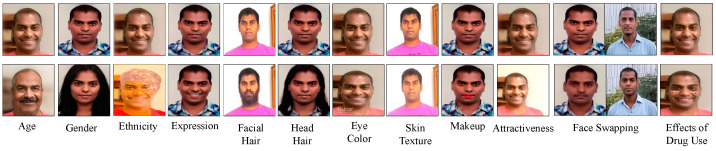
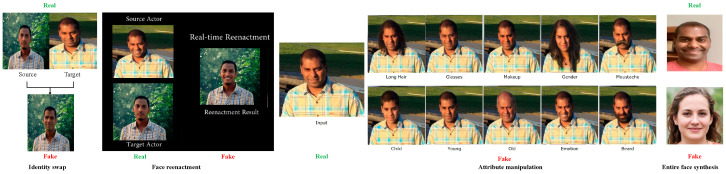
Advancements in deep learning techniques and the availability of free, large databases have made it possible, even for non-technical people, to either manipulate or generate realistic facial samples for both benign and malicious purposes. DeepFakes refer to face multimedia content, which has been digitally altered or synthetically created using deep neural networks. The paper first outlines the readily available face editing apps and the vulnerability (or performance degradation) of face recognition systems under various face manipulations. Next, this survey presents an overview of the techniques and works that have been carried out in recent years for deepfake and face manipulations. Especially, four kinds of deepfake or face manipulations are reviewed, i.e., identity swap, face reenactment, attribute manipulation, and entire face synthesis. For each category, deepfake or face manipulation generation methods as well as those manipulation detection methods are detailed. Despite significant progress based on traditional and advanced computer vision, artificial intelligence, and physics, there is still a huge arms race surging up between attackers/offenders/adversaries (i.e., DeepFake generation methods) and defenders (i.e., DeepFake detection methods). Thus, open challenges and potential research directions are also discussed. This paper is expected to aid the readers in comprehending deepfake generation and detection mechanisms, together with open issues and future directions.
深度学习技术的进步以及免费大型数据库的可用性,使得即使是非技术人员也有可能出于良性或恶意目的操纵或生成逼真的面部样本。深度伪造是指使用深度神经网络进行数字更改或合成创建的面部多媒体内容。本文首先概述了现有的面部编辑应用程序以及各种面部操纵下人脸识别系统的脆弱性(或性能下降)。接下来,本综述介绍了近年来针对深度伪造和面部操纵所开展的技术和工作。特别是,回顾了四种深度伪造或面部操纵,即身份交换、面部重演、属性操纵和全脸合成。对于每个类别,详细介绍了深度伪造或面部操纵生成方法以及那些操纵检测方法。尽管基于传统和先进的计算机视觉、人工智能和物理学取得了重大进展,但攻击者/违法者/对手(即深度伪造生成方法)和防御者(即深度伪造检测方法)之间仍在激烈竞争。因此,还讨论了开放挑战和潜在的研究方向。本文旨在帮助读者理解深度伪造生成和检测机制,以及开放问题和未来方向。