Batool Sania, Chokkakula Santosh, Song Min-Suk
Department of Microbiology, Chungbuk National University, College of Medicine and Medical Research Institute, Cheongju 28644, Chungbuk, Republic of Korea.
Microorganisms. 2023 Jan 11;11(1):183. doi: 10.3390/microorganisms11010183.
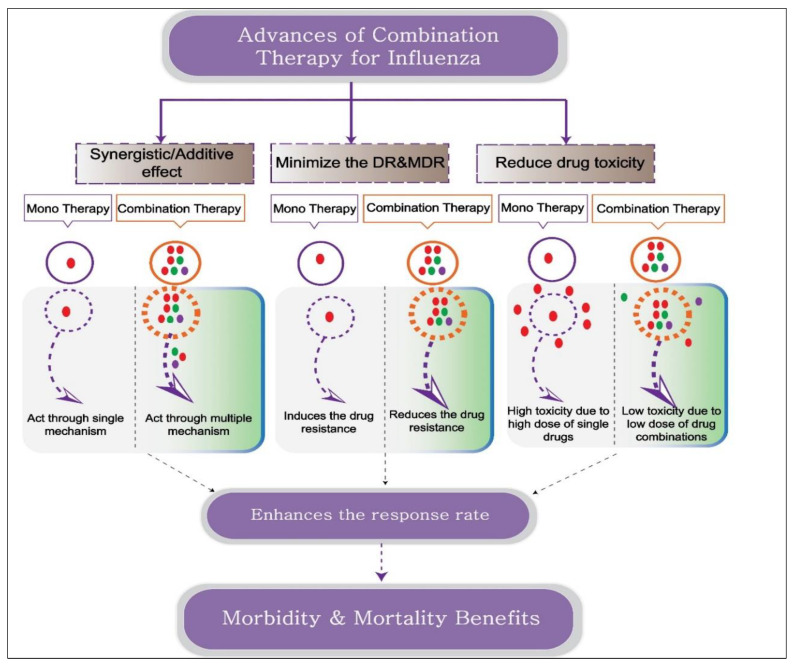
Influenza infection is serious and debilitating for humans and animals. The influenza virus undergoes incessant mutation, segment recombination, and genome reassortment. As a result, new epidemics and pandemics are expected to emerge, making the elimination challenging of the disease. Antiviral therapy has been used for the treatment of influenza since the development of amantadine in the 1960s; however, its use is hampered by the emergence of novel strains and the development of drug resistance. Thus, combinational therapy with two or more antivirals or immunomodulators with different modes of action is the optimal strategy for the effective treatment of influenza infection. In this review, we describe current options for combination therapy, their performance, and constraints imposed by resistance, calling attention to the advantages of combination therapy against severe influenza infections. We also discuss the challenges of influenza therapy and the limitations of approved antiviral drugs.
流感感染对人类和动物来说严重且使人虚弱。流感病毒不断发生突变、片段重组和基因组重配。因此,预计会出现新的流行病和大流行,这使得消除该疾病具有挑战性。自20世纪60年代金刚烷胺研发以来,抗病毒疗法一直用于治疗流感;然而,新型毒株的出现和耐药性的产生阻碍了其使用。因此,联合使用两种或更多种具有不同作用方式的抗病毒药物或免疫调节剂进行联合治疗是有效治疗流感感染的最佳策略。在本综述中,我们描述了联合治疗的当前选择、它们的性能以及耐药性带来的限制,提请注意联合治疗针对严重流感感染的优势。我们还讨论了流感治疗的挑战以及已批准抗病毒药物的局限性。