Department of Medical Chemistry and Laboratory Medicine, Poznan University of Medical Sciences, 61-701 Poznan, Poland.
Institute of Computing Science, Poznan University of Technology, 60-965 Poznan, Poland.
Nutrients. 2023 Jan 14;15(2):442. doi: 10.3390/nu15020442.
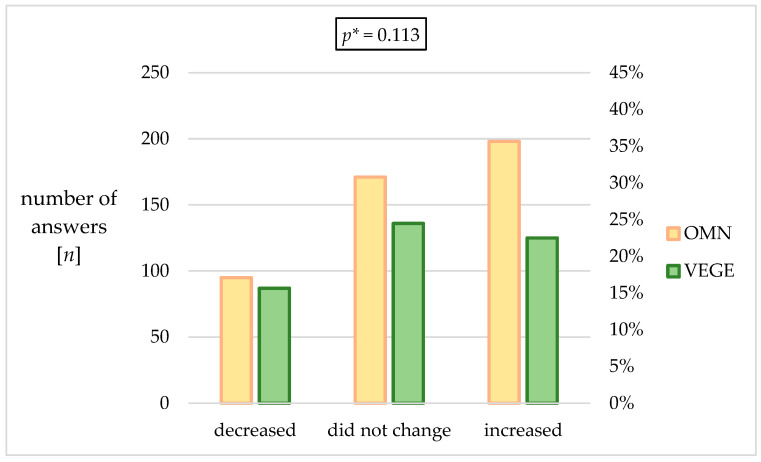
Background: This study assessed how two food groups—omnivores (OMN) and vegetarians (VEGE)—differ in lifestyle changes, including dietary habits during the COVID-19 pandemic. Materials: A total of 861 persons participated in the survey and were divided into two groups: persons following a mixed diet (n = 489) and vegetarians, including vegans (n = 372). The mean age shows no significant differences. Methods: An online survey was conducted on the Polish population during the COVID-19 pandemic. Data was collected using social media; the survey was intended for adults and included separate sheets for different diets (OMN vs. VEGE). Results: The results in both groups were similar regarding the burden of premature diseases. Most respondents (~90%) did not indicate cardiovascular disease abnormalities. In the OMN group, overweight and obesity occurred more often, and the OMN group also showed a higher percentage of people reporting weight gain (OMN 42.7% vs. VEGE 35.9%). The results disclosed the VEGE group significantly more frequently chose products, i.e., vegetables (p = 0.029), legumes (p < 0.001), and dairy products or their plant substitutes (p = 0.002), compared to the OMN group. Conclusions: The VEGE group revealed the most regularities in dietary habits during the pandemic.
本研究评估了两种食物群体——杂食者(OMN)和素食者(VEGE)在生活方式改变方面的差异,包括在 COVID-19 大流行期间的饮食习惯。
共有 861 人参与了这项调查,并分为两组:混合饮食组(n = 489)和素食者组,包括纯素食者(n = 372)。两组的平均年龄没有显著差异。
在 COVID-19 大流行期间,对波兰人口进行了在线调查。数据通过社交媒体收集;该调查针对成年人进行,包括针对不同饮食(OMN 与 VEGE)的单独问卷。
两组在导致过早发病的因素方面结果相似。大多数受访者(约 90%)没有报告心血管疾病异常。在 OMN 组中,超重和肥胖更为常见,而且 OMN 组报告体重增加的比例也更高(OMN 为 42.7%,VEGE 为 35.9%)。结果显示,VEGE 组选择蔬菜(p = 0.029)、豆类(p < 0.001)和奶制品或其植物替代品(p = 0.002)的频率显著高于 OMN 组。
VEGE 组在大流行期间的饮食习惯更有规律。