• 文献检索
  • 文档翻译
  • 深度研究
  • 学术资讯
  • Suppr Zotero 插件Zotero 插件
  • 邀请有礼
  • 套餐&价格
  • 历史记录
应用&插件
Suppr Zotero 插件Zotero 插件浏览器插件Mac 客户端Windows 客户端微信小程序
定价
高级版会员购买积分包购买API积分包
服务
文献检索文档翻译深度研究API 文档MCP 服务
关于我们
关于 Suppr公司介绍联系我们用户协议隐私条款
关注我们

Suppr 超能文献

核心技术专利:CN118964589B侵权必究
粤ICP备2023148730 号-1Suppr @ 2026

文献检索

告别复杂PubMed语法,用中文像聊天一样搜索,搜遍4000万医学文献。AI智能推荐,让科研检索更轻松。

立即免费搜索

文件翻译

保留排版,准确专业,支持PDF/Word/PPT等文件格式,支持 12+语言互译。

免费翻译文档

深度研究

AI帮你快速写综述,25分钟生成高质量综述,智能提取关键信息,辅助科研写作。

立即免费体验

SL-HarDNet:使用HarDNet进行皮肤病变分割

SL-HarDNet: Skin lesion segmentation with HarDNet.

作者信息

Bai Ruifeng, Zhou Mingwei

机构信息

Changchun Institute of Optics, Fine Mechanics and Physics, Chinese Academy of Sciences, Changchun, China.

University of Chinese Academy of Sciences, Beijing, China.

出版信息

Front Bioeng Biotechnol. 2023 Jan 5;10:1028690. doi: 10.3389/fbioe.2022.1028690. eCollection 2022.

DOI:10.3389/fbioe.2022.1028690
PMID:36686227
原文链接:https://pmc.ncbi.nlm.nih.gov/articles/PMC9849244/
Abstract

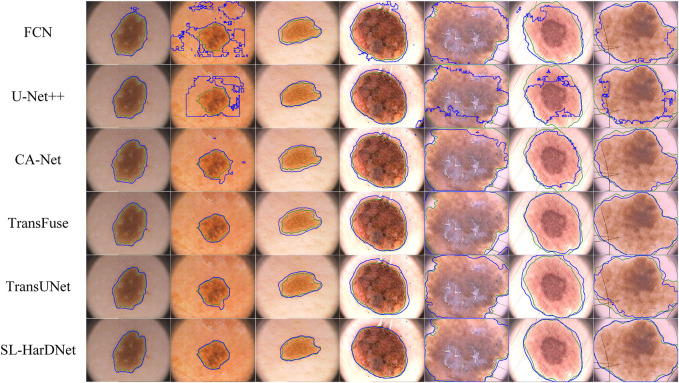
Automatic segmentation of skin lesions from dermoscopy is of great significance for the early diagnosis of skin cancer. However, due to the complexity and fuzzy boundary of skin lesions, automatic segmentation of skin lesions is a challenging task. In this paper, we present a novel skin lesion segmentation network based on HarDNet (SL-HarDNet). We adopt HarDNet as the backbone, which can learn more robust feature representation. Furthermore, we introduce three powerful modules, including: cascaded fusion module (CFM), spatial channel attention module (SCAM) and feature aggregation module (FAM). Among them, CFM combines the features of different levels and effectively aggregates the semantic and location information of skin lesions. SCAM realizes the capture of key spatial information. The cross-level features are effectively fused through FAM, and the obtained high-level semantic position information features are reintegrated with the features from CFM to improve the segmentation performance of the model. We apply the challenge dataset ISIC-2016&PH2 and ISIC-2018, and extensively evaluate and compare the state-of-the-art skin lesion segmentation methods. Experiments show that our SL-HarDNet performance is always superior to other segmentation methods and achieves the latest performance.

摘要

从皮肤镜图像中自动分割皮肤病变对于皮肤癌的早期诊断具有重要意义。然而,由于皮肤病变的复杂性和边界模糊性,皮肤病变的自动分割是一项具有挑战性的任务。在本文中,我们提出了一种基于HarDNet的新型皮肤病变分割网络(SL-HarDNet)。我们采用HarDNet作为主干网络,它能够学习更强大的特征表示。此外,我们引入了三个强大的模块,包括:级联融合模块(CFM)、空间通道注意力模块(SCAM)和特征聚合模块(FAM)。其中,CFM结合不同层次的特征,有效地聚合皮肤病变的语义和位置信息。SCAM实现关键空间信息的捕获。通过FAM有效地融合跨层次特征,并将获得的高层次语义位置信息特征与CFM的特征重新整合,以提高模型的分割性能。我们应用了挑战性数据集ISIC-2016&PH2和ISIC-2018,并对当前最先进的皮肤病变分割方法进行了广泛的评估和比较。实验表明,我们的SL-HarDNet性能始终优于其他分割方法,并取得了最新的性能。

https://cdn.ncbi.nlm.nih.gov/pmc/blobs/572f/9849244/3247b5865007/fbioe-10-1028690-g010.jpg
https://cdn.ncbi.nlm.nih.gov/pmc/blobs/572f/9849244/6bf596acb65b/fbioe-10-1028690-g001.jpg
https://cdn.ncbi.nlm.nih.gov/pmc/blobs/572f/9849244/868c88b1b945/fbioe-10-1028690-g002.jpg
https://cdn.ncbi.nlm.nih.gov/pmc/blobs/572f/9849244/3788d2be96f3/fbioe-10-1028690-g003.jpg
https://cdn.ncbi.nlm.nih.gov/pmc/blobs/572f/9849244/1e090736e858/fbioe-10-1028690-g004.jpg
https://cdn.ncbi.nlm.nih.gov/pmc/blobs/572f/9849244/214d3a2cfa7f/fbioe-10-1028690-g005.jpg
https://cdn.ncbi.nlm.nih.gov/pmc/blobs/572f/9849244/28fa7dfbb2fd/fbioe-10-1028690-g006.jpg
https://cdn.ncbi.nlm.nih.gov/pmc/blobs/572f/9849244/843c65748f1f/fbioe-10-1028690-g007.jpg
https://cdn.ncbi.nlm.nih.gov/pmc/blobs/572f/9849244/3e4f816fede2/fbioe-10-1028690-g008.jpg
https://cdn.ncbi.nlm.nih.gov/pmc/blobs/572f/9849244/75aea0d1050c/fbioe-10-1028690-g009.jpg
https://cdn.ncbi.nlm.nih.gov/pmc/blobs/572f/9849244/3247b5865007/fbioe-10-1028690-g010.jpg
https://cdn.ncbi.nlm.nih.gov/pmc/blobs/572f/9849244/6bf596acb65b/fbioe-10-1028690-g001.jpg
https://cdn.ncbi.nlm.nih.gov/pmc/blobs/572f/9849244/868c88b1b945/fbioe-10-1028690-g002.jpg
https://cdn.ncbi.nlm.nih.gov/pmc/blobs/572f/9849244/3788d2be96f3/fbioe-10-1028690-g003.jpg
https://cdn.ncbi.nlm.nih.gov/pmc/blobs/572f/9849244/1e090736e858/fbioe-10-1028690-g004.jpg
https://cdn.ncbi.nlm.nih.gov/pmc/blobs/572f/9849244/214d3a2cfa7f/fbioe-10-1028690-g005.jpg
https://cdn.ncbi.nlm.nih.gov/pmc/blobs/572f/9849244/28fa7dfbb2fd/fbioe-10-1028690-g006.jpg
https://cdn.ncbi.nlm.nih.gov/pmc/blobs/572f/9849244/843c65748f1f/fbioe-10-1028690-g007.jpg
https://cdn.ncbi.nlm.nih.gov/pmc/blobs/572f/9849244/3e4f816fede2/fbioe-10-1028690-g008.jpg
https://cdn.ncbi.nlm.nih.gov/pmc/blobs/572f/9849244/75aea0d1050c/fbioe-10-1028690-g009.jpg
https://cdn.ncbi.nlm.nih.gov/pmc/blobs/572f/9849244/3247b5865007/fbioe-10-1028690-g010.jpg

相似文献

1
SL-HarDNet: Skin lesion segmentation with HarDNet.SL-HarDNet:使用HarDNet进行皮肤病变分割
Front Bioeng Biotechnol. 2023 Jan 5;10:1028690. doi: 10.3389/fbioe.2022.1028690. eCollection 2022.
2
HMA-Net: A deep U-shaped network combined with HarDNet and multi-attention mechanism for medical image segmentation.HMA-Net:一种结合 HarDNet 和多注意力机制的深度 U 形网络,用于医学图像分割。
Med Phys. 2023 Mar;50(3):1635-1646. doi: 10.1002/mp.16065. Epub 2022 Nov 3.
3
Dynamically aggregating MLPs and CNNs for skin lesion segmentation with geometry regularization.基于几何正则化的动态聚合 MLP 和 CNN 进行皮肤病变分割。
Comput Methods Programs Biomed. 2023 Aug;238:107601. doi: 10.1016/j.cmpb.2023.107601. Epub 2023 May 14.
4
Learning from dermoscopic images in association with clinical metadata for skin lesion segmentation and classification.结合临床元数据从皮肤镜图像中学习以进行皮肤病变分割和分类。
Comput Biol Med. 2023 Jan;152:106321. doi: 10.1016/j.compbiomed.2022.106321. Epub 2022 Nov 17.
5
Attention-based dual-path feature fusion network for automatic skin lesion segmentation.用于自动皮肤病变分割的基于注意力的双路径特征融合网络。
BioData Min. 2023 Oct 9;16(1):28. doi: 10.1186/s13040-023-00345-x.
6
Efficient skin lesion segmentation using separable-Unet with stochastic weight averaging.使用可分离 U-Net 和随机权重平均化实现高效的皮肤病变分割。
Comput Methods Programs Biomed. 2019 Sep;178:289-301. doi: 10.1016/j.cmpb.2019.07.005. Epub 2019 Jul 8.
7
Automatic lesion segmentation using atrous convolutional deep neural networks in dermoscopic skin cancer images.基于空洞卷积深度神经网络的皮肤镜图像中自动病变分割。
BMC Med Imaging. 2022 May 29;22(1):103. doi: 10.1186/s12880-022-00829-y.
8
TGDAUNet: Transformer and GCNN based dual-branch attention UNet for medical image segmentation.TGDAUNet:基于 Transformer 和 GCNN 的双分支注意力 U-Net 用于医学图像分割。
Comput Biol Med. 2023 Dec;167:107583. doi: 10.1016/j.compbiomed.2023.107583. Epub 2023 Oct 21.
9
Skin lesion segmentation using high-resolution convolutional neural network.基于高分辨率卷积神经网络的皮肤损伤分割。
Comput Methods Programs Biomed. 2020 Apr;186:105241. doi: 10.1016/j.cmpb.2019.105241. Epub 2019 Dec 4.
10
Transformer guided self-adaptive network for multi-scale skin lesion image segmentation.Transformer 引导的自适网络用于多尺度皮肤病变图像分割。
Comput Biol Med. 2024 Feb;169:107846. doi: 10.1016/j.compbiomed.2023.107846. Epub 2023 Dec 23.

引用本文的文献

1
Advancements and challenges of artificial intelligence in dermatology: a review of applications and perspectives in China.人工智能在皮肤病学中的进展与挑战:中国应用与前景综述
Front Digit Health. 2025 Aug 13;7:1544520. doi: 10.3389/fdgth.2025.1544520. eCollection 2025.
2
Two-dimensional segmentation fusion tool: an extensible, free-to-use, user-friendly tool for combining different bidimensional segmentations.二维分割融合工具:一种用于组合不同二维分割的可扩展、免费使用且用户友好的工具。
Front Bioeng Biotechnol. 2024 Jan 31;12:1339723. doi: 10.3389/fbioe.2024.1339723. eCollection 2024.

本文引用的文献

1
ICL-Net: Global and Local Inter-Pixel Correlations Learning Network for Skin Lesion Segmentation.ICL-Net:用于皮肤病变分割的全局和局部像素间相关性学习网络。
IEEE J Biomed Health Inform. 2023 Jan;27(1):145-156. doi: 10.1109/JBHI.2022.3162342. Epub 2023 Jan 4.
2
CA-Net: Comprehensive Attention Convolutional Neural Networks for Explainable Medical Image Segmentation.CA-Net:用于可解释医学图像分割的综合注意力卷积神经网络。
IEEE Trans Med Imaging. 2021 Feb;40(2):699-711. doi: 10.1109/TMI.2020.3035253. Epub 2021 Feb 2.
3
Cancer Statistics, 2020: Report From National Cancer Registry Programme, India.
《2020年癌症统计数据:来自印度国家癌症登记计划的报告》
JCO Glob Oncol. 2020 Jul;6:1063-1075. doi: 10.1200/GO.20.00122.
4
UNet++: A Nested U-Net Architecture for Medical Image Segmentation.U-Net++:一种用于医学图像分割的嵌套U-Net架构。
Deep Learn Med Image Anal Multimodal Learn Clin Decis Support (2018). 2018 Sep;11045:3-11. doi: 10.1007/978-3-030-00889-5_1. Epub 2018 Sep 20.
5
A Mutual Bootstrapping Model for Automated Skin Lesion Segmentation and Classification.一种用于皮肤病变自动分割和分类的互引导模型。
IEEE Trans Med Imaging. 2020 Jul;39(7):2482-2493. doi: 10.1109/TMI.2020.2972964. Epub 2020 Feb 10.
6
Skin lesion segmentation using high-resolution convolutional neural network.基于高分辨率卷积神经网络的皮肤损伤分割。
Comput Methods Programs Biomed. 2020 Apr;186:105241. doi: 10.1016/j.cmpb.2019.105241. Epub 2019 Dec 4.
7
CE-Net: Context Encoder Network for 2D Medical Image Segmentation.CE-Net:用于二维医学图像分割的上下文编码器网络。
IEEE Trans Med Imaging. 2019 Oct;38(10):2281-2292. doi: 10.1109/TMI.2019.2903562. Epub 2019 Mar 7.
8
Improving Dermoscopic Image Segmentation with Enhanced Convolutional-Deconvolutional Networks.增强型卷积-反卷积网络在皮肤镜图像分割中的应用。
IEEE J Biomed Health Inform. 2019 Mar;23(2):519-526. doi: 10.1109/JBHI.2017.2787487. Epub 2017 Dec 25.
9
Skin lesion segmentation in dermoscopy images via deep full resolution convolutional networks.基于深度全分辨率卷积网络的皮肤镜图像皮损分割。
Comput Methods Programs Biomed. 2018 Aug;162:221-231. doi: 10.1016/j.cmpb.2018.05.027. Epub 2018 May 19.
10
Global, Regional, and National Cancer Incidence, Mortality, Years of Life Lost, Years Lived With Disability, and Disability-Adjusted Life-Years for 29 Cancer Groups, 1990 to 2016: A Systematic Analysis for the Global Burden of Disease Study.全球、区域和国家癌症发病率、死亡率、生命损失年数、失能生存年数以及 29 种癌症组别的伤残调整生命年数,1990 年至 2016 年:全球疾病负担研究的系统分析。
JAMA Oncol. 2018 Nov 1;4(11):1553-1568. doi: 10.1001/jamaoncol.2018.2706.