• 文献检索
  • 文档翻译
  • 深度研究
  • 学术资讯
  • Suppr Zotero 插件Zotero 插件
  • 邀请有礼
  • 套餐&价格
  • 历史记录
应用&插件
Suppr Zotero 插件Zotero 插件浏览器插件Mac 客户端Windows 客户端微信小程序
定价
高级版会员购买积分包购买API积分包
服务
文献检索文档翻译深度研究API 文档MCP 服务
关于我们
关于 Suppr公司介绍联系我们用户协议隐私条款
关注我们

Suppr 超能文献

核心技术专利:CN118964589B侵权必究
粤ICP备2023148730 号-1Suppr @ 2026

文献检索

告别复杂PubMed语法,用中文像聊天一样搜索,搜遍4000万医学文献。AI智能推荐,让科研检索更轻松。

立即免费搜索

文件翻译

保留排版,准确专业,支持PDF/Word/PPT等文件格式,支持 12+语言互译。

免费翻译文档

深度研究

AI帮你快速写综述,25分钟生成高质量综述,智能提取关键信息,辅助科研写作。

立即免费体验

基于空洞卷积深度神经网络的皮肤镜图像中自动病变分割。

Automatic lesion segmentation using atrous convolutional deep neural networks in dermoscopic skin cancer images.

机构信息

School of Engineering, Computer, and Mathematical Sciences, Auckland University of Technology, 55 Wellesley street, 1010, Auckland, New Zealand.

School of Innovation Design and Engineering, Mälardalen University, Västerås, Sweden.

出版信息

BMC Med Imaging. 2022 May 29;22(1):103. doi: 10.1186/s12880-022-00829-y.

DOI:10.1186/s12880-022-00829-y
PMID:35644612
原文链接:https://pmc.ncbi.nlm.nih.gov/articles/PMC9148511/
Abstract

BACKGROUND

Melanoma is the most dangerous and aggressive form among skin cancers, exhibiting a high mortality rate worldwide. Biopsy and histopathological analysis are standard procedures for skin cancer detection and prevention in clinical settings. A significant step in the diagnosis process is the deep understanding of the patterns, size, color, and structure of lesions based on images obtained through dermatoscopes for the infected area. However, the manual segmentation of the lesion region is time-consuming because the lesion evolves and changes its shape over time, making its prediction challenging. Moreover, it is challenging to predict melanoma at the initial stage as it closely resembles other skin cancer types that are not malignant as melanoma; thus, automatic segmentation techniques are required to design a computer-aided system for accurate and timely detection.

METHODS

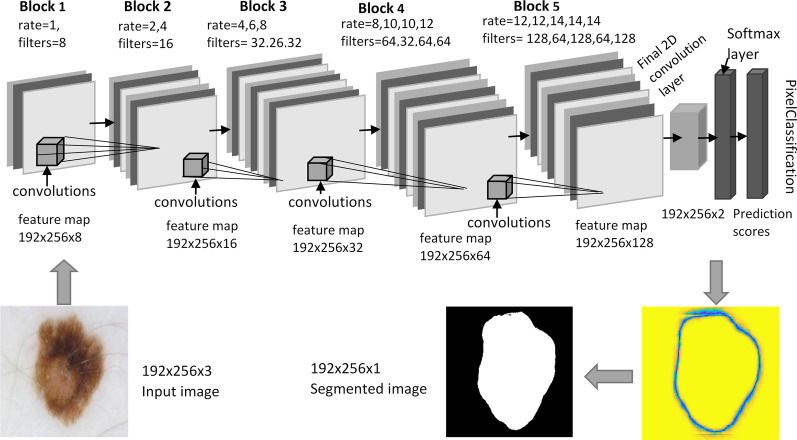
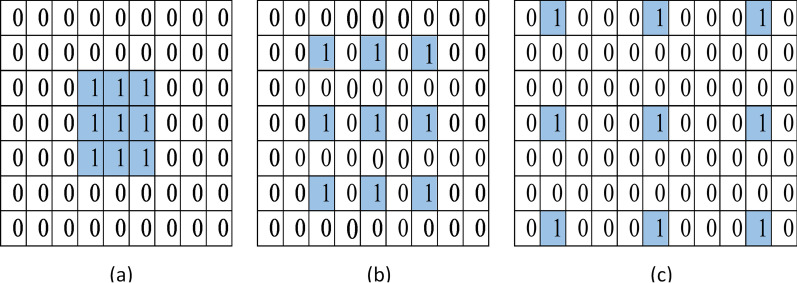
As deep learning approaches have gained significant attention in recent years due to their remarkable performance, therefore, in this work, we proposed a novel design of a convolutional neural network (CNN) framework based on atrous convolutions for automatic lesion segmentation. This architecture is built based on the concept of atrous/dilated convolutions which are effective for semantic segmentation. A deep neural network is designed from scratch employing several building blocks consisting of convolutional, batch normalization, leakyReLU layer, and fine-tuned hyperparameters contributing altogether towards higher performance.

CONCLUSION

The network was tested on three benchmark datasets provided by International Skin Imaging Collaboration (ISIC), i.e., ISIC 2016, ISIC 2017, and ISIC 2018. The experimental results showed that the proposed network achieved an average Jaccard index of 90.4% on ISIC 2016, 81.8% on ISIC 2017, and 89.1% on ISIC 2018 datasets, respectively which is recorded as higher than the top three winners of the ISIC challenge and other state-of-the-art methods. Also, the model successfully extracts lesions from the whole image in one pass in less time, requiring no pre-processing step. The conclusions yielded that network is accurate in performing lesion segmentation on adopted datasets.

摘要

背景

黑色素瘤是皮肤癌中最危险和最具侵袭性的形式,在全球范围内死亡率很高。活检和组织病理学分析是临床中皮肤癌检测和预防的标准程序。在诊断过程中,一个重要步骤是根据皮肤科医生获取的受感染区域的图像,深入了解病变的模式、大小、颜色和结构。然而,由于病变会随时间演变并改变形状,因此病变区域的手动分割非常耗时,这使得预测变得具有挑战性。此外,由于黑色素瘤在初始阶段难以预测,因为它与其他非恶性皮肤癌类型非常相似,因此需要自动分割技术来设计用于准确和及时检测的计算机辅助系统。

方法

由于深度学习方法近年来因其出色的性能而受到广泛关注,因此,在这项工作中,我们提出了一种基于空洞卷积的新型卷积神经网络 (CNN) 框架设计,用于自动病变分割。该架构基于空洞/扩张卷积的概念构建,这些卷积对于语义分割非常有效。使用由卷积、批量归一化、泄漏 ReLU 层和微调超参数组成的几个构建块从头开始设计深度神经网络,这些构建块共同提高了性能。

结论

该网络在国际皮肤成像协作 (ISIC) 提供的三个基准数据集上进行了测试,即 ISIC 2016、ISIC 2017 和 ISIC 2018。实验结果表明,所提出的网络在 ISIC 2016 数据集上的平均 Jaccard 指数为 90.4%,在 ISIC 2017 数据集上为 81.8%,在 ISIC 2018 数据集上为 89.1%,分别高于 ISIC 挑战赛的前三名获奖者和其他最先进的方法。此外,该模型成功地在一次传递中从整个图像中提取病变,所需时间更少,且无需预处理步骤。结论表明,该网络在采用的数据集上进行病变分割是准确的。
https://cdn.ncbi.nlm.nih.gov/pmc/blobs/82e9/9148511/397b2b359602/12880_2022_829_Fig8_HTML.jpg
https://cdn.ncbi.nlm.nih.gov/pmc/blobs/82e9/9148511/3bf683d16911/12880_2022_829_Fig1_HTML.jpg
https://cdn.ncbi.nlm.nih.gov/pmc/blobs/82e9/9148511/e7e17ecf2e25/12880_2022_829_Fig2_HTML.jpg
https://cdn.ncbi.nlm.nih.gov/pmc/blobs/82e9/9148511/c19afa10d94e/12880_2022_829_Fig3_HTML.jpg
https://cdn.ncbi.nlm.nih.gov/pmc/blobs/82e9/9148511/e0de3886fdc4/12880_2022_829_Fig4_HTML.jpg
https://cdn.ncbi.nlm.nih.gov/pmc/blobs/82e9/9148511/fd82dcddbc6c/12880_2022_829_Fig5_HTML.jpg
https://cdn.ncbi.nlm.nih.gov/pmc/blobs/82e9/9148511/df34d09014c8/12880_2022_829_Fig6_HTML.jpg
https://cdn.ncbi.nlm.nih.gov/pmc/blobs/82e9/9148511/b3285a10f4d5/12880_2022_829_Fig7_HTML.jpg
https://cdn.ncbi.nlm.nih.gov/pmc/blobs/82e9/9148511/397b2b359602/12880_2022_829_Fig8_HTML.jpg
https://cdn.ncbi.nlm.nih.gov/pmc/blobs/82e9/9148511/3bf683d16911/12880_2022_829_Fig1_HTML.jpg
https://cdn.ncbi.nlm.nih.gov/pmc/blobs/82e9/9148511/e7e17ecf2e25/12880_2022_829_Fig2_HTML.jpg
https://cdn.ncbi.nlm.nih.gov/pmc/blobs/82e9/9148511/c19afa10d94e/12880_2022_829_Fig3_HTML.jpg
https://cdn.ncbi.nlm.nih.gov/pmc/blobs/82e9/9148511/e0de3886fdc4/12880_2022_829_Fig4_HTML.jpg
https://cdn.ncbi.nlm.nih.gov/pmc/blobs/82e9/9148511/fd82dcddbc6c/12880_2022_829_Fig5_HTML.jpg
https://cdn.ncbi.nlm.nih.gov/pmc/blobs/82e9/9148511/df34d09014c8/12880_2022_829_Fig6_HTML.jpg
https://cdn.ncbi.nlm.nih.gov/pmc/blobs/82e9/9148511/b3285a10f4d5/12880_2022_829_Fig7_HTML.jpg
https://cdn.ncbi.nlm.nih.gov/pmc/blobs/82e9/9148511/397b2b359602/12880_2022_829_Fig8_HTML.jpg

相似文献

1
Automatic lesion segmentation using atrous convolutional deep neural networks in dermoscopic skin cancer images.基于空洞卷积深度神经网络的皮肤镜图像中自动病变分割。
BMC Med Imaging. 2022 May 29;22(1):103. doi: 10.1186/s12880-022-00829-y.
2
Melanoma segmentation using deep learning with test-time augmentations and conditional random fields.使用带有测试时增强和条件随机场的深度学习进行黑色素瘤分割。
Sci Rep. 2022 Mar 10;12(1):3948. doi: 10.1038/s41598-022-07885-y.
3
Efficient skin lesion segmentation using separable-Unet with stochastic weight averaging.使用可分离 U-Net 和随机权重平均化实现高效的皮肤病变分割。
Comput Methods Programs Biomed. 2019 Sep;178:289-301. doi: 10.1016/j.cmpb.2019.07.005. Epub 2019 Jul 8.
4
DSNet: Automatic dermoscopic skin lesion segmentation.DSNet:皮肤镜下皮肤病变自动分割
Comput Biol Med. 2020 May;120:103738. doi: 10.1016/j.compbiomed.2020.103738. Epub 2020 Apr 2.
5
Multiple skin lesions diagnostics via integrated deep convolutional networks for segmentation and classification.基于集成深度卷积网络的多皮肤损伤诊断,用于分割和分类。
Comput Methods Programs Biomed. 2020 Jul;190:105351. doi: 10.1016/j.cmpb.2020.105351. Epub 2020 Jan 23.
6
LAMA: Lesion-Aware Mixup Augmentation for Skin Lesion Segmentation.LAMA:基于病灶感知的图像混合增强在皮肤病灶分割中的应用。
J Imaging Inform Med. 2024 Aug;37(4):1812-1823. doi: 10.1007/s10278-024-01000-5. Epub 2024 Feb 26.
7
Melanoma Classification Using a Novel Deep Convolutional Neural Network with Dermoscopic Images.基于皮肤镜图像的新型深度卷积神经网络的黑色素瘤分类。
Sensors (Basel). 2022 Feb 2;22(3):1134. doi: 10.3390/s22031134.
8
Dynamically aggregating MLPs and CNNs for skin lesion segmentation with geometry regularization.基于几何正则化的动态聚合 MLP 和 CNN 进行皮肤病变分割。
Comput Methods Programs Biomed. 2023 Aug;238:107601. doi: 10.1016/j.cmpb.2023.107601. Epub 2023 May 14.
9
Skin lesion segmentation in dermoscopy images via deep full resolution convolutional networks.基于深度全分辨率卷积网络的皮肤镜图像皮损分割。
Comput Methods Programs Biomed. 2018 Aug;162:221-231. doi: 10.1016/j.cmpb.2018.05.027. Epub 2018 May 19.
10
Lesion Border Detection of Skin Cancer Images Using Deep Fully Convolutional Neural Network with Customized Weights.使用带有定制权重的深度全卷积神经网络进行皮肤癌图像病灶边界检测。
Annu Int Conf IEEE Eng Med Biol Soc. 2021 Nov;2021:3035-3038. doi: 10.1109/EMBC46164.2021.9630512.

引用本文的文献

1
SGNet: A Structure-Guided Network with Dual-Domain Boundary Enhancement and Semantic Fusion for Skin Lesion Segmentation.SGNet:一种用于皮肤病变分割的具有双域边界增强和语义融合的结构引导网络
Sensors (Basel). 2025 Jul 27;25(15):4652. doi: 10.3390/s25154652.
2
Multiclass skin lesion classification and localziation from dermoscopic images using a novel network-level fused deep architecture and explainable artificial intelligence.使用新型网络级融合深度架构和可解释人工智能从皮肤镜图像中进行多类别皮肤病变分类与定位
BMC Med Inform Decis Mak. 2025 Jul 1;25(1):215. doi: 10.1186/s12911-025-03051-2.
3
EMCAH-Net: an effective multi-scale context aggregation hybrid network for medical image segmentation.

本文引用的文献

1
Melanoma segmentation using deep learning with test-time augmentations and conditional random fields.使用带有测试时增强和条件随机场的深度学习进行黑色素瘤分割。
Sci Rep. 2022 Mar 10;12(1):3948. doi: 10.1038/s41598-022-07885-y.
2
Skin Lesion Segmentation Using Deep Learning with Auxiliary Task.基于辅助任务的深度学习皮肤病变分割
J Imaging. 2021 Apr 2;7(4):67. doi: 10.3390/jimaging7040067.
3
ASCU-Net: Attention Gate, Spatial and Channel Attention U-Net for Skin Lesion Segmentation.ASCU-Net:用于皮肤病变分割的注意力门控、空间和通道注意力U-Net
EMCAH-Net:一种用于医学图像分割的高效多尺度上下文聚合混合网络。
Quant Imaging Med Surg. 2025 Apr 1;15(4):3064-3083. doi: 10.21037/qims-24-1983. Epub 2025 Mar 28.
4
YOLOSAMIC: A Hybrid Approach to Skin Cancer Segmentation with the Segment Anything Model and YOLOv8.YOLOSAMIC:一种结合Segment Anything模型和YOLOv8的皮肤癌分割混合方法。
Diagnostics (Basel). 2025 Feb 16;15(4):479. doi: 10.3390/diagnostics15040479.
5
Addressing Challenges in Skin Cancer Diagnosis: A Convolutional Swin Transformer Approach.应对皮肤癌诊断中的挑战:一种卷积Swin Transformer方法。
J Imaging Inform Med. 2025 Jun;38(3):1755-1775. doi: 10.1007/s10278-024-01290-9. Epub 2024 Oct 22.
6
Intelligent skin lesion segmentation using deformable attention Transformer U-Net with bidirectional attention mechanism in skin cancer images.在皮肤癌图像中使用具有双向注意力机制的可变形注意力Transformer U-Net进行智能皮肤病变分割。
Skin Res Technol. 2024 Aug;30(8):e13783. doi: 10.1111/srt.13783.
7
Enhanced skin cancer diagnosis using optimized CNN architecture and checkpoints for automated dermatological lesion classification.利用优化的 CNN 架构和检查点进行皮肤癌自动诊断和分类。
BMC Med Imaging. 2024 Aug 2;24(1):201. doi: 10.1186/s12880-024-01356-8.
8
Multimodal Biomedical Image Segmentation using Multi-Dimensional U-Convolutional Neural Network.基于多维 U 型卷积神经网络的多模态生物医学图像分割
BMC Med Imaging. 2024 Feb 8;24(1):38. doi: 10.1186/s12880-024-01197-5.
9
Dermo-Seg: ResNet-UNet Architecture and Hybrid Loss Function for Detection of Differential Patterns to Diagnose Pigmented Skin Lesions.皮肤病变分割:用于检测鉴别模式以诊断色素性皮肤病变的ResNet-UNet架构和混合损失函数
Diagnostics (Basel). 2023 Sep 12;13(18):2924. doi: 10.3390/diagnostics13182924.
10
DI-UNet: dual-branch interactive U-Net for skin cancer image segmentation.DI-UNet:用于皮肤癌图像分割的双分支交互式U-Net
J Cancer Res Clin Oncol. 2023 Nov;149(17):15511-15524. doi: 10.1007/s00432-023-05319-4. Epub 2023 Aug 30.
Diagnostics (Basel). 2021 Mar 12;11(3):501. doi: 10.3390/diagnostics11030501.
4
Skin lesion segmentation via generative adversarial networks with dual discriminators.基于双鉴别器生成对抗网络的皮肤损伤分割。
Med Image Anal. 2020 Aug;64:101716. doi: 10.1016/j.media.2020.101716. Epub 2020 May 23.
5
Skin Lesion Segmentation from Dermoscopic Images Using Convolutional Neural Network.基于卷积神经网络的皮肤镜图像皮损分割。
Sensors (Basel). 2020 Mar 13;20(6):1601. doi: 10.3390/s20061601.
6
Skin lesion segmentation using high-resolution convolutional neural network.基于高分辨率卷积神经网络的皮肤损伤分割。
Comput Methods Programs Biomed. 2020 Apr;186:105241. doi: 10.1016/j.cmpb.2019.105241. Epub 2019 Dec 4.
7
Melanoma.黑色素瘤。
Lancet. 2018 Sep 15;392(10151):971-984. doi: 10.1016/S0140-6736(18)31559-9.
8
The HAM10000 dataset, a large collection of multi-source dermatoscopic images of common pigmented skin lesions.HAM10000 数据集,一个大型的常见色素性皮肤病变多源皮肤镜图像集合。
Sci Data. 2018 Aug 14;5:180161. doi: 10.1038/sdata.2018.161.
9
Skin lesion segmentation in dermoscopy images via deep full resolution convolutional networks.基于深度全分辨率卷积网络的皮肤镜图像皮损分割。
Comput Methods Programs Biomed. 2018 Aug;162:221-231. doi: 10.1016/j.cmpb.2018.05.027. Epub 2018 May 19.
10
Analysis of national skin cancer expenditures in the United States Medicare population, 2013.2013年美国医疗保险人群中皮肤癌国家支出分析
J Am Acad Dermatol. 2019 Jan;80(1):275-278. doi: 10.1016/j.jaad.2018.04.035. Epub 2018 Apr 22.