Pharmacy, Kingston University, Kingston Upon Thames, UK.
Diabetes, Kingston Hospital NHS Foundation Trust, Kingston, UK.
BMJ Open. 2022 Sep 6;12(9):e058467. doi: 10.1136/bmjopen-2021-058467.
Poor medication adherence is associated with worsening patient health outcomes and increasing healthcare costs. A holistic tool to assess both medication adherence and drivers of adherence behaviour has yet to be developed. This study aimed to examine SPUR, a multifactorial patient-reported outcome measure of medication adherence in patients living with type 2 diabetes, with a view to develop a suitable model for psychometric analysis.Furthermore, the study aimed to explore the relationship between the SPUR model and socio-clinical factors of medication adherence.
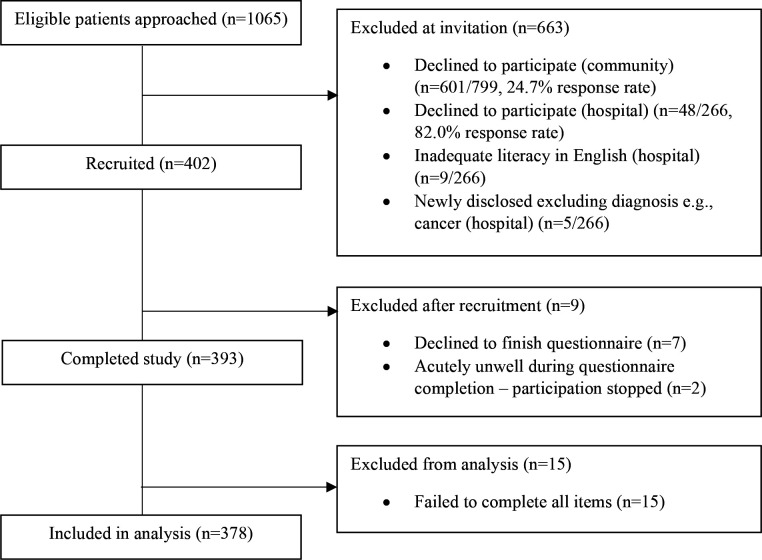
The study recruited 378 adult patients living with type 2 diabetes from a mix of community and secondary-care settings to participate in this non-interventional cross-sectional study. The original SPUR-45 tool was completed by participants with other patient-reported outcome measures for comparison, in addition to the collection of two objective adherence measures; HbA and the medication possession ratio (MPR).
Factor and reliability analysis conducted on SPUR-45 produced a revised and more concise version (27-items) of the tool, SPUR-27, which was psychometrically assessed. SPUR-27 observed strong internal consistency with significant correlations to the other psychometric measures (Beliefs about Medication Questionnaire, Diabetes Treatment Satisfaction Questionnaire, Medicine Adherence Rating Scale) completed by participants. Higher SPUR-27 scores were associated with lower HbA values and a higher MPR, as well as other predicted socio-clinical factors such as higher income, increased age and lower body mass index.
SPUR-27 demonstrated strong psychometric properties. Further work should look to examine the test-retest reliability of the model as well as examine transferability to other chronic conditions and broader population samples. Overall, the initial findings suggest that SPUR-27 is a reliable model for the multifactorial assessment of medication adherence among patients living with type 2 diabetes.
药物治疗依从性差与患者健康状况恶化和医疗保健成本增加有关。尚未开发出一种综合工具来评估药物治疗依从性和影响药物治疗依从性的因素。本研究旨在检验 SPUR,一种用于评估 2 型糖尿病患者药物治疗依从性的多因素患者报告结局测量工具,以期为心理测量分析开发合适的模型。此外,该研究旨在探索 SPUR 模型与药物治疗依从性的社会临床因素之间的关系。
本研究招募了 378 名来自社区和二级保健机构的成年 2 型糖尿病患者参与这项非干预性横断面研究。参与者完成了原始的 SPUR-45 工具,并与其他患者报告结局测量工具一起完成,以进行比较,此外还收集了两种客观的药物治疗依从性测量指标;糖化血红蛋白和药物使用剂量比(MPR)。
对 SPUR-45 进行的因素和可靠性分析产生了工具的修订和更简洁的版本(27 项),即 SPUR-27,并对其进行了心理测量评估。SPUR-27 观察到具有较强的内部一致性,与参与者完成的其他心理测量测量工具(药物信念问卷、糖尿病治疗满意度问卷、药物依从性评定量表)有显著相关性。较高的 SPUR-27 得分与较低的糖化血红蛋白值和较高的 MPR 以及其他预测性社会临床因素(如较高的收入、年龄增加和较低的体重指数)相关。
SPUR-27 表现出良好的心理测量特性。进一步的研究应关注该模型的重测信度,并研究其在其他慢性疾病和更广泛的人群样本中的可转移性。总的来说,初步结果表明,SPUR-27 是评估 2 型糖尿病患者药物治疗依从性的可靠模型。