
实施可疑筛查方法评估为种族多样化顾客提供服务的美国理发师的职业性化学暴露:一项初步研究。
Implementing a suspect screening method to assess occupational chemical exposures among US-based hairdressers serving an ethnically diverse clientele: a pilot study.
机构信息
Department of Environmental Health & Engineering, Johns Hopkins University, Baltimore, MD, 21205, USA.
Maryland Institute of Applied Environmental Health, School of Public Health, University of Maryland, College Park, MD, 20742, USA.
出版信息
J Expo Sci Environ Epidemiol. 2023 Jul;33(4):566-574. doi: 10.1038/s41370-023-00519-z. Epub 2023 Jan 24.
BACKGROUND
There are over 700,000 hairdressers in the United States, and it is estimated that >90% are female and 31% are Black or Hispanic/Latina. Racial and ethnic minorities in this workforce may be exposed to a unique mixture of potentially hazardous chemicals from products used and services provided. However, previous biomonitoring studies of hairdressers target a narrow list of compounds and few studies have investigated exposures among minority hairdressers.
OBJECTIVE
To assess occupational chemical exposures in a sample of US-based Black and Latina hairdressers serving an ethnically diverse clientele by analyzing urine specimens with a suspect screening method.
METHODS
Post-shift urine samples were collected from a sample of US female hairdressers (n = 23) and office workers (n = 17) and analyzed via reverse-phase liquid chromatography coupled to high-resolution mass spectrometry. Detected compounds were filtered based on peak area differences between groups and matching with a suspect screening list. When possible, compound identities were confirmed with reference standards. Possible exposure sources were evaluated for detected compounds.
RESULTS
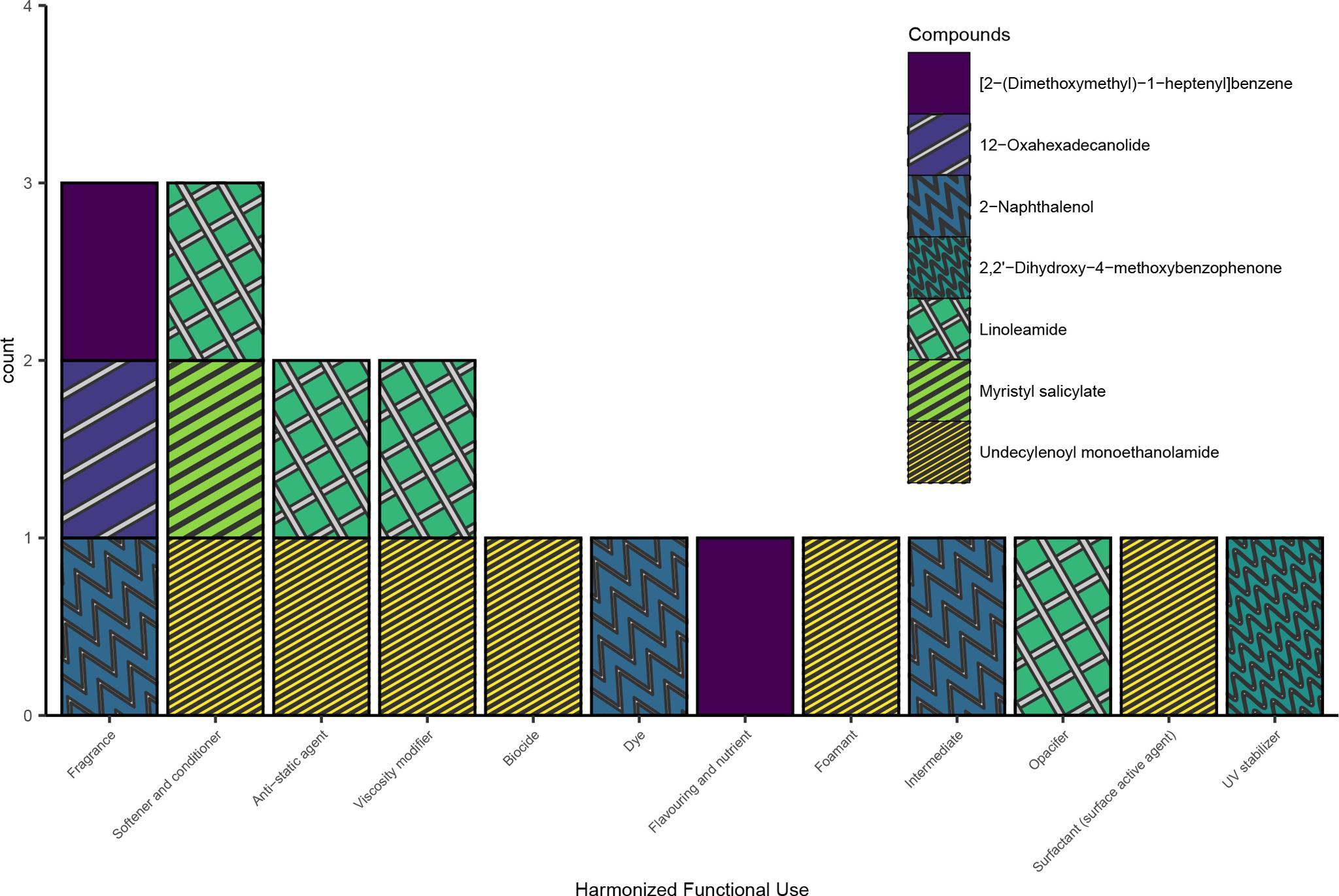
The developed workflow allowed for the detection of 24 compounds with median peak areas ≥2x greater among hairdressers compared to office workers. Product use categories (PUCs) and harmonized functional uses were searched for these compounds, including confirmed compounds methylparaben, ethylparaben, propylparaben, and 2-naphthol. Most product use categories were associated with "personal use" and included 11 different "hair styling and care" product types (e.g., hair conditioner, hair relaxer). Functional uses for compounds without associated PUCs included fragrance, hair and skin conditioning, hair dyeing, and UV stabilizer.
SIGNIFICANCE
Our suspect screening approach detected several compounds not previously reported in biomonitoring studies of hairdressers. These results will help guide future studies to improve characterization of occupational chemical exposures in this workforce and inform exposure and risk mitigation strategies to reduce potential associated work-related health disparities.
背景
美国有超过 70 万名美发师,据估计其中>90%为女性,31%为黑人和西班牙裔/拉丁裔。在这个劳动力中,少数族裔美发师可能会接触到来自使用的产品和提供的服务中潜在有害化学物质的独特混合物。然而,以前针对美发师的生物监测研究针对的是一小部分化合物,而且很少有研究调查少数族裔美发师的暴露情况。
目的
通过分析具有可疑筛选方法的尿液样本,评估美国黑人和拉丁裔美发师样本中的职业化学暴露情况,这些美发师为种族多样化的客户提供服务。
方法
从一组美国女性美发师(n=23)和办公室工作人员(n=17)中收集工作后尿液样本,并通过反相液相色谱法与高分辨率质谱法进行分析。根据组间峰面积差异和与可疑筛选清单的匹配,对检测到的化合物进行过滤。在可能的情况下,通过参考标准确认化合物的身份。评估了检测到的化合物的可能暴露源。
结果
所开发的工作流程允许检测到 24 种化合物,其在美发师中的峰面积中位数比办公室工作人员高 2 倍以上。对这些化合物进行了产品使用类别(PUC)和协调功能用途的搜索,包括已确认的化合物甲基对羟基苯甲酸酯、乙基对羟基苯甲酸酯、丙基对羟基苯甲酸酯和 2-萘酚。大多数产品使用类别与“个人使用”相关,并包括 11 种不同的“头发造型和护理”产品类型(例如,护发素、头发拉直剂)。无相关 PUC 的化合物的功能用途包括香料、头发和皮肤调理、染发和紫外线稳定剂。
意义
我们的可疑筛选方法检测到了以前在美发师生物监测研究中未报告的几种化合物。这些结果将有助于指导未来的研究,以改善对该劳动力职业化学暴露的描述,并为减少潜在相关工作相关健康差异的暴露和风险缓解策略提供信息。


 Zotero 插件