
三维重建头图像中面部信息的可重复性:一项探索性研究。
Reproducibility of Facial Information in Three-Dimensional Reconstructed Head Images: An Exploratory Study.
机构信息
Department of Neurosurgery, The University of Tokyo, 7-3-1 Hongo, Bunkyo-ku, Tokyo 113-8655, Japan.
Department of Clinical Information Engineering, Graduate School of Medicine, The University of Tokyo, 7-3-1 Hongo, Bunkyo-ku, Tokyo 113-8655, Japan.
出版信息
Curr Med Imaging. 2023;19(12):1387-1393. doi: 10.2174/1573405619666230123105057.
BACKGROUND
Facial information acquired via three-dimensional reconstruction of head computed tomography (CT) data may be considered personal information, which can be problematic for neuroimaging studies. However, no study has verified the relationship between slice thickness and face reproducibility. This study determined the relationship and match rate between image slice thickness and face detection accuracy of face-recognition software in facial reconstructed models.
METHODS
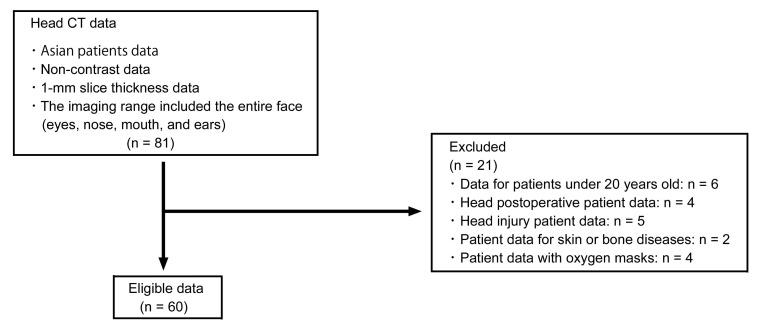
Head CT data of 60 cases comprising entire faces obtained under conditions of non-contrast and 1-mm slice thickness were resampled to obtain 2-10-mm slice-thickness data. Facial models, reconstructed by image thresholding, were acquired from the data. We performed face detection tests per slice thickness on the models and calculated the face detection rate. The reconstructed facial models created from 1-mm slice-thickness data and other slice thicknesses were used as training and test data, respectively. Match confidence scores were obtained three programs, match rates were calculated per slice thickness, and generalized estimating equations were used to evaluate the match rate trend.
RESULTS
In general, the face detection rates for the 1-10-mm slice thicknesses were 100, 100, 98.3, 98.3, 95.0, 91.7, 86.7, 78.3, 68.3, and 61.7 %, respectively. The match rates for the 2-10-mm slice thicknesses were 100, 98.3, 98.3, 95.0, 85.0, 71.7, 53.3, 28.3, and 16.7 %, respectively.
CONCLUSION
The reconstructed models tended to have higher match rates as the slice thickness decreased. Thus, thin-slice head CT imaging data may increase the possibility of the information becoming personally identifiable health information.
背景
通过对头 CT 数据的三维重建获得的面部信息可能被视为个人信息,这可能会给神经影像学研究带来问题。然而,尚无研究验证层厚与面部识别软件对面部可重复性之间的关系。本研究旨在确定面部重建模型中图像层厚与面部识别软件对面部检测准确性之间的关系和匹配率。
方法
对 60 例无对比剂和 1mm 层厚条件下获得的头部 CT 数据进行重采样,以获得 2-10mm 层厚的数据。通过图像阈值处理从数据中获取面部模型。我们对模型进行了每一层厚度的面部检测测试,并计算了面部检测率。将 1mm 层厚数据和其他层厚重建的面部模型分别作为训练和测试数据。使用三种程序获取匹配置信度评分,计算每一层厚度的匹配率,并使用广义估计方程评估匹配率趋势。
结果
总体而言,1-10mm 层厚的面部检测率分别为 100%、100%、98.3%、98.3%、95.0%、91.7%、86.7%、78.3%、68.3%和 61.7%。2-10mm 层厚的匹配率分别为 100%、98.3%、98.3%、95.0%、85.0%、71.7%、53.3%、28.3%和 16.7%。
结论
随着层厚的减小,重建模型的匹配率往往更高。因此,薄层层头 CT 成像数据可能会增加信息成为可识别个人健康信息的可能性。



 Zotero 插件