Institute of Ophthalmology, University College London, 11-43 Bath St., London, EC1V 9EL, UK.
Section of Ophthalmology, King's College London, London, WC2R 2LS, UK.
Sci Rep. 2023 Jan 25;13(1):1392. doi: 10.1038/s41598-023-28347-z.
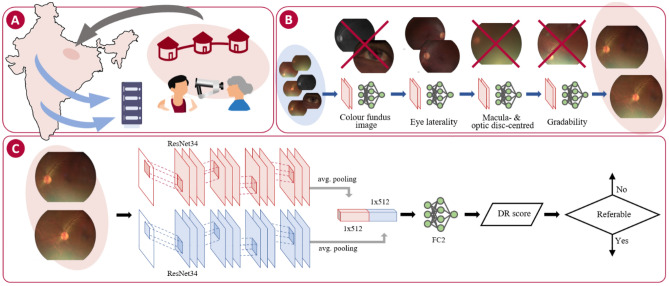
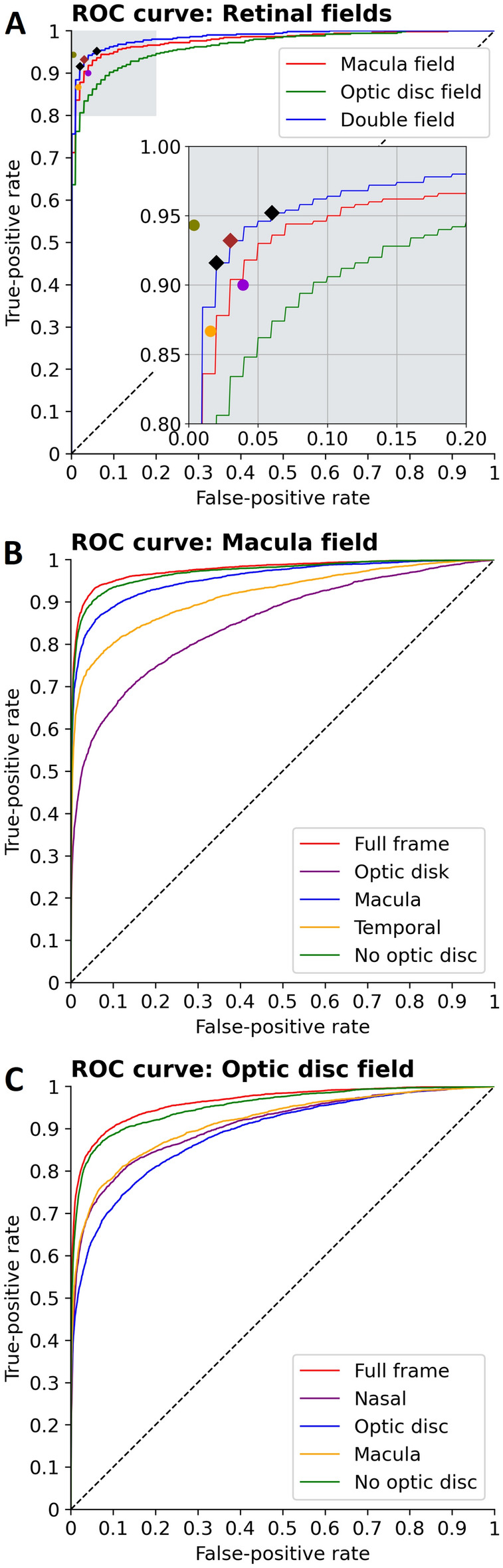
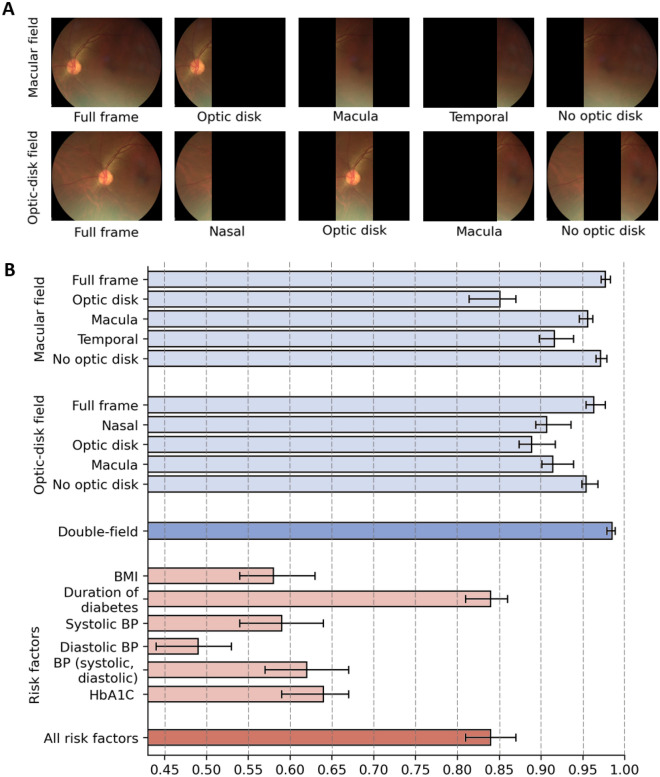
Diabetic retinopathy (DR) at risk of vision loss (referable DR) needs to be identified by retinal screening and referred to an ophthalmologist. Existing automated algorithms have mostly been developed from images acquired with high cost mydriatic retinal cameras and cannot be applied in the settings used in most low- and middle-income countries. In this prospective multicentre study, we developed a deep learning system (DLS) that detects referable DR from retinal images acquired using handheld non-mydriatic fundus camera by non-technical field workers in 20 sites across India. Macula-centred and optic-disc-centred images from 16,247 eyes (9778 participants) were used to train and cross-validate the DLS and risk factor based logistic regression models. The DLS achieved an AUROC of 0.99 (1000 times bootstrapped 95% CI 0.98-0.99) using two-field retinal images, with 93.86 (91.34-96.08) sensitivity and 96.00 (94.68-98.09) specificity at the Youden's index operational point. With single field inputs, the DLS reached AUROC of 0.98 (0.98-0.98) for the macula field and 0.96 (0.95-0.98) for the optic-disc field. Intergrader performance was 90.01 (88.95-91.01) sensitivity and 96.09 (95.72-96.42) specificity. The image based DLS outperformed all risk factor-based models. This DLS demonstrated a clinically acceptable performance for the identification of referable DR despite challenging image capture conditions.
糖尿病性视网膜病变(DR)有视力丧失风险(可转诊 DR),需要通过视网膜筛查识别,并转介给眼科医生。现有的自动化算法大多是基于高成本的散瞳视网膜相机获取的图像开发的,不能应用于大多数中低收入国家使用的环境中。在这项前瞻性多中心研究中,我们开发了一种深度学习系统(DLS),该系统可由非技术领域工作人员使用手持式非散瞳眼底相机从印度 20 个地点采集的视网膜图像中检测出可转诊 DR。使用来自 16247 只眼睛(9778 名参与者)的黄斑中心和视盘中心图像,对 DLS 和基于风险因素的逻辑回归模型进行训练和交叉验证。DLS 使用两视野视网膜图像获得了 0.99 的 AUROC(1000 次 bootstrap 95%CI 0.98-0.99),在 Youden 指数操作点的敏感性为 93.86(91.34-96.08),特异性为 96.00(94.68-98.09)。使用单视野输入,DLS 在黄斑区达到 0.98(0.98-0.98)的 AUROC,在视盘区达到 0.96(0.95-0.98)的 AUROC。分级器的性能为 90.01(88.95-91.01)的敏感性和 96.09(95.72-96.42)的特异性。基于图像的 DLS 优于所有基于风险因素的模型。尽管图像采集条件具有挑战性,但该 DLS 仍能对可转诊 DR 的识别表现出可接受的临床性能。