School of Occupational Therapy, College of Medicine, National Taiwan University, Taipei, Taiwan.
Department of Physical Medicine and Rehabilitation, National Taiwan University Hospital, Taipei, Taiwan.
J Neuroeng Rehabil. 2023 Jan 27;20(1):13. doi: 10.1186/s12984-023-01135-6.
Constraint-induced movement therapy (CIMT) is a prominent neurorehabilitation approach for improving affected upper extremity motor function in children with unilateral cerebral palsy (UCP). However, the restraint of the less-affected upper extremity and intensive training protocol during CIMT may decrease children's motivation and increase the therapist's workload and family's burden. A kinect-based CIMT program, aiming to mitigate the concerns of CIMT, has been developed. The preliminary results demonstrated that this program was child-friendly and feasible for improving upper extremity motor function. However, whether the kinect-based CIMT can achieve better or at least comparable effects to that of traditional CIMT (i.e., therapist-based CIMT) should be further investigated. Therefore, this study aimed to compare the effects of kinect-based CIMT with that of therapist-based CIMT on upper extremity and trunk motor control and on daily motor function in children with UCP.
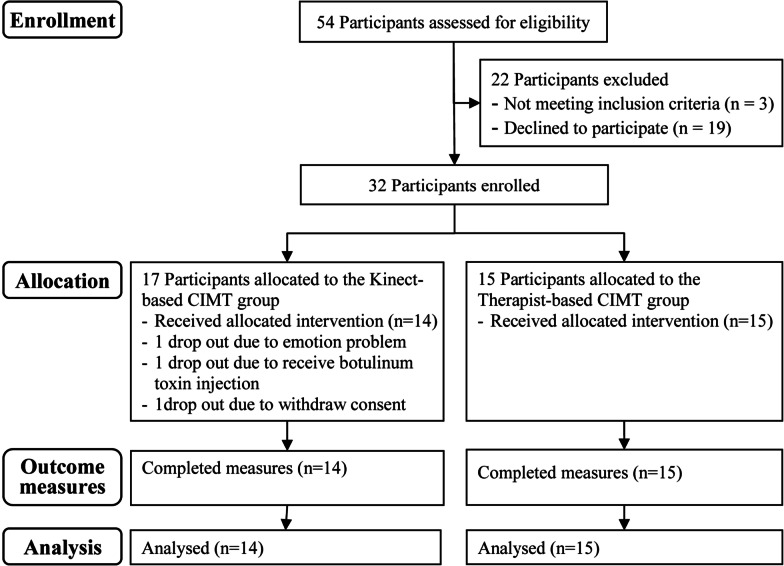
Twenty-nine children with UCP were recruited and randomly allocated to kinect-based CIMT (n = 14) or therapist-based CIMT (n = 15). The intervention dosage was 2.25 h a day, 2 days a week for 8 weeks. Outcome measures, namely upper extremity and trunk motor control and daily motor function, were evaluated before and after 36-h interventions. Upper extremity and trunk motor control were assessed with unimanual reach-to-grasp kinematics, and daily motor function was evaluated with the Revised Pediatric Motor Activity Log. Between-group comparisons of effectiveness on all outcome measures were analyzed by analysis of covariance (α = 0.05).
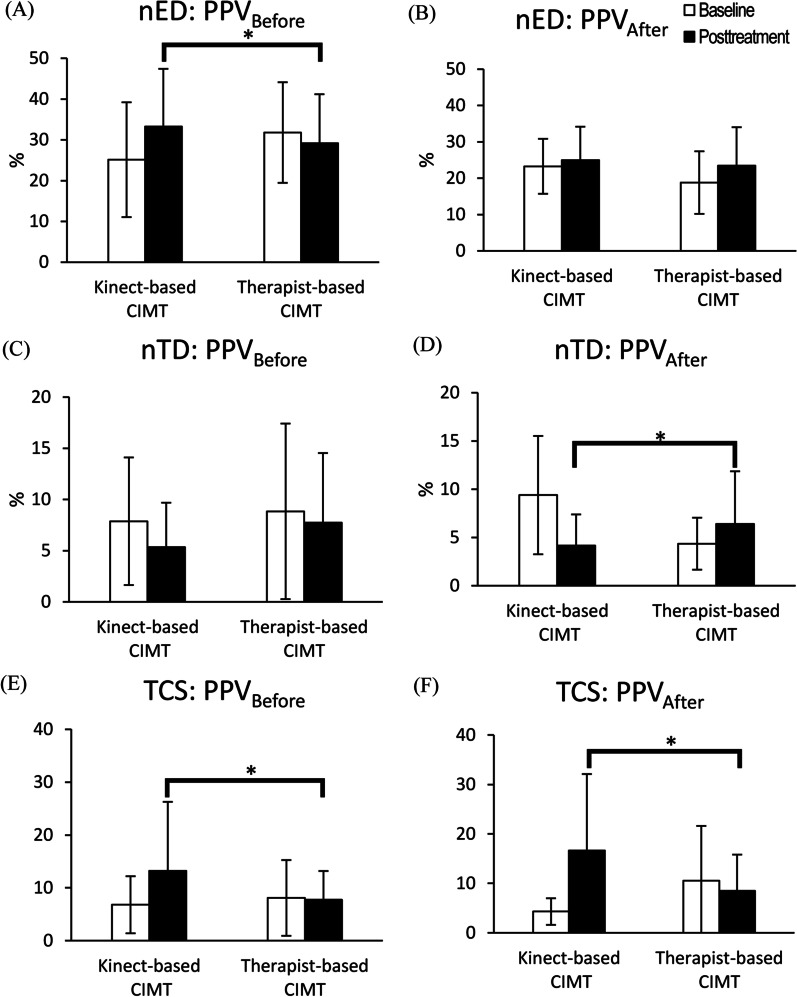
The two groups demonstrated similar improvements in upper extremity motor control and daily motor function. In addition, the kinect-based CIMT group demonstrated greater improvements in trunk motor control than the therapist-based CIMT group did (F(1,28) > 4.862, p < 0.036).
Kinect-based CIMT has effects comparable to that of therapist-based CIMT on UE motor control and daily motor function. Moreover, kinect-based CIMT helps decrease trunk compensation during reaching in children with UCP. Therefore, kinect-based CIMT can be used as an alternative approach to therapist-based CIMT.
ClinicalTrials.gov Identifier: NCT02808195. Registered on 2016/06/21, https://clinicaltrials.gov/ct2/show/NCT02808195 .
强制性运动疗法(CIMT)是一种提高单侧脑瘫(UCP)儿童患侧上肢运动功能的重要神经康复方法。然而,CIMT 过程中对非患侧上肢的限制和强化训练方案可能会降低儿童的积极性,增加治疗师的工作量和家庭的负担。已经开发了一种基于 Kinect 的 CIMT 程序,旨在减轻 CIMT 的担忧。初步结果表明,该程序对儿童友好且可行,可改善上肢运动功能。然而,基于 Kinect 的 CIMT 是否能比传统 CIMT(即基于治疗师的 CIMT)取得更好或至少相当的效果,仍有待进一步研究。因此,本研究旨在比较基于 Kinect 的 CIMT 与基于治疗师的 CIMT 对 UCP 儿童上肢和躯干运动控制以及日常运动功能的影响。
招募了 29 名 UCP 儿童,并将其随机分配到基于 Kinect 的 CIMT(n=14)或基于治疗师的 CIMT(n=15)组。干预剂量为每天 2.25 小时,每周 2 天,持续 8 周。在 36 小时干预前后评估了上肢和躯干运动控制以及日常运动功能等结局指标。采用单臂伸手抓握运动学评估上肢和躯干运动控制,采用修订后的儿科运动活动日志评估日常运动功能。采用协方差分析(α=0.05)对所有结局指标的组间疗效进行比较。
两组在上肢运动控制和日常运动功能方面均有类似的改善。此外,基于 Kinect 的 CIMT 组在躯干运动控制方面的改善明显优于基于治疗师的 CIMT 组(F(1,28)>4.862,p<0.036)。
基于 Kinect 的 CIMT 在 UE 运动控制和日常运动功能方面与基于治疗师的 CIMT 效果相当。此外,基于 Kinect 的 CIMT 有助于减少 UCP 儿童在伸手过程中的躯干代偿。因此,基于 Kinect 的 CIMT 可以作为基于治疗师的 CIMT 的替代方法。
ClinicalTrials.gov 标识符:NCT02808195。注册于 2016 年 6 月 21 日,https://clinicaltrials.gov/ct2/show/NCT02808195。