Lv Jingjing, Dong Bin, Lei Hao, Shi Guocheng, Wang Hansong, Zhu Fang, Wen Chen, Zhang Qian, Fu Lijun, Gu Xiaorong, Yuan Jiajun, Guan Yongmei, Xia Yuxian, Zhao Liebin, Chen Huiwen
Department of Cardiothoracic Surgery, Heart Center, Shanghai Children's Medical Center, Shanghai Jiaotong University School of Medicine, NO.1678 Dongfang Road, Pudong New District, Shanghai 200127, PR China.
Department of Anesthesiology, Shanghai Children's Medical Center, Shanghai Jiaotong University School of Medicine, NO.1678 Dongfang Road, Pudong New District, Shanghai 200127, PR China.
Eur Heart J Digit Health. 2021 Jan 6;2(1):119-124. doi: 10.1093/ehjdh/ztaa017. eCollection 2021 Mar.
Computer-assisted auscultation has become available to assist clinicians with physical examinations to detect congenital heart disease (CHD). However, its accuracy and effectiveness remain to be evaluated. This study seeks to evaluate the accuracy of auscultations of abnormal heart sounds of an artificial intelligence-assisted auscultation (AI-AA) platform we create.
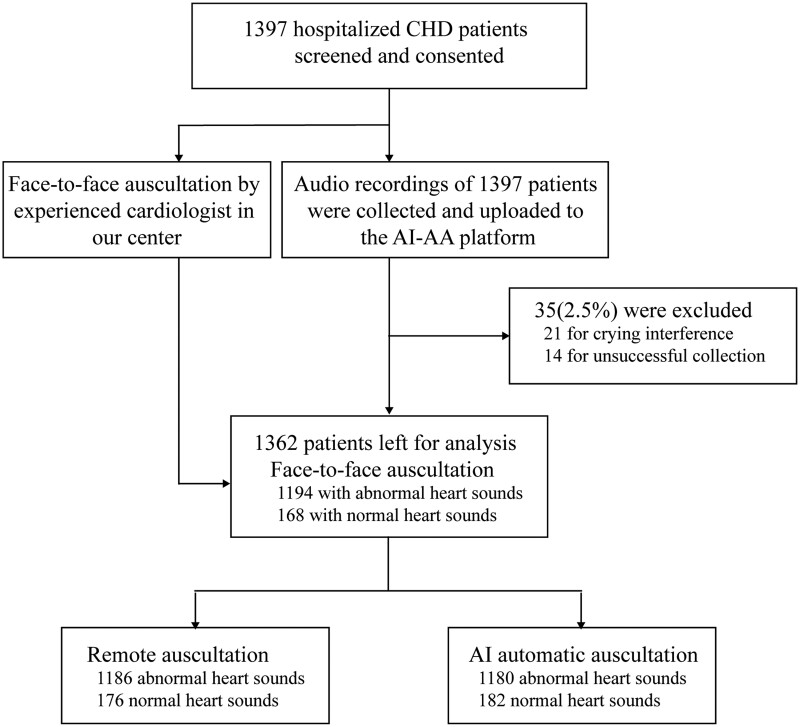
Initially, 1397 patients with CHD were enrolled in the study. The samples of their heart sounds were recorded and uploaded to the platform using a digital stethoscope. By the platform, both remote auscultation by a team of experienced cardiologists from Shanghai Children's Medical Center and automatic auscultation of the heart sound samples were conducted. Samples of 35 patients were deemed unsuitable for the analysis; therefore, the remaining samples from 1362 patients (mean age-2.4 ± 3.1 years and 46% female) were analysed. Sensitivity, specificity, and accuracy were calculated for remote auscultation compared to experts' face-to-face auscultation and for artificial intelligence automatic auscultation compared to experts' face-to-face auscultation. Kappa coefficients were measured. Compared to face-to-face auscultation, remote auscultation detected abnormal heart sound with 98% sensitivity, 91% specificity, 97% accuracy, and kappa coefficient 0.87. AI-AA demonstrated 97% sensitivity, 89% specificity, 96% accuracy, and kappa coefficient 0.84.
The remote auscultations and automatic auscultations, using the AI-AA platform, reported high auscultation accuracy in detecting abnormal heart sound and showed excellent concordance to experts' face-to-face auscultation. Hence, the platform may provide a feasible way to screen and detect CHD.
计算机辅助听诊已可用于协助临床医生进行体格检查以检测先天性心脏病(CHD)。然而,其准确性和有效性仍有待评估。本研究旨在评估我们创建的人工智能辅助听诊(AI - AA)平台对异常心音听诊的准确性。
最初,1397例CHD患者被纳入研究。使用数字听诊器记录他们的心音样本并上传至该平台。通过该平台,由上海儿童医学中心一组经验丰富的心脏病专家进行远程听诊,并对心音样本进行自动听诊。35例患者的样本被认为不适合分析;因此,对其余1362例患者(平均年龄2.4±3.1岁,46%为女性)的样本进行分析。计算远程听诊与专家面对面听诊相比以及人工智能自动听诊与专家面对面听诊相比的敏感性、特异性和准确性。测量Kappa系数。与面对面听诊相比,远程听诊检测异常心音的敏感性为98%,特异性为91%,准确性为97%,Kappa系数为0.87。AI - AA的敏感性为97%,特异性为89%,准确性为96%,Kappa系数为0.84。
使用AI - AA平台进行的远程听诊和自动听诊在检测异常心音方面具有较高的听诊准确性,并且与专家面对面听诊具有极好的一致性。因此,该平台可能为筛查和检测CHD提供一种可行的方法。