• 文献检索
  • 文档翻译
  • 深度研究
  • 学术资讯
  • Suppr Zotero 插件Zotero 插件
  • 邀请有礼
  • 套餐&价格
  • 历史记录
应用&插件
Suppr Zotero 插件Zotero 插件浏览器插件Mac 客户端Windows 客户端微信小程序
定价
高级版会员购买积分包购买API积分包
服务
文献检索文档翻译深度研究API 文档MCP 服务
关于我们
关于 Suppr公司介绍联系我们用户协议隐私条款
关注我们

Suppr 超能文献

核心技术专利:CN118964589B侵权必究
粤ICP备2023148730 号-1Suppr @ 2026

文献检索

告别复杂PubMed语法,用中文像聊天一样搜索,搜遍4000万医学文献。AI智能推荐,让科研检索更轻松。

立即免费搜索

文件翻译

保留排版,准确专业,支持PDF/Word/PPT等文件格式,支持 12+语言互译。

免费翻译文档

深度研究

AI帮你快速写综述,25分钟生成高质量综述,智能提取关键信息,辅助科研写作。

立即免费体验

培养抵御传染病威胁和抗微生物药物耐药性的适应能力:将有针对性的卫生措施落实到家庭和日常生活中。

Developing resilience against the threat of infectious diseases and anti-microbial resistance: Putting targeted hygiene into practice in home and everyday lives.

作者信息

Bloomfield Sally F, Ackerley Lisa M

机构信息

International Scientific Forum on Home Hygiene, Montacute, Somerset, UK.

Royal Society of Public Health, London, UK.

出版信息

Public Health Pract (Oxf). 2023 Jun;5:100362. doi: 10.1016/j.puhip.2023.100362. Epub 2023 Jan 23.

DOI:10.1016/j.puhip.2023.100362
PMID:36712152
原文链接:https://pmc.ncbi.nlm.nih.gov/articles/PMC9869640/
Abstract

OBJECTIVES

COVID-19 has highlighted the importance of hygiene in home and everyday life (HEDL) to build population resilience against ongoing infectious disease threats. Despite having high awareness of hygiene, people have relatively poor understanding of hygiene risk which compromises their ability to follow advice. This paper combines new insights into hygiene science and hygiene behaviour to propose a framework for achieving more effective behavior. It is aimed at supporting government initiatives to build hygiene resilience within the UK population.

STUDY DESIGN

Non-systematic narrative review.

METHODS

The review is based on findings of recent consensus reviews, prepared by acknowledged hygiene experts. It also draws on studies of hygiene understanding, drivers for behaviour change and behaviour change models.

RESULTS

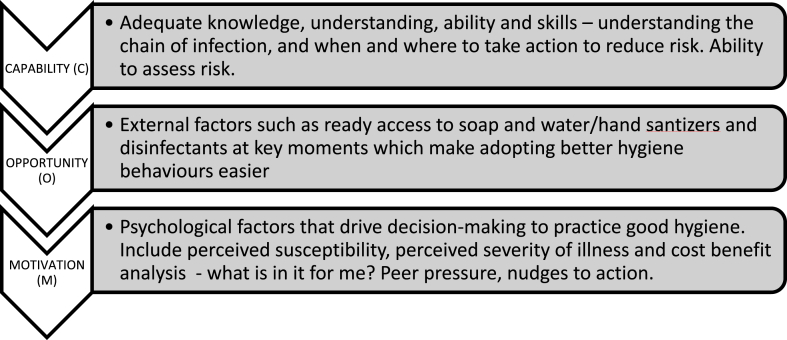
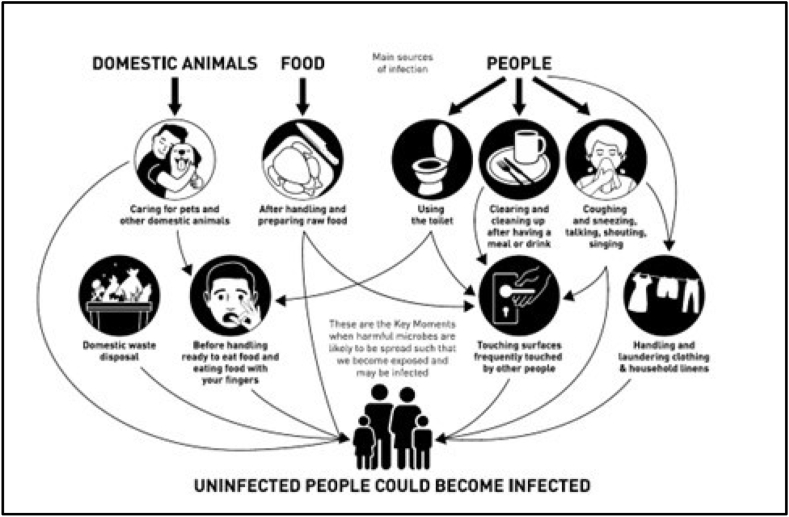
To build hygiene resilience, HEDL hygiene requires a risk management approach where practices combine to reduce infection risk in community populations to an acceptable level. Using this we construct a framework showing when, where and how to practice hygiene. Based on visualization, it gives clear practical guidance and develops better hygiene understanding. Promoting this approach using health belief models ensures behaviours that are embedded are fit for purpose.

CONCLUSIONS

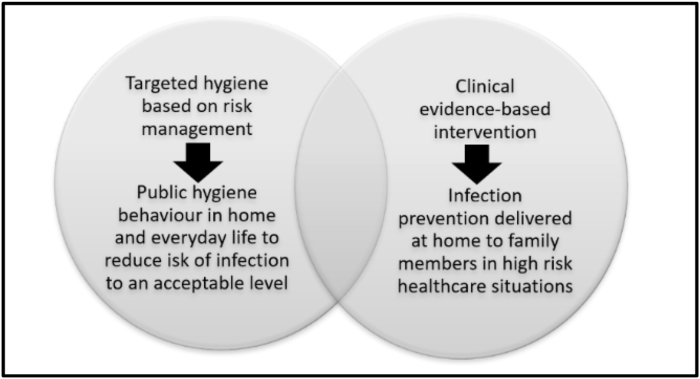
A risk management approach to hygiene, promoted through behaviour change models, provides a framework for developing effective resilient hygiene behaviour. To achieve this, however, the separate aspects of HEDL hygiene (food, healthcare, pandemic preparedness) must be combined and communicated in a user-centric manner. Leadership teams must also be established with sole responsibility for HEDL hygiene, and the power to drive change.

摘要

目标

新冠疫情凸显了家庭及日常生活卫生(HEDL)对于增强民众抵御持续存在的传染病威胁能力的重要性。尽管人们对卫生有较高的认知度,但对卫生风险的理解相对较差,这影响了他们遵循相关建议的能力。本文结合了卫生科学和卫生行为方面的新见解,提出了一个实现更有效行为的框架。其目的是支持英国政府在民众中建立卫生抵御能力的举措。

研究设计

非系统性叙述性综述。

方法

该综述基于知名卫生专家近期撰写的共识性综述的结果。它还借鉴了关于卫生理解、行为改变驱动因素及行为改变模型的研究。

结果

为建立卫生抵御能力,HEDL卫生需要一种风险管理方法,即通过多种措施将社区人群的感染风险降低到可接受水平。利用这一点,我们构建了一个框架,展示何时、何地以及如何进行卫生防护。基于可视化,它给出了明确的实用指导,并增进了对卫生的更好理解。运用健康信念模型推广这种方法可确保所形成的行为符合目的。

结论

通过行为改变模型推广的卫生风险管理方法,为培养有效的抗御性卫生行为提供了一个框架。然而,要实现这一点,HEDL卫生的各个方面(食品、医疗保健、大流行防范)必须以用户为中心进行整合和宣传。还必须设立领导团队,专门负责HEDL卫生,并拥有推动变革的权力。
https://cdn.ncbi.nlm.nih.gov/pmc/blobs/7cc9/9900614/72b78d5aa335/gr3.jpg
https://cdn.ncbi.nlm.nih.gov/pmc/blobs/7cc9/9900614/7be2681ab8dc/gr1.jpg
https://cdn.ncbi.nlm.nih.gov/pmc/blobs/7cc9/9900614/a1b1a65e7456/gr2.jpg
https://cdn.ncbi.nlm.nih.gov/pmc/blobs/7cc9/9900614/72b78d5aa335/gr3.jpg
https://cdn.ncbi.nlm.nih.gov/pmc/blobs/7cc9/9900614/7be2681ab8dc/gr1.jpg
https://cdn.ncbi.nlm.nih.gov/pmc/blobs/7cc9/9900614/a1b1a65e7456/gr2.jpg
https://cdn.ncbi.nlm.nih.gov/pmc/blobs/7cc9/9900614/72b78d5aa335/gr3.jpg

相似文献

1
Developing resilience against the threat of infectious diseases and anti-microbial resistance: Putting targeted hygiene into practice in home and everyday lives.培养抵御传染病威胁和抗微生物药物耐药性的适应能力:将有针对性的卫生措施落实到家庭和日常生活中。
Public Health Pract (Oxf). 2023 Jun;5:100362. doi: 10.1016/j.puhip.2023.100362. Epub 2023 Jan 23.
2
Developing better understanding of hygiene is key to developing hygiene behaviour change in home and everyday life settings.更好地理解卫生知识是在家庭和日常生活环境中改变卫生行为的关键。
Perspect Public Health. 2024 Nov;144(6):354-362. doi: 10.1177/17579139231163734. Epub 2023 Apr 22.
3
Folic acid supplementation and malaria susceptibility and severity among people taking antifolate antimalarial drugs in endemic areas.在流行地区,服用抗叶酸抗疟药物的人群中,叶酸补充剂与疟疾易感性和严重程度的关系。
Cochrane Database Syst Rev. 2022 Feb 1;2(2022):CD014217. doi: 10.1002/14651858.CD014217.
4
What did we learn about changing behaviour during the COVID-19 pandemic? A systematic review of interventions to change hand hygiene and mask use behaviour.在 COVID-19 大流行期间,我们对改变行为有哪些了解?改变手卫生和口罩使用行为的干预措施的系统评价。
Int J Hyg Environ Health. 2024 Apr;257:114309. doi: 10.1016/j.ijheh.2023.114309. Epub 2024 Feb 6.
5
Reducing antibiotic prescribing and addressing the global problem of antibiotic resistance by targeted hygiene in the home and everyday life settings: A position paper.减少抗生素处方并通过家庭和日常生活环境中的有针对性卫生措施解决全球抗生素耐药性问题:立场文件。
Am J Infect Control. 2020 Sep;48(9):1090-1099. doi: 10.1016/j.ajic.2020.04.011. Epub 2020 Apr 18.
6
[Prevention of infection through hygiene in the home and community. The need for a family-centred approach].[通过家庭和社区卫生预防感染。采用以家庭为中心的方法的必要性]
Bundesgesundheitsblatt Gesundheitsforschung Gesundheitsschutz. 2008 Nov;51(11):1258-63. doi: 10.1007/s00103-008-0695-2.
7
The 2023 Latin America report of the Countdown on health and climate change: the imperative for health-centred climate-resilient development.《2023年健康与气候变化倒计时拉丁美洲报告:以健康为中心的气候适应型发展的必要性》
Lancet Reg Health Am. 2024 Apr 23;33:100746. doi: 10.1016/j.lana.2024.100746. eCollection 2024 May.
8
Understanding a constellation of eight COVID-19 disease prevention behaviours using the COM-B model and the theoretical domains framework: a qualitative study using the behaviour change wheel.利用 COM-B 模型和理论领域框架理解八项 COVID-19 疾病预防行为:使用行为变革轮的定性研究。
Front Public Health. 2023 Jul 5;11:1130875. doi: 10.3389/fpubh.2023.1130875. eCollection 2023.
9
Kenyan school book knowledge for water, sanitation, hygiene and health education interventions: Disconnect, integration or opportunities?肯尼亚学校教材中的水、环境卫生和个人卫生教育干预措施:脱节、整合还是机遇?
Int J Hyg Environ Health. 2021 Jun;235:113756. doi: 10.1016/j.ijheh.2021.113756. Epub 2021 May 15.
10
Developing and promoting hygiene in the home and community.在家庭和社区中发展并推广卫生习惯。
Ann Ig. 2010 Jan-Feb;22(1):1-8.

引用本文的文献

1
Impact of COVID-19 restrictions on incidence of gastrointestinal protozoal infections in Mexico and their association with environmental and socioeconomic risk factors.新型冠状病毒肺炎防控措施对墨西哥胃肠道原生动物感染发病率的影响及其与环境和社会经济风险因素的关联
Parasite. 2025;32:52. doi: 10.1051/parasite/2025049. Epub 2025 Aug 19.
2
Microbial landscape of Indian homes: the microbial diversity, pathogens and antimicrobial resistome in urban residential spaces.印度家庭的微生物景观:城市居住空间中的微生物多样性、病原体及抗菌耐药基因组
Environ Microbiome. 2025 Feb 25;20(1):25. doi: 10.1186/s40793-025-00684-8.
3
Diversity analysis of livestock-associated nasal strains between animal and humans.

本文引用的文献

1
Developing better understanding of hygiene is key to developing hygiene behaviour change in home and everyday life settings.更好地理解卫生知识是在家庭和日常生活环境中改变卫生行为的关键。
Perspect Public Health. 2024 Nov;144(6):354-362. doi: 10.1177/17579139231163734. Epub 2023 Apr 22.
2
Impact of the COVID-19 pandemic on gastrointestinal infection trends in England, February-July 2020.2020 年 2 月至 7 月英格兰 COVID-19 大流行对胃肠道感染趋势的影响。
BMJ Open. 2022 Mar 21;12(3):e050469. doi: 10.1136/bmjopen-2021-050469.
3
WHO's 7 policy recommendations on building resilient health systems.
动物与人类鼻腔携带的牲畜相关菌株的多样性分析。
Open Vet J. 2024 Sep;14(9):2256-2260. doi: 10.5455/OVJ.2024.v14.i9.13. Epub 2024 Sep 30.
4
COVID-19 cleaning protocol changes, experiences, and respiratory symptom prevalence among cleaning services personnel.新冠病毒清洁协议的变更、清洁服务人员的经验以及呼吸道症状的流行情况。
Front Public Health. 2023 Sep 14;11:1181047. doi: 10.3389/fpubh.2023.1181047. eCollection 2023.
5
Developing better understanding of hygiene is key to developing hygiene behaviour change in home and everyday life settings.更好地理解卫生知识是在家庭和日常生活环境中改变卫生行为的关键。
Perspect Public Health. 2024 Nov;144(6):354-362. doi: 10.1177/17579139231163734. Epub 2023 Apr 22.
世界卫生组织关于建设有韧性卫生系统的7项政策建议。
Saudi Med J. 2021 Nov;42(11):1261.
4
Association of Changes in Seasonal Respiratory Virus Activity and Ambulatory Antibiotic Prescriptions With the COVID-19 Pandemic.季节性呼吸道病毒活动和门诊抗生素处方变化与 COVID-19 大流行的关联。
JAMA Intern Med. 2021 Oct 1;181(10):1399-1402. doi: 10.1001/jamainternmed.2021.2621.
5
Coronavirus is in the air - there's too much focus on surfaces.冠状病毒存在于空气中——人们过于关注物体表面了。
Nature. 2021 Feb;590(7844):7. doi: 10.1038/d41586-021-00277-8.
6
Antibiotic prescribing in general practice during COVID-19.COVID-19疫情期间全科医疗中的抗生素处方情况。
Lancet Infect Dis. 2021 Jun;21(6):e144. doi: 10.1016/S1473-3099(20)30917-8. Epub 2020 Dec 1.
7
Where has all the influenza gone? The impact of COVID-19 on the circulation of influenza and other respiratory viruses, Australia, March to September 2020.流感都去哪儿了?2020 年 3 月至 9 月澳大利亚 COVID-19 对流感和其他呼吸道病毒传播的影响。
Euro Surveill. 2020 Nov;25(47). doi: 10.2807/1560-7917.ES.2020.25.47.2001847.
8
Modeling COVID-19 infection risks for a single hand-to-fomite scenario and potential risk reductions offered by surface disinfection.针对单一经手-污染场景的 COVID-19 感染风险建模,以及表面消毒提供的潜在风险降低。
Am J Infect Control. 2021 Jun;49(6):846-848. doi: 10.1016/j.ajic.2020.11.013. Epub 2020 Nov 15.
9
Reducing antibiotic prescribing and addressing the global problem of antibiotic resistance by targeted hygiene in the home and everyday life settings: A position paper.减少抗生素处方并通过家庭和日常生活环境中的有针对性卫生措施解决全球抗生素耐药性问题:立场文件。
Am J Infect Control. 2020 Sep;48(9):1090-1099. doi: 10.1016/j.ajic.2020.04.011. Epub 2020 Apr 18.
10
RSPH and IFH call for a clean-up of public understanding and attitudes to hygiene.皇家环境卫生学会和国际卫生联合会呼吁清理公众对卫生的理解和态度。
Perspect Public Health. 2019 Nov;139(6):285-288. doi: 10.1177/1757913919878367.