Institute of Social Science Survey, Peking University, Beijing, China.
China Center for Health Development Studies, Peking University, Beijing, China.
Nat Med. 2023 Mar;29(3):623-631. doi: 10.1038/s41591-023-02241-7. Epub 2023 Jan 31.
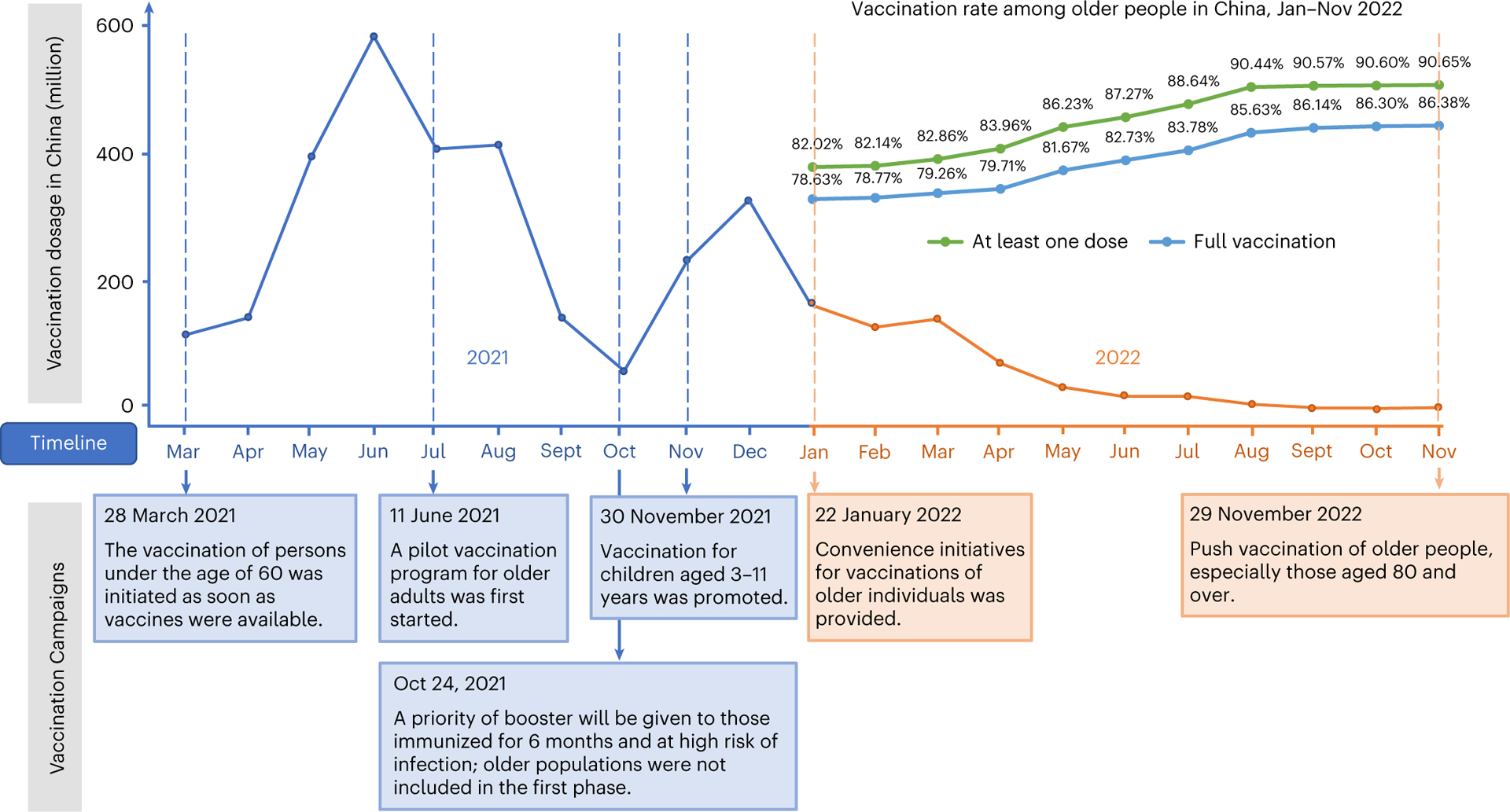
Vaccination is the primary defense against severe acute respiratory syndrome coronavirus 2, especially among older adults and those with chronic conditions. Using a nationally representative sample of 12,900 participants from the fifth wave (2021-2022) of the China Health and Retirement Longitudinal Study (CHARLS), we examined the coronavirus disease 2019 (COVID-19) vaccination status and the determinants of vaccination hesitancy in Chinese adults aged 52 and older. By July/August 2022, 92.3% of the Chinese population aged 60 years and older had received at least one COVID-19 vaccination, 88.6% had completed the primary series and 72.4% had received a booster. Those aged 80 years and older had lower vaccination rates, with 71.9% and 46.7% completing the primary series and booster shots, respectively. These statistics represent the situation before China ended the Zero-COVID policy in November 2022 because vaccination stagnated between July/August and November 2022. Multivariate regression analysis revealed that belonging to the oldest age groups (individuals aged 70 years and older and especially those aged 80 years and older) as well as being female and unmarried, residing in urban areas, being functionally dependent and having chronic conditions meant that these individuals were less likely to receive COVID-19 vaccines. Our regression analysis results were corroborated by self-reported reasons for nonvaccination. Vaccination hesitancy probably contributed to excessive mortality among vulnerable populations after China ceased its Zero-COVID policy. Our study provides important lessons on how to balance containment efforts with vaccination and treatment measures, as well as highlighting the need to clarify the side effects and contraindications of vaccines early on.
接种疫苗是预防严重急性呼吸综合征冠状病毒 2 型(SARS-CoV-2)的主要手段,尤其对老年人和慢性病患者而言。本研究使用了中国健康与养老追踪调查(CHARLS)第五波(2021-2022 年)全国代表性样本中的 12900 名参与者,调查了中国 52 岁及以上成年人的新冠肺炎(COVID-19)疫苗接种状况和疫苗犹豫的决定因素。截至 2022 年 7/8 月,中国 60 岁及以上人群中 92.3%至少接种了 1 剂 COVID-19 疫苗,88.6%完成了基础免疫系列,72.4%接种了加强针。80 岁及以上人群的疫苗接种率较低,分别有 71.9%和 46.7%完成了基础免疫系列和加强针。这些数据反映了 2022 年 11 月中国结束“动态清零”政策之前的情况,因为 2022 年 7/8 月至 11 月期间疫苗接种停滞不前。多变量回归分析显示,属于最年长的年龄组(70 岁及以上,尤其是 80 岁及以上)、女性和未婚、居住在城市地区、功能依赖和患有慢性病,这些因素使这些人不太可能接种 COVID-19 疫苗。我们的回归分析结果得到了自我报告的未接种疫苗原因的证实。在中国停止“动态清零”政策后,疫苗犹豫可能导致脆弱人群的死亡率过高。我们的研究为如何平衡遏制努力与疫苗接种和治疗措施提供了重要经验教训,并强调需要尽早明确疫苗的副作用和禁忌症。