Wellcome Trust Wellcome Centre for Human Neuroimaging, University College London, London, United Kingdom.
Wellcome Trust Wellcome Centre for Human Neuroimaging, University College London, London, United Kingdom; School of Psychology, Trinity College Dublin, Dublin, Ireland.
Biol Psychiatry. 2018 Sep 15;84(6):443-451. doi: 10.1016/j.biopsych.2017.12.017. Epub 2018 Jan 11.
Distortions in metacognition-the ability to reflect on and control other cognitive processes-are thought to be characteristic of poor mental health. However, it remains unknown whether such shifts in self-evaluation are due to specific alterations in metacognition and/or a downstream consequence of changes in decision-making processes.
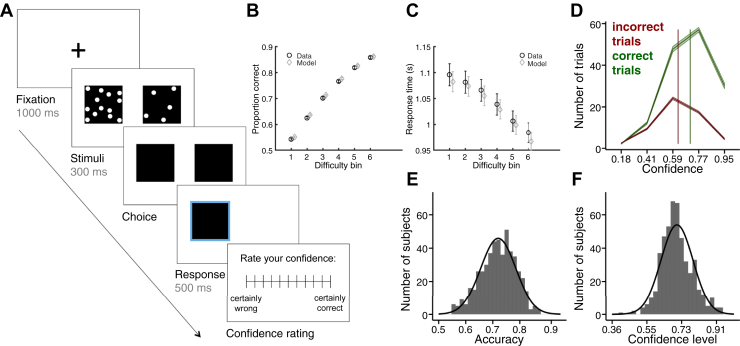
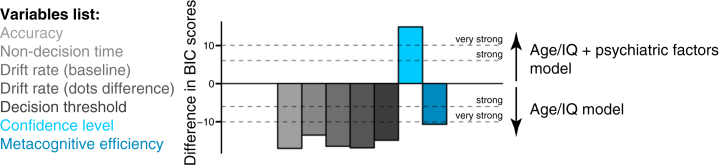
Using perceptual decision making as a model system, we employed a computational psychiatry approach to relate parameters governing both decision formation and metacognitive evaluation to self-reported transdiagnostic symptom dimensions in a large general population sample (N = 995).
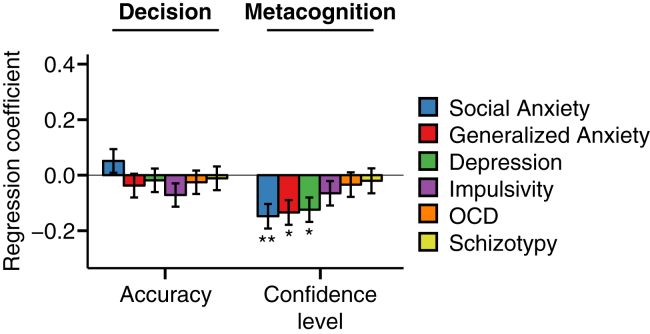
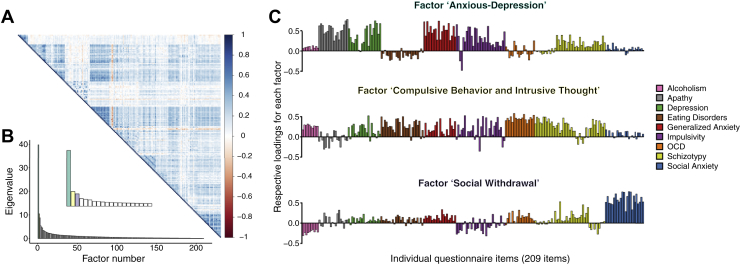
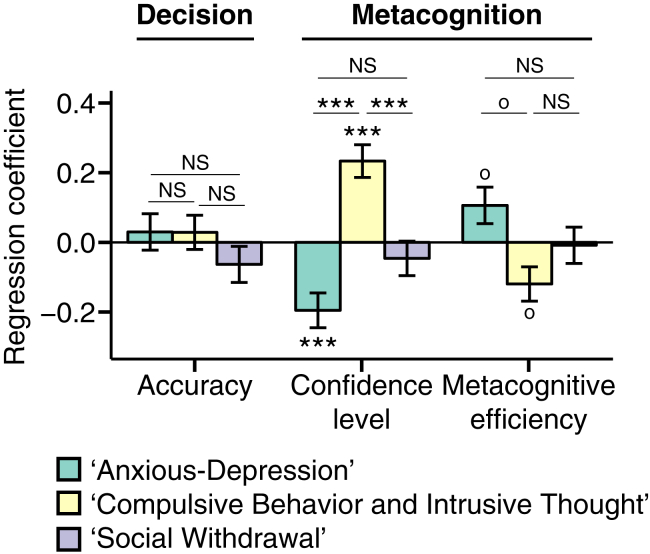
Variability in psychopathology was unrelated to either speed or accuracy of decision formation. In contrast, leveraging a dimensional approach, we revealed independent relationships between psychopathology and metacognition: a symptom dimension related to anxiety and depression was associated with lower confidence and heightened metacognitive efficiency, whereas a dimension characterizing compulsive behavior and intrusive thoughts was associated with higher confidence and lower metacognitive efficiency. Furthermore, we obtained a robust double dissociation-whereas psychiatric symptoms predicted changes in metacognition but not decision performance, age predicted changes in decision performance but not metacognition.
Our findings indicate a specific and pervasive link between metacognition and mental health. Our study bridges a gap between an emerging neuroscience of decision making and an understanding of metacognitive alterations in psychopathology.
元认知——即反思和控制其他认知过程的能力——的扭曲被认为是心理健康状况不佳的特征。然而,目前尚不清楚这种自我评价的转变是由于元认知的特定改变,还是由于决策过程变化的下游后果。
我们使用感知决策作为模型系统,采用计算精神病学方法,将控制决策形成和元认知评估的参数与来自大样本一般人群(N=995)的自我报告的跨诊断症状维度联系起来。
精神病理学的变异性与决策形成的速度或准确性无关。相比之下,利用维度方法,我们揭示了精神病理学和元认知之间的独立关系:一个与焦虑和抑郁有关的症状维度与较低的信心和较高的元认知效率有关,而一个特征为强迫行为和侵入性思维的维度则与较高的信心和较低的元认知效率有关。此外,我们获得了一个稳健的双重分离——即精神症状预测元认知的变化,但不预测决策表现,年龄预测决策表现的变化,但不预测元认知的变化。
我们的发现表明元认知和心理健康之间存在特定而普遍的联系。我们的研究在正在兴起的决策神经科学和对精神病理学中元认知改变的理解之间架起了一座桥梁。