Dai Fei-Cai, Wang Peng, Li Qiong, Zhang Lei, Yu Li-Jun, Wu Lin, Tao Rui-Xue, Zhu Peng
Department of Maternal, Child and Adolescent Health, School of Public Health, Anhui Medical University, Hefei, China.
MOE Key Laboratory of Population Health Across Life Cycle, Hefei, China.
Front Nutr. 2023 Jan 16;9:1078481. doi: 10.3389/fnut.2022.1078481. eCollection 2022.
Embryonic neural development is associated with intrauterine nutritional status. However, few cohort studies estimated the relationship between maternal dietary patterns during pregnancy and offspring's early neurodevelopment.
To examine the impact of the Mediterranean diet (MD) during pregnancy on infant neurodevelopment, including the potential mediating role of cord blood metabolites.
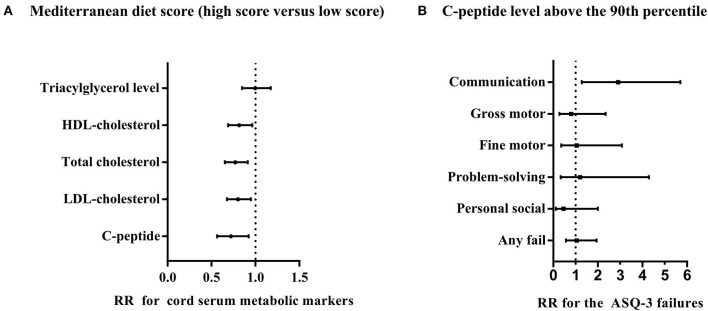
Among 1,471 mother-child pairs in a prospective birth cohort study in Hefei, China, we investigated the associations between maternal MD score [calculated based on a validated food frequency questionnaire (FFQ)] and child neurodevelopment at infancy [assessed using Ages and Stages Questionnaires, Third Edition (ASQ-3)]. The cord blood metabolic markers (including C-peptide, high-density lipoprotein-cholesterol, low-density lipoprotein-cholesterol, total cholesterol, and triglycerides) were measured.
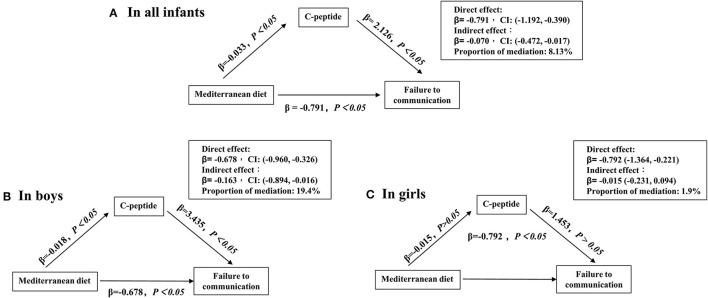
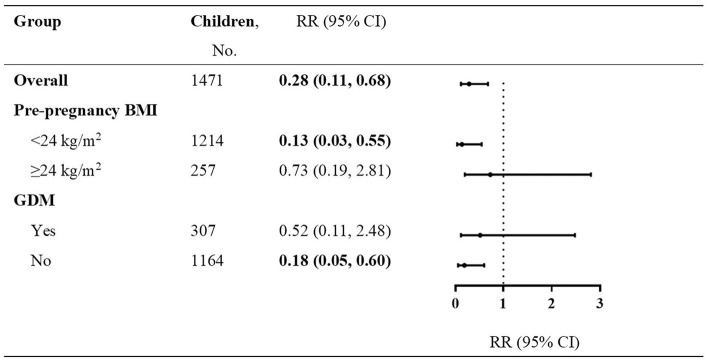
The MD score was negatively associated with communication domain developmental delays in infants [relative risk (RR) with 95% CI: 0.34 (0.16, 0.72)]. Compared with girls, boys born from mothers with lower MD scores during pregnancy were inclined to the failure of the communication domain [RRs with 95% CI for boys: 0.34 (0.14, 0.84); for girls: 0.26 (0.06, 1.18)]. Mediation analysis showed that the association between the maternal MD score and failure of communication domain mediated by C-peptide was 19.4% in boys but not in girls.
Adhering to the MD during pregnancy was associated with a decreased risk of poor neurodevelopment, possibly mediated by lower levels of cord blood C-peptide.
胚胎神经发育与宫内营养状况相关。然而,很少有队列研究评估孕期母亲饮食模式与后代早期神经发育之间的关系。
研究孕期地中海饮食(MD)对婴儿神经发育的影响,包括脐血代谢物的潜在中介作用。
在中国合肥一项前瞻性出生队列研究的1471对母婴中,我们调查了母亲MD评分[基于经过验证的食物频率问卷(FFQ)计算]与婴儿期儿童神经发育[使用《年龄与发育阶段问卷》第三版(ASQ-3)评估]之间的关联。测量了脐血代谢标志物(包括C肽、高密度脂蛋白胆固醇、低密度脂蛋白胆固醇、总胆固醇和甘油三酯)。
MD评分与婴儿沟通领域发育迟缓呈负相关[相对风险(RR)及95%置信区间:0.34(0.16,0.72)]。与女孩相比,孕期母亲MD评分较低的男孩更易出现沟通领域发育不良[男孩的RR及95%置信区间:0.34(0.14,0.84);女孩:0.26(0.06,1.18)]。中介分析表明,母亲MD评分与沟通领域发育不良之间由C肽介导的关联在男孩中为19.4%,在女孩中则不存在。
孕期坚持地中海饮食与神经发育不良风险降低相关,可能由脐血C肽水平降低介导。