School of Public Health, Anhui Medical University, No 81 Meishan Road, Hefei 230032, China.
Key Laboratory of Population Health Across Life Cycle, Ministry of Education of the People's Republic of China, Anhui Medical University, No 81 Meishan Road, Hefei 230032, China.
Nutrients. 2024 May 19;16(10):1530. doi: 10.3390/nu16101530.
Research studies have showed that maternal diet may influence fetal neurodevelopment, but most studies have only assessed single nutrients or food groups.
To investigate the impact of maternal prenatal dietary patterns during pregnancy on child neurodevelopment.
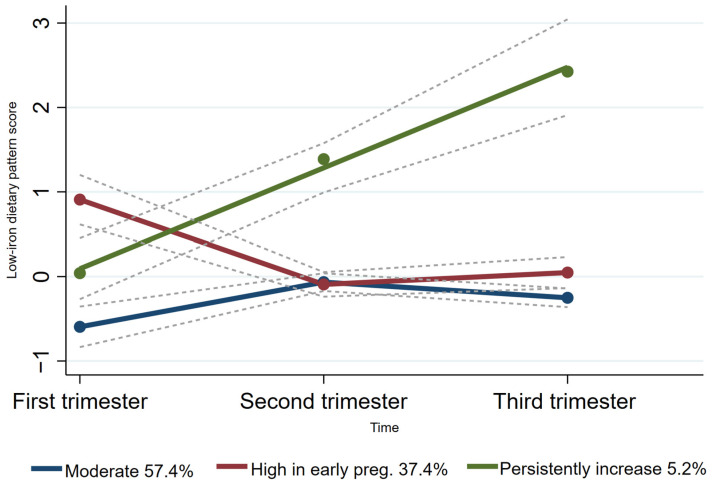
Study participants were obtained from the China National Birth Cohort. The Ages and Stages Questionnaire, Third Edition, was used to assess children's neurodevelopment at 36 months old. Maternal antenatal dietary data were collected over three trimesters using food frequency questionnaires. Five distinct maternal dietary patterns throughout pregnancy were identified by principal component analysis, namely protein- and micronutrient-rich dietary patterns, low-iron dietary patterns, pasta as the staple food dietary patterns, iron-rich dietary patterns, tubers, fruits, and baked food dietary patterns. Group-based trajectory modeling was performed for dietary patterns present in all three periods. Multiple linear regression models were used for statistical analysis.
Children of mothers who followed a high protein- and micronutrient-rich dietary pattern trajectory during pregnancy presented better neurodevelopment, including higher gross motor and problem-solving scores. Furthermore, it was observed that children born of women with low-iron dietary patterns had poorer neurodevelopment. In detail, children born to mothers with a low-iron dietary pattern during the first trimester had lower problem-solving scores, while to those who were exposed to a low-iron dietary pattern in the second and third trimesters had lower gross motor scores. Additionally, children with mothers who had a low-iron dietary pattern in the third trimester had lower communication scores.
A nutrition-balanced protein- and micronutrient-rich dietary pattern and adequate iron dietary pattern for mothers throughout pregnancy may be beneficial to children's neurodevelopment.
研究表明,母体饮食可能会影响胎儿的神经发育,但大多数研究仅评估了单一营养素或食物组。
探讨孕期母体产前饮食模式对儿童神经发育的影响。
研究对象来自中国国家出生队列。采用《年龄与阶段问卷》第三版评估儿童 36 个月时的神经发育情况。通过食物频率问卷在妊娠的三个孕期收集母体产前饮食数据。采用主成分分析确定五种不同的孕期母体饮食模式,即富含蛋白质和微量营养素的饮食模式、低铁饮食模式、以面食为主食的饮食模式、富含铁的饮食模式、根茎类、水果和烘焙食品的饮食模式。对所有三个孕期均存在的饮食模式进行基于群组的轨迹建模。采用多元线性回归模型进行统计分析。
孕期遵循高蛋白和富含微量营养素饮食模式轨迹的儿童神经发育更好,包括更高的粗大运动和解决问题的评分。此外,还发现低铁饮食模式母亲所生的儿童神经发育较差。具体而言,在孕早期采用低铁饮食模式的母亲所生的儿童解决问题的评分较低,而在孕中期和孕晚期采用低铁饮食模式的母亲所生的儿童粗大运动评分较低。此外,在孕晚期采用低铁饮食模式的母亲所生的儿童沟通评分较低。
孕期母亲均衡的富含蛋白质和微量营养素的饮食模式和充足的铁饮食模式可能有益于儿童的神经发育。