Institute for Exercise and Environmental Medicine, Texas Health Presbyterian Hospital Dallas, Dallas, TX.
Med Sci Sports Exerc. 2023 May 1;55(5):765-776. doi: 10.1249/MSS.0000000000003099. Epub 2022 Dec 5.
Pulmonary function is lower after a severe burn injury, which could influence ventilatory responses during exercise. It is unclear whether exercise training improves pulmonary function or ventilatory responses during exercise in adults with well-healed burn injuries. Therefore, we tested the hypothesis that exercise training improves pulmonary function and ventilatory responses during exercise in adults with well-healed burn injuries.
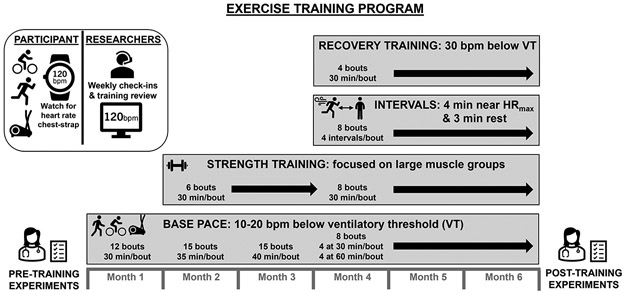
Thirty-nine adults (28 with well-healed burn injuries and 11 non-burn-injured controls) completed 6 months of unsupervised, progressive exercise training including endurance, resistance, and high-intensity interval components. Before and after exercise training, we performed comprehensive pulmonary function testing and measured ventilatory responses during cycling exercise. We compared variables using two-way ANOVA (group-time; i.e., preexercise/postexercise training (repeated factor)).
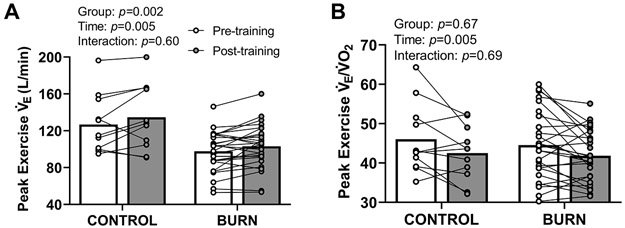
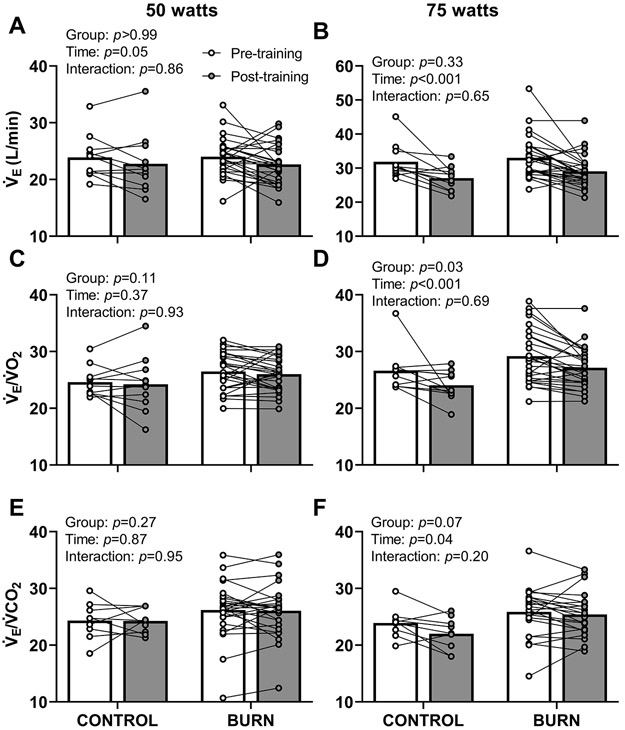
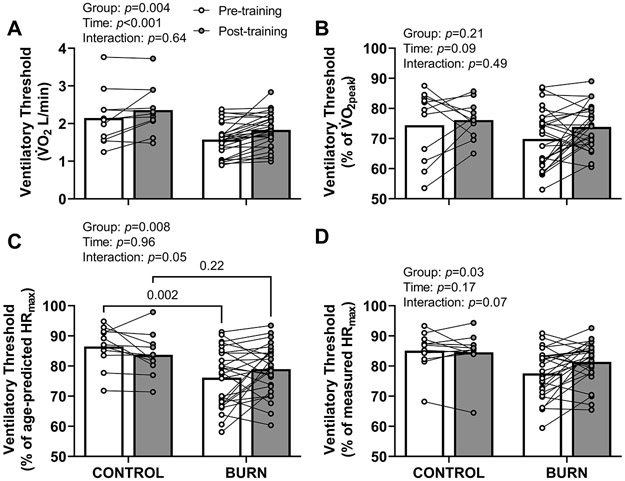
Exercise training did not increase percent predicted spirometry, lung diffusing capacity, or airway resistance measures (time: P ≥ 0.14 for all variables). However, exercise training reduced minute ventilation ( V̇E ; time: P ≤ 0.05 for 50 and 75 W) and the ventilatory equivalent for oxygen ( V̇E /V̇O 2 ; time: P < 0.001 for 75 W) during fixed-load exercise for both groups. The ventilatory equivalent for carbon dioxide ( V̇E /V̇CO 2 ) during exercise at 75 W was reduced after exercise training (time: P = 0.04). The percentage of age-predicted maximum heart rate at the ventilatory threshold was lower in adults with well-healed burn injuries before ( P = 0.002), but not after ( P = 0.22), exercise training. Lastly, exercise training increased V̇E and reduced V̇E /V̇O 2 during maximal exercise (time: P = 0.005 for both variables).
These novel findings demonstrate that exercise training can improve ventilatory responses during exercise in adults with well-healed burn injuries.
严重烧伤后肺功能降低,这可能会影响运动时的通气反应。目前尚不清楚在愈合良好的烧伤患者中,运动训练是否能改善肺功能或运动时的通气反应。因此,我们检验了这样一个假设,即在愈合良好的烧伤患者中,运动训练能改善肺功能和运动时的通气反应。
39 名成年人(28 名愈合良好的烧伤患者和 11 名非烧伤对照组)完成了 6 个月的非监督、渐进性运动训练,包括耐力、阻力和高强度间歇成分。在运动训练前后,我们进行了全面的肺功能测试,并在骑自行车运动期间测量了通气反应。我们使用双因素方差分析(组间-时间;即,运动前/运动训练后(重复因素))比较了变量。
运动训练并未增加预计百分比肺活量、肺弥散量或气道阻力测量值(时间:所有变量 P≥0.14)。然而,运动训练降低了分钟通气量(V̇E;时间:两组 50 和 75 W 时 P≤0.05)和氧通气当量(V̇E/V̇O2;时间:75 W 时 P<0.001)。在 75 W 固定负荷运动期间,运动训练后二氧化碳通气当量(V̇E/V̇CO2)降低(时间:P=0.04)。愈合良好的烧伤患者在运动训练前(P=0.002),而不是在运动训练后(P=0.22),达到最大心率的年龄预测百分比较低。最后,运动训练增加了最大运动时的 V̇E,并降低了 V̇E/V̇O2(时间:两个变量均为 P=0.005)。
这些新发现表明,运动训练可以改善愈合良好的烧伤患者运动时的通气反应。