• 文献检索
  • 文档翻译
  • 深度研究
  • 学术资讯
  • Suppr Zotero 插件Zotero 插件
  • 邀请有礼
  • 套餐&价格
  • 历史记录
应用&插件
Suppr Zotero 插件Zotero 插件浏览器插件Mac 客户端Windows 客户端微信小程序
定价
高级版会员购买积分包购买API积分包
服务
文献检索文档翻译深度研究API 文档MCP 服务
关于我们
关于 Suppr公司介绍联系我们用户协议隐私条款
关注我们

Suppr 超能文献

核心技术专利:CN118964589B侵权必究
粤ICP备2023148730 号-1Suppr @ 2026

文献检索

告别复杂PubMed语法,用中文像聊天一样搜索,搜遍4000万医学文献。AI智能推荐,让科研检索更轻松。

立即免费搜索

文件翻译

保留排版,准确专业,支持PDF/Word/PPT等文件格式,支持 12+语言互译。

免费翻译文档

深度研究

AI帮你快速写综述,25分钟生成高质量综述,智能提取关键信息,辅助科研写作。

立即免费体验

真相还是谎言:探索欺骗的语言。

Truth or lie: Exploring the language of deception.

机构信息

Institute of Psychology, Polish Academy of Sciences, Warszawa, Poland.

Polish-Japanese Academy of Information Technology, Warszawa, Poland.

出版信息

PLoS One. 2023 Feb 2;18(2):e0281179. doi: 10.1371/journal.pone.0281179. eCollection 2023.

DOI:10.1371/journal.pone.0281179
PMID:36730363
原文链接:https://pmc.ncbi.nlm.nih.gov/articles/PMC9894434/
Abstract

Lying appears in everyday oral and written communication. As a consequence, detecting it on the basis of linguistic analysis is particularly important. Our study aimed to verify whether the differences between true and false statements in terms of complexity and sentiment that were reported in previous studies can be confirmed using tools dedicated to measuring those factors. Further, we investigated whether linguistic features that differentiate true and false utterances in English-namely utterance length, concreteness, and particular parts-of-speech-are also present in the Polish language. We analyzed nearly 1,500 true and false statements, half of which were transcripts while the other half were written statements. Our results show that false statements are less complex in terms of vocabulary, are more concise and concrete, and have more positive words and fewer negative words. We found no significant differences between spoken and written lies. Using this data, we built classifiers to automatically distinguish true from false utterances, achieving an accuracy of 60%. Our results provide a significant contribution to previous conclusions regarding linguistic deception indicators.

摘要

说谎在日常口语和书面语中都存在。因此,基于语言分析来检测说谎尤为重要。我们的研究旨在验证先前研究中报告的真实性和虚假陈述在复杂性和情感方面的差异是否可以使用专门测量这些因素的工具来证实。此外,我们还研究了区分英语中真实和虚假话语的语言特征——即话语长度、具体性和特定词性——是否也存在于波兰语中。我们分析了近 1500 个真实和虚假的陈述,其中一半是文字记录,另一半是书面陈述。我们的结果表明,在词汇方面,虚假陈述的复杂性较低,更为简洁和具体,且包含更多的积极词汇和较少的消极词汇。我们没有发现口头和书面谎言之间的显著差异。我们使用这些数据构建了分类器来自动区分真实和虚假的话语,准确率达到 60%。我们的结果为之前关于语言欺骗指标的结论提供了重要贡献。
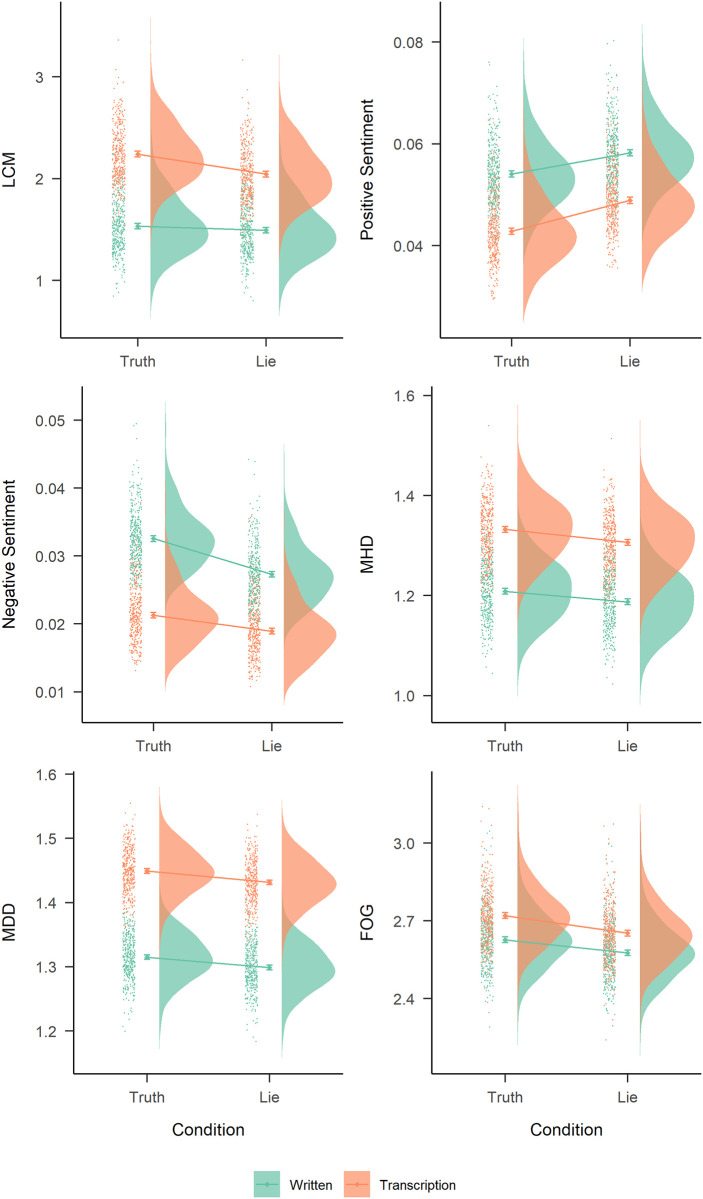
https://cdn.ncbi.nlm.nih.gov/pmc/blobs/826a/9894434/273dbc6ade68/pone.0281179.g002.jpg
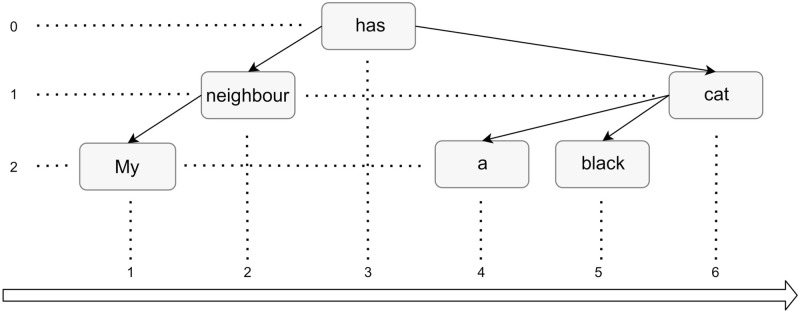
https://cdn.ncbi.nlm.nih.gov/pmc/blobs/826a/9894434/178481d64f4d/pone.0281179.g001.jpg
https://cdn.ncbi.nlm.nih.gov/pmc/blobs/826a/9894434/273dbc6ade68/pone.0281179.g002.jpg
https://cdn.ncbi.nlm.nih.gov/pmc/blobs/826a/9894434/178481d64f4d/pone.0281179.g001.jpg
https://cdn.ncbi.nlm.nih.gov/pmc/blobs/826a/9894434/273dbc6ade68/pone.0281179.g002.jpg

相似文献

1
Truth or lie: Exploring the language of deception.真相还是谎言:探索欺骗的语言。
PLoS One. 2023 Feb 2;18(2):e0281179. doi: 10.1371/journal.pone.0281179. eCollection 2023.
2
Lying words: predicting deception from linguistic styles.谎言:从语言风格预测欺骗行为。
Pers Soc Psychol Bull. 2003 May;29(5):665-75. doi: 10.1177/0146167203029005010.
3
Truth from language and truth from fit: the impact of linguistic concreteness and level of construal on subjective truth.语言真实与契合真实:语言具体性和解释水平对主观真实的影响。
Pers Soc Psychol Bull. 2010 Nov;36(11):1576-88. doi: 10.1177/0146167210386238. Epub 2010 Oct 14.
4
Verbal deception in picture naming.言语欺骗在图片命名中的表现。
Q J Exp Psychol (Hove). 2023 Oct;76(10):2390-2400. doi: 10.1177/17470218221146540. Epub 2023 Jan 12.
5
Markers of deception in italian speech.意大利语言语中的欺骗标记。
Front Psychol. 2012 Oct 30;3:453. doi: 10.3389/fpsyg.2012.00453. eCollection 2012.
6
Prosodic and lexical aspects of maternal linguistic input to late-talking toddlers.母亲对学话较晚幼儿的语言输入中的韵律和词汇方面。
Int J Lang Commun Disord. 2006 May-Jun;41(3):293-311. doi: 10.1080/13682820500342976.
7
Analysing Deception in Witness Memory through Linguistic Styles in Spontaneous Language.通过自发语言中的语言风格分析证人记忆中的欺骗行为。
Brain Sci. 2023 Feb 13;13(2):317. doi: 10.3390/brainsci13020317.
8
Learning language in autism: maternal linguistic input contributes to later vocabulary.自闭症患者的语言学习:母亲的语言输入对后期词汇量有影响。
Autism Res. 2015 Apr;8(2):214-23. doi: 10.1002/aur.1440. Epub 2015 Mar 2.
9
Lying in a native and foreign language.用母语和外语说谎。
Psychon Bull Rev. 2015 Aug;22(4):1124-9. doi: 10.3758/s13423-014-0781-4.
10
[Linguistic and narrative variables in oral and written language disorder].[口语和书面语言障碍中的语言及叙事变量]
Pro Fono. 2006 May-Aug;18(2):177-88. doi: 10.1590/s0104-56872006000200007.

引用本文的文献

1
Experimental economics for machine learning-a methodological contribution on lie detection.用于机器学习的实验经济学——关于测谎的方法学贡献
PLoS One. 2024 Dec 31;19(12):e0314806. doi: 10.1371/journal.pone.0314806. eCollection 2024.
2
Verbal lie detection using Large Language Models.使用大语言模型进行言语谎言检测。
Sci Rep. 2023 Dec 21;13(1):22849. doi: 10.1038/s41598-023-50214-0.
3
Are Intelligent People Better Liars? Relationships between Cognitive Abilities and Credible Lying.聪明人更擅长说谎吗?认知能力与可信谎言之间的关系。

本文引用的文献

1
Raincloud plots: a multi-platform tool for robust data visualization.雨云图:一种用于稳健数据可视化的多平台工具。
Wellcome Open Res. 2021 Jan 21;4:63. doi: 10.12688/wellcomeopenres.15191.2. eCollection 2019.
2
Are computers effective lie detectors? A meta-analysis of linguistic cues to deception.电脑能有效测谎吗?对欺骗的语言线索进行元分析。
Pers Soc Psychol Rev. 2015 Nov;19(4):307-42. doi: 10.1177/1088868314556539. Epub 2014 Nov 11.
3
Deception detection from written accounts.从书面陈述中进行欺骗检测。
J Intell. 2023 Apr 3;11(4):69. doi: 10.3390/jintelligence11040069.
Scand J Psychol. 2012 Apr;53(2):103-11. doi: 10.1111/j.1467-9450.2011.00931.x. Epub 2011 Dec 19.
4
The cognition of deception: the role of executive processes in producing lies.对欺骗的认知:执行过程在说谎中的作用。
Genet Soc Gen Psychol Monogr. 2006 Aug;132(3):197-214. doi: 10.3200/mono.132.3.197-214.
5
Lying words: predicting deception from linguistic styles.谎言:从语言风格预测欺骗行为。
Pers Soc Psychol Bull. 2003 May;29(5):665-75. doi: 10.1177/0146167203029005010.
6
Cues to deception.欺骗的线索。
Psychol Bull. 2003 Jan;129(1):74-118. doi: 10.1037/0033-2909.129.1.74.
7
Lying in everyday life.日常生活中的谎言。
J Pers Soc Psychol. 1996 May;70(5):979-95.