Kim Jeong Yeon, Suh Jin Woong, Kang Jae Seong, Kim Sun Bean, Yoon Young Kyung, Sohn Jang Wook
Division of Infectious Diseases, Department of Internal Medicine, Korea University College of Medicine, Seoul, Korea.
Infect Chemother. 2023 Mar;55(1):1-9. doi: 10.3947/ic.2022.0145. Epub 2023 Jan 6.
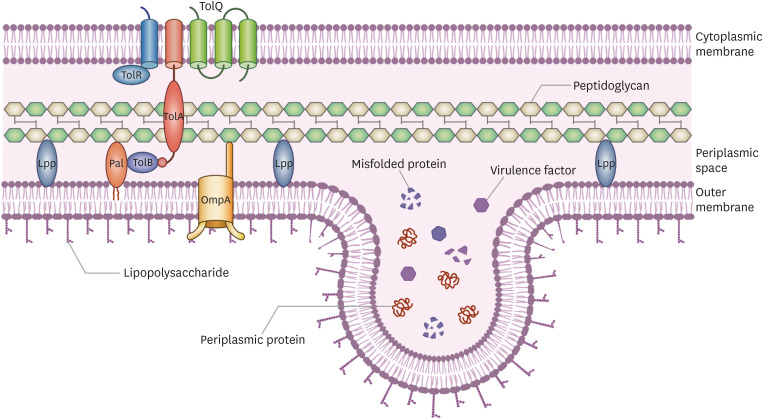
Outer membrane vesicles (OMVs) are spherical bilayered nanoparticles derived from the outer layer of Gram-negative bacteria. Bacteria communicate with nearby bacteria, their environment, and the cells of their host by secreting OMVs, which are essential for their survival. OMVs also play a critical role in bacterial pathogenesis since they are loaded with virulence factors, toxins, and enzymes. OMVs may modulate the immune response of the host by initiating inflammation through cytokine production and activating the innate immune response. OMVs also contribute to the resistance of bacteria to antibiotics by carrying antibiotic-degrading enzymes and acting as natural protection barriers. Concerns have also been raised regarding OMVs mediating the transfer of antibiotic resistance. Due to their advantageous properties, OMVs are attractive platforms for vaccine discovery and drug delivery research. In this review, we discuss the fundamental structure and biogenesis mechanisms of OMVs as well as their multifaceted roles in bacterial infection pathogenesis and host immune responses. We also discuss application examples of OMVs.
外膜囊泡(OMVs)是源自革兰氏阴性菌外层的球形双层纳米颗粒。细菌通过分泌OMVs与附近的细菌、它们的生存环境以及宿主细胞进行交流,OMVs对细菌的生存至关重要。OMVs在细菌致病过程中也起着关键作用,因为它们装载有毒力因子、毒素和酶。OMVs可能通过细胞因子产生引发炎症并激活先天免疫反应来调节宿主的免疫反应。OMVs还通过携带抗生素降解酶并作为天然保护屏障,有助于细菌对抗生素产生耐药性。人们也对OMVs介导抗生素耐药性转移表示担忧。由于其有利特性,OMVs是疫苗研发和药物递送研究的有吸引力的平台。在本综述中,我们讨论了OMVs的基本结构和生物发生机制,以及它们在细菌感染发病机制和宿主免疫反应中的多方面作用。我们还讨论了OMVs的应用实例。