Department of Child and Adolescent Health, School of Medicine, Hunan Normal University, 410006, Changsha, China.
Key Laboratory of Molecular Epidemiology of Hunan Province, School of Medicine, Hunan Normal University, 410081, Changsha, China.
Pediatr Res. 2023 Aug;94(2):653-659. doi: 10.1038/s41390-023-02467-8. Epub 2023 Feb 2.
The brain and muscle Arnt-like protein-1 (BMAL1) gene is an important circadian clock gene and previous studies have found that certain polymorphisms are associated with type 2 diabetes in adults. However, it remains unknown if such polymorphisms can affect fasting glucose in children and if other factors modify the associations.
A school-based cross-sectional study with 947 Chinese children was conducted. A multivariable linear regression model was used to analyze the association between BMAL1 gene polymorphisms and fasting glucose level.
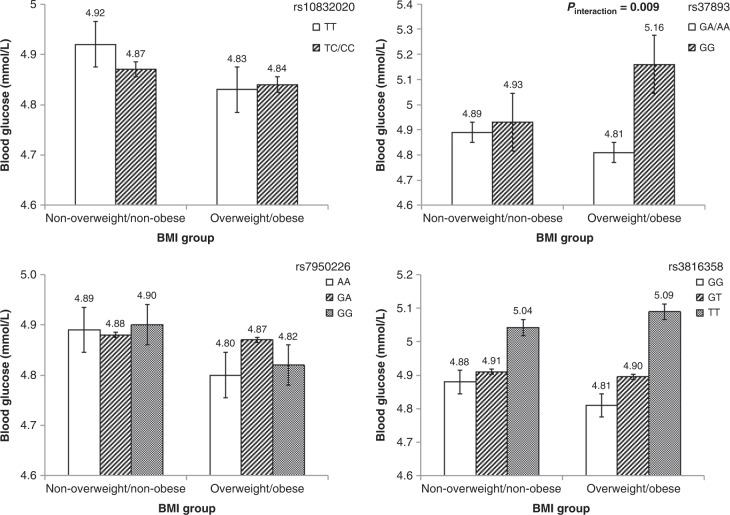
After adjusting for age, sex, body mass index (BMI), physical activity, and unhealthy diet, GG genotype carriers of BMAL1 rs3789327 had higher fasting glucose than AA/GA genotype carriers (b = 0.101, SE = 0.050, P = 0.045). Adjusting for the same confounders, rs3816358 was shown to be significantly associated with fasting glucose (b = 0.060, SE = 0.028, P = 0.032). Furthermore, a significant interaction between rs3789327 and nutritional status on fasting glucose was identified (P = 0.009); rs3789327 was associated with fasting glucose in the overweight/obese subgroup (b = 0.353, SE = 0.126, P = 0.006), but not in non-overweight/non-obese children.
BMAL1 polymorphisms were significantly associated with the fasting glucose level in children. Additionally, the observed interaction between nutritional status and BMAL1 supports promoting an optimal BMI in children genetically predisposed to higher glucose level.
Polymorphisms in the essential circadian clock gene BMAL1 were associated with fasting blood glucose levels in children. Additionally, there was a significant interaction between nutritional status and BMAL1 affecting fasting glucose levels. BMAL1 rs3789327 was associated with fasting glucose only in overweight/obese children. This finding could bring novel insights into mechanisms by which nutritional status influences fasting glucose in children.
脑和肌肉 ARNT 样蛋白-1(BMAL1)基因是一个重要的生物钟基因,先前的研究发现某些多态性与成年人 2 型糖尿病有关。然而,目前尚不清楚这些多态性是否会影响儿童的空腹血糖,以及是否有其他因素会改变这些关联。
采用基于学校的横断面研究,纳入了 947 名中国儿童。使用多变量线性回归模型分析 BMAL1 基因多态性与空腹血糖水平之间的关系。
在调整年龄、性别、体重指数(BMI)、体力活动和不健康饮食后,BMAL1 rs3789327 的 GG 基因型携带者的空腹血糖高于 AA/GA 基因型携带者(b=0.101,SE=0.050,P=0.045)。在调整相同混杂因素后,rs3816358 与空腹血糖呈显著相关(b=0.060,SE=0.028,P=0.032)。此外,还发现 rs3789327 与营养状况对空腹血糖的交互作用具有统计学意义(P=0.009);rs3789327 与超重/肥胖亚组的空腹血糖相关(b=0.353,SE=0.126,P=0.006),但与非超重/非肥胖儿童无关。
BMAL1 多态性与儿童的空腹血糖水平显著相关。此外,观察到的营养状况与 BMAL1 之间的相互作用支持在遗传上易出现高血糖的儿童中促进最佳 BMI。
关键生物钟基因 BMAL1 的多态性与儿童的空腹血糖水平相关。此外,营养状况与 BMAL1 之间存在显著的相互作用,影响空腹血糖水平。仅在超重/肥胖儿童中,rs3789327 与空腹血糖相关。这一发现为营养状况影响儿童空腹血糖的机制提供了新的见解。