School of Public Health, Tianjin Medical University, Tianjin, China.
Department of Bioinformatics, School of Basic Medical Sciences, Tianjin Medical University, Tianjin, China.
Transl Psychiatry. 2023 Feb 3;13(1):40. doi: 10.1038/s41398-023-02338-0.
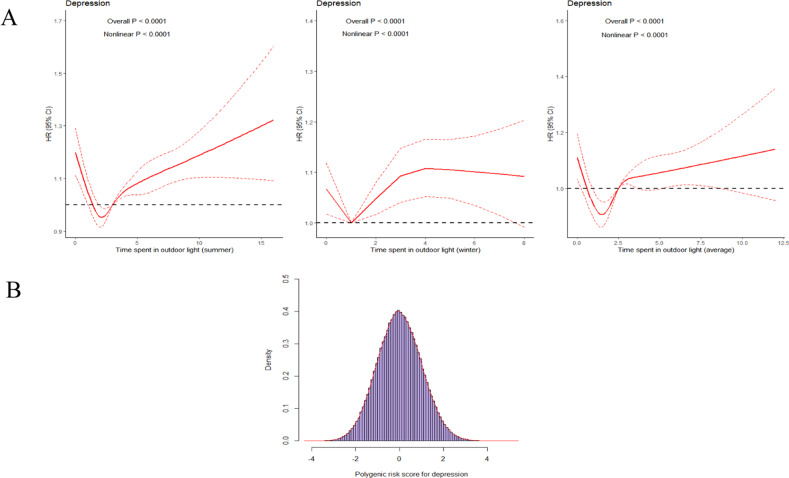
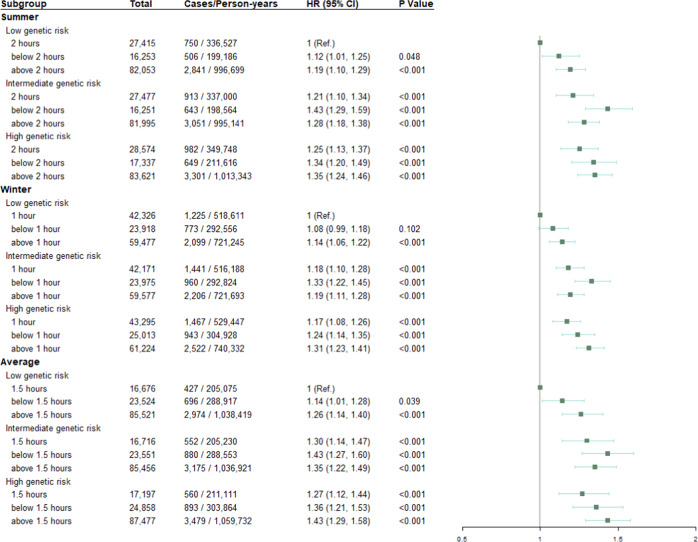
Depression is the consequence of both environment and genes working together. Genetic factors increase depression risk, but it is unclear whether this association can be offset by time spent in outdoor light. The study was undertaken to investigate the optimal time spent in outdoor light for lowering the risk of depression and the joint association of time spent in outdoor light and depression genetic risk. In UK Biobank, 380,976 depression-free individuals were included in this study. Polygenic risk score (PRS) was categorized into three groups in terms of tertiles. Time spent in outdoor light on a typical day in summer or winter originated from the questionnaire survey. Depression was defined as hospital admission. The potential dose-response relationship between time spent in outdoor light and depression risk was shown by a restricted cubic spline. Data were analyzed using Cox regressions and Laplace regression. After the median follow-up of 12.6 years, 13,636 individuals suffered from depression in the end. A nonlinear (J-shaped relationship) trend was observed between time spent in outdoor light and depression risk. On average, 1.5 h/day of outdoor light was related to the minimum risk of depression. Individuals below and above this optimal time both had elevated depression risk (below, HR = 1.09, 95% CI: 1.02-1.16; above, HR = 1.13, 95% CI: 1.07-1.20), and the time to incident depression were both shortened by 0.46 years (50th percentile differences [PD] = -0.46, 95% CI: -0.78, -0.14) and 0.63 years (50th PD = -0.63, 95% CI: -0.90, -0.35) years, respectively. In a comparison of individuals with the lowest tertile of PRS and average 1.5 h/day outdoor light, the HRs and 95% CIs of depression were 1.36 (1.21-1.53) and 1.43 (1.29-1.58) in those with the highest tertile of PRS and below/above this reference value, respectively. Significant multiplicative interactions were observed between intermediate genetic risks and longer time spent in outdoor light. We found that an average of 1.5 h/day spent in outdoor light was associated with a lower depression risk whatever the degree of depression genetic predisposition. Moderate time spent in outdoor light may contribute to a decreased depression risk even among people with a higher genetic risk of depression.
抑郁症是环境和基因共同作用的结果。遗传因素会增加患抑郁症的风险,但目前尚不清楚在户外光照下花费的时间是否可以抵消这种风险。本研究旨在调查户外光照时间对降低抑郁症风险的最佳时间,并探讨户外光照时间与抑郁症遗传风险的联合作用。在英国生物库中,纳入了 380976 名无抑郁症的个体进行研究。多基因风险评分(PRS)根据三分位数分为三组。夏季或冬季典型日的户外光照时间来自问卷调查。抑郁症的定义为住院治疗。通过限制性立方样条显示户外光照时间与抑郁症风险之间的潜在剂量-反应关系。使用 Cox 回归和拉普拉斯回归进行数据分析。中位随访 12.6 年后,共有 13636 人患上抑郁症。观察到户外光照时间与抑郁症风险之间呈非线性(J 形关系)趋势。平均每天 1.5 小时的户外光照与最低的抑郁症风险相关。低于和高于该最佳时间的个体均具有更高的抑郁症风险(低于最佳时间,HR=1.09,95%CI:1.02-1.16;高于最佳时间,HR=1.13,95%CI:1.07-1.20),且发病时间分别缩短了 0.46 年(50%分位数差值[PD]=-0.46,95%CI:-0.78,-0.14)和 0.63 年(50%PD=-0.63,95%CI:-0.90,-0.35)。在比较 PRS 最低三分位数和平均 1.5 小时/天户外光照的个体时,PRS 最高三分位数和低于/高于该参考值的个体的抑郁症 HR 和 95%CI 分别为 1.36(1.21-1.53)和 1.43(1.29-1.58)。在中等遗传风险和较长户外光照时间之间观察到显著的乘法交互作用。无论抑郁症遗传易感性如何,我们发现每天平均 1.5 小时的户外光照与较低的抑郁症风险相关。即使在具有较高抑郁症遗传风险的人群中,适度的户外光照时间也可能有助于降低抑郁症风险。