Escola Superior de Educação, Instituto Politécnico de Lisboa, Lisboa, Portugal.
Research Center in Sports Performance, Recreation, Innovation and Technology, SPRINT, Melgaço, Portugal.
Percept Mot Skills. 2023 Apr;130(2):680-699. doi: 10.1177/00315125231152662. Epub 2023 Feb 6.
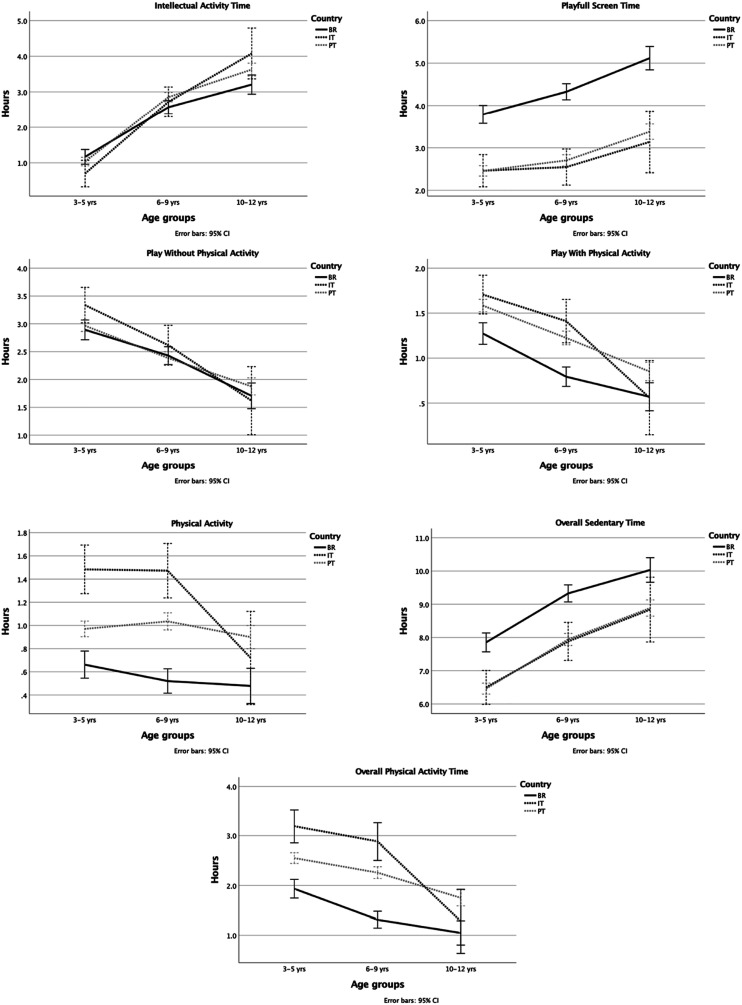
The COVID-19 pandemic forced governments to implement measures that disrupted the daily routines of many families worldwide. We studied how the COVID-19 lockdown affected children's routines in Portugal (PT), Brazil (BR), and Italy (IT) to determine if children's age and country impacted their physical activity (PA) and sedentary time. We launched an anonymous online survey to assess how 3-12 years old children adjusted their daily routines to this situation. Parents reported the times each child was engaged in different activities throughout the day, and we used these data to calculate separately overall sedentary and physical activity time. We conducted separate analyses of variance for age and country on the percentage of time spent in the different activities. Results, based on the data from 3045 children in these three countries (PT = 2044; BR = 836; IT = 165), showed that, during lockdown, most children spent most of their awake daily hours in sedentary activities. There was a clear age effect on the way their routines were organized. Percentages of time spent in intellectual activity, playful screen activity, and overall sedentary time were greater in the older age groups, whereas percentages of time spent in play (with and without PA) and in overall PA were greater in the younger groups. We found a main effect of country for all variables except play without PA. The country effect was mainly due to the difference between the routines in BR when compared to PT and IT. Values of playful screen time and overall sedentary activity were higher in BR than in the two European countries. Conversely, values for play with PA, PA, and overall PA (except in the older group) were lower in BR. Patterns of time spent in these activities were similar in IT and PT, but PA and overall PA times were higher in the two younger age groups in IT. In summary, percentage of PA time of confined children was low and decreased with age across all three countries and was particularly low for children in BR relative to those in PT and IT.
COVID-19 大流行迫使各国政府采取措施,打乱了全球许多家庭的日常生活。我们研究了 COVID-19 封锁如何影响葡萄牙(PT)、巴西(BR)和意大利(IT)儿童的日常生活,以确定儿童的年龄和国家是否会影响他们的体育活动(PA)和久坐时间。我们发布了一项匿名在线调查,以评估 3-12 岁儿童如何调整其日常生活以适应这种情况。父母报告了每个孩子在一天中的不同时间从事不同活动的时间,我们使用这些数据分别计算了总久坐时间和体育活动时间。我们对年龄和国家分别进行了方差分析,以评估不同活动中所花费时间的百分比。基于来自这三个国家的 3045 名儿童的数据(PT = 2044;BR = 836;IT = 165),结果表明,在封锁期间,大多数儿童在清醒时间的大部分时间里都处于久坐状态。儿童的日常生活组织方式存在明显的年龄效应。在智力活动、娱乐性屏幕活动和总久坐时间方面,年龄较大的儿童所占的比例较大,而在游戏(有和没有 PA)和总 PA 方面,年龄较小的儿童所占的比例较大。除了无 PA 的游戏之外,我们发现所有变量都存在国家的主要影响。国家效应主要归因于 BR 与 PT 和 IT 之间的日常差异。BR 中娱乐性屏幕时间和总久坐活动的价值高于另外两个欧洲国家。相反,BR 中的有 PA 的游戏、PA 和总 PA(除了年龄较大的群体)的价值较低。在 IT 和 PT 中,这些活动的时间分配模式相似,但在 IT 中,两个年龄较小的群体的 PA 和总 PA 时间更高。总之,所有三个国家的受限制儿童的 PA 时间百分比都很低,并且随着年龄的增长而下降,而与 PT 和 IT 相比,BR 儿童的 PA 时间尤其低。