State Key Laboratory of Molecular Developmental Biology, Institute of Genetics and Developmental Biology, Chinese Academy of Sciences, Beijing 100080, China.
University of Chinese Academy of Sciences, Beijing 100190, China.
Sci Adv. 2023 Feb 10;9(6):eade8829. doi: 10.1126/sciadv.ade8829. Epub 2023 Feb 8.
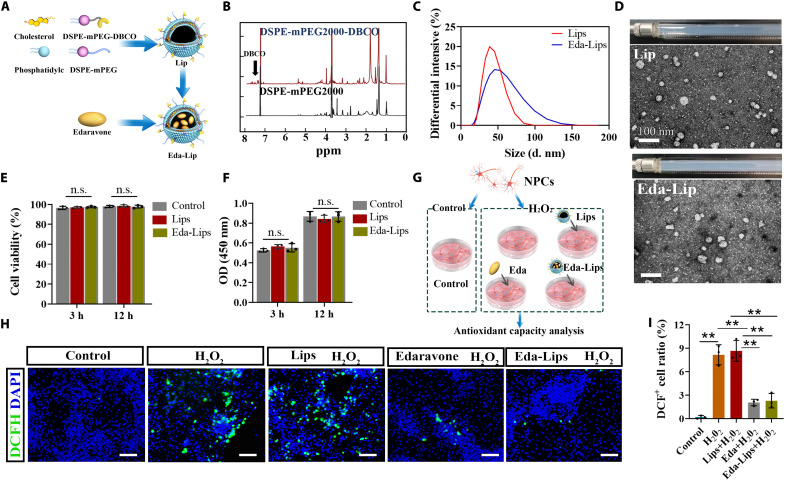
Noncovalent interactions between cells and environmental cues have been recognized as fundamental physiological interactions that regulate cell behavior. However, the effects of the covalent interactions between cells and biomaterials on cell behavior have not been examined. Here, we demonstrate a combined strategy based on covalent conjugation between biomaterials (collagen fibers/lipid nanoparticles) and various cells (exogenous neural progenitor cells/astrocytes/endogenous tissue-resident cells) to promote neural regeneration after spinal cord injury (SCI). We found that metabolic azido-labeled human neural progenitor cells conjugated on dibenzocyclooctyne-modified collagen fibers significantly promoted cell adhesion, spreading, and differentiation compared with noncovalent adhesion. In addition, dibenzocyclooctyne-modified lipid nanoparticles containing edaravone, a well-known ROS scavenger, could target azide-labeled spinal cord tissues or transplanted azide-modified astrocytes to improve the SCI microenvironment. The combined application of these covalent conjugation strategies in a rat SCI model boosted neural regeneration, suggesting that the covalent interactions between cells and biomaterials have great potential for tissue regeneration.
细胞与环境信号之间的非共价相互作用已被认为是调节细胞行为的基本生理相互作用。然而,细胞与生物材料之间的共价相互作用对细胞行为的影响尚未得到检验。在这里,我们展示了一种基于生物材料(胶原纤维/脂质纳米颗粒)与各种细胞(外源性神经祖细胞/星形胶质细胞/内源性组织驻留细胞)之间的共价偶联的组合策略,以促进脊髓损伤(SCI)后的神经再生。我们发现,与非共价黏附相比,代谢叠氮标记的与人神经祖细胞偶联在二苯并环辛炔修饰的胶原纤维上显著促进了细胞黏附、铺展和分化。此外,含有依达拉奉(一种著名的 ROS 清除剂)的二苯并环辛炔修饰的脂质纳米颗粒可以靶向叠氮标记的脊髓组织或移植的叠氮修饰的星形胶质细胞,以改善 SCI 微环境。这些共价偶联策略在大鼠 SCI 模型中的联合应用促进了神经再生,表明细胞与生物材料之间的共价相互作用在组织再生方面具有巨大的潜力。