Department of Molecular Medicine and Surgery, Section for Integrative Physiology, Karolinska Institutet, SE-171 77 Stockholm, Sweden.
Novo Nordisk Foundation Center for Basic Metabolic Research, Faculty of Health and Medical Sciences, University of Copenhagen, DK-2200 Copenhagen, Denmark.
Proc Natl Acad Sci U S A. 2023 Feb 21;120(8):e2218510120. doi: 10.1073/pnas.2218510120. Epub 2023 Feb 13.
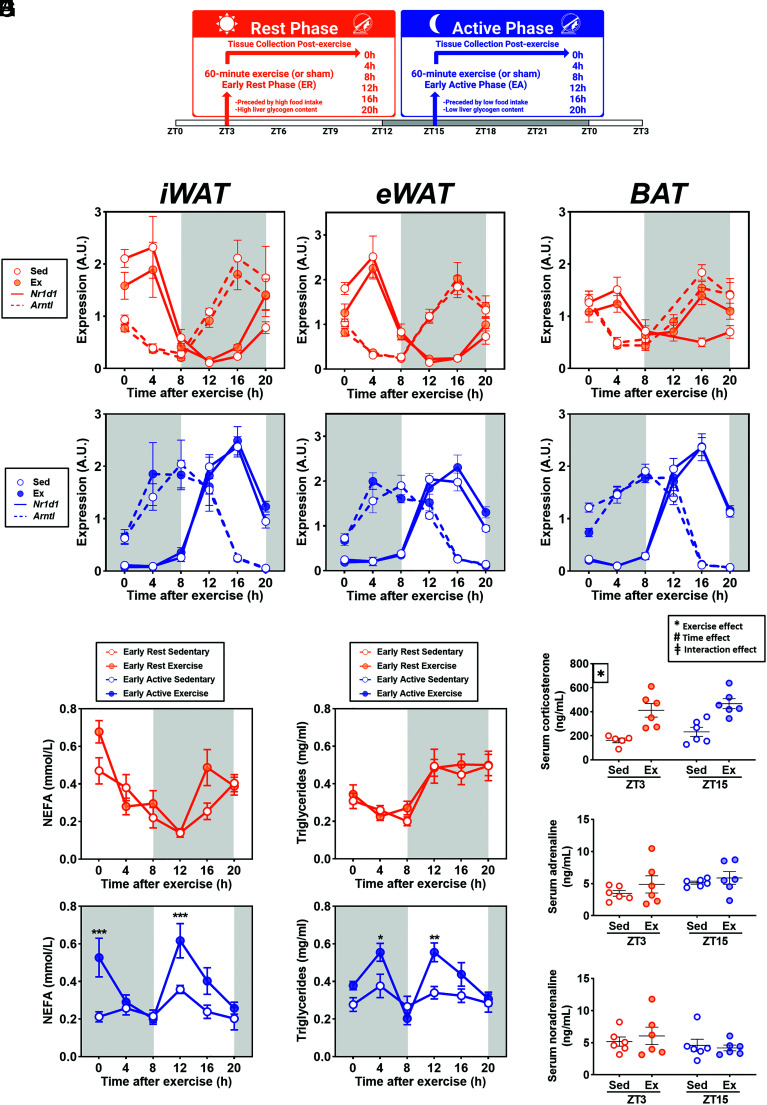
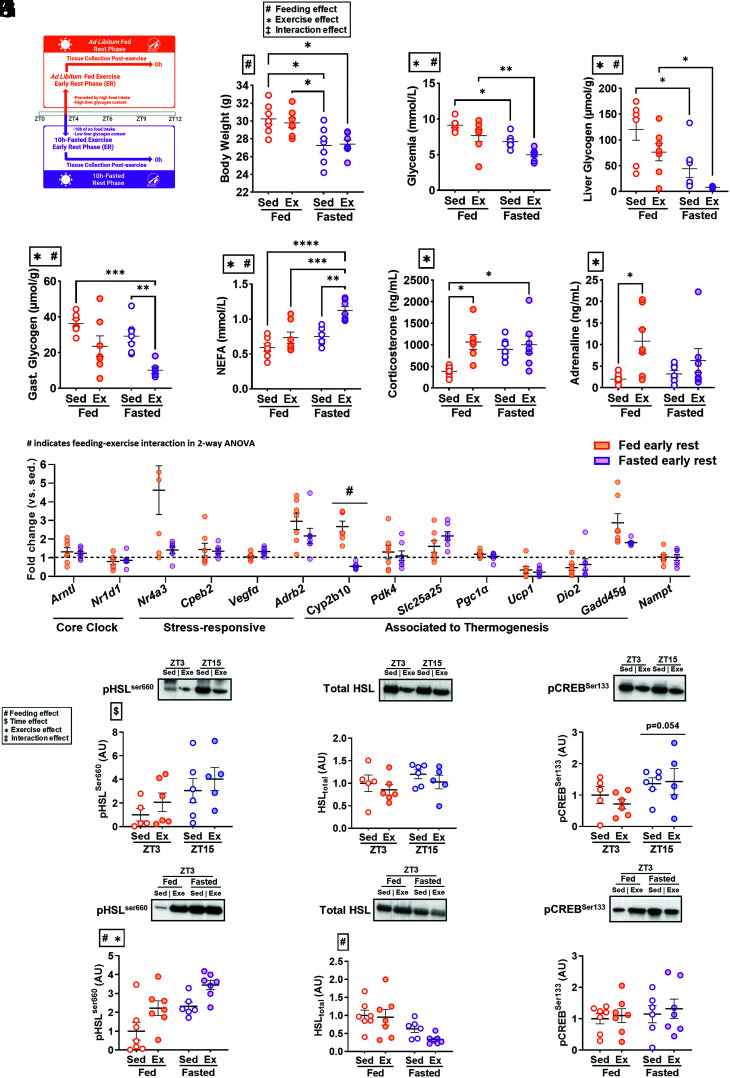
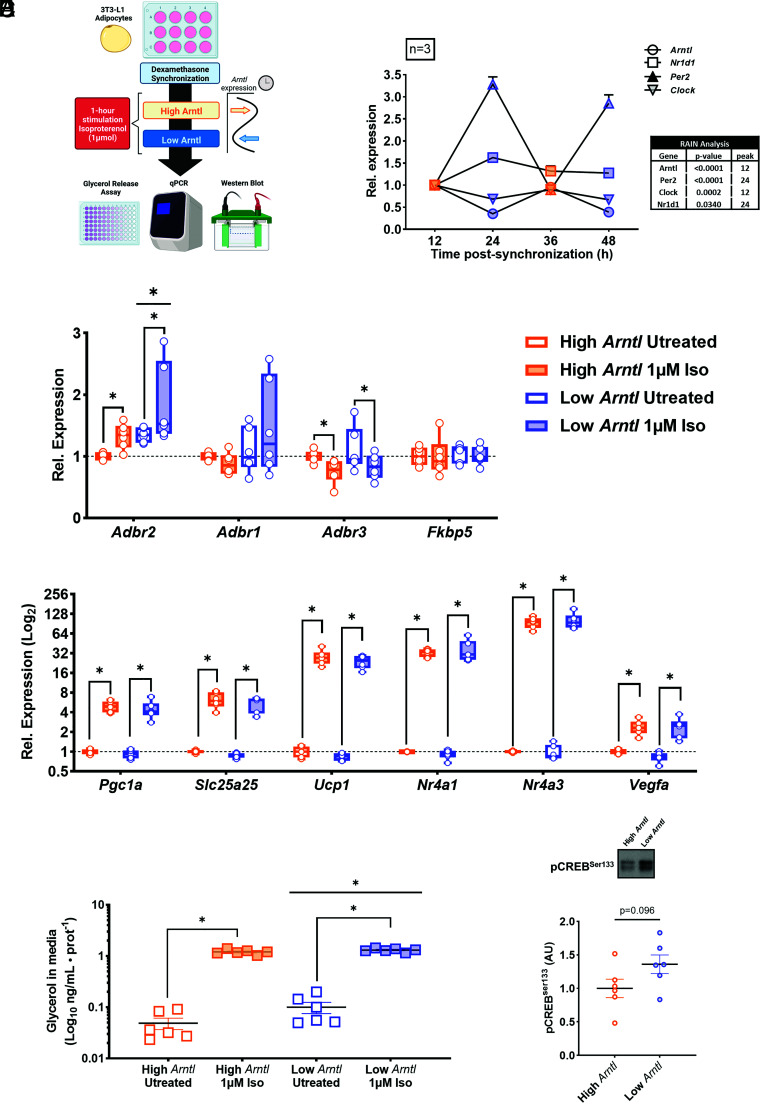
The circadian clock is a cell-autonomous transcription-translation feedback mechanism that anticipates and adapts physiology and behavior to different phases of the day. A variety of factors including hormones, temperature, food-intake, and exercise can act on tissue-specific peripheral clocks to alter the expression of genes that influence metabolism, all in a time-of-day dependent manner. The aim of this study was to elucidate the effects of exercise timing on adipose tissue metabolism. We performed RNA sequencing on inguinal adipose tissue of mice immediately following maximal exercise or sham treatment at the early rest or early active phase. Only during the early active phase did exercise elicit an immediate increase in serum nonesterified fatty acids. Furthermore, early active phase exercise increased expression of markers of thermogenesis and mitochondrial proliferation in inguinal adipose tissue. In vitro, synchronized 3T3-L1 adipocytes showed a timing-dependent difference in expression, as well as a greater lipolytic activity. Thus, the response of adipose tissue to exercise is time-of-day sensitive and may be partly driven by the circadian clock. To determine the influence of feeding state on the time-of-day response to exercise, we replicated the experiment in 10-h-fasted early rest phase mice to mimic the early active phase metabolic status. A 10-h fast led to a similar lipolytic response as observed after active phase exercise but did not replicate the transcriptomic response, suggesting that the observed changes in gene expression are not driven by feeding status. In conclusion, acute exercise elicits timing-specific effects on adipose tissue to maintain metabolic homeostasis.
生物钟是一种细胞自主的转录-翻译反馈机制,它预测并适应生理和行为在一天中的不同阶段。各种因素,包括激素、温度、食物摄入和运动,都可以作用于组织特异性的外周时钟,改变影响代谢的基因的表达,所有这些都是按照时间依赖的方式进行的。本研究旨在阐明运动时机对脂肪组织代谢的影响。我们在最大运动后或在早期休息或早期活动阶段进行模拟处理后,立即对小鼠腹股沟脂肪组织进行 RNA 测序。只有在早期活动阶段,运动才会立即增加血清非酯化脂肪酸。此外,早期活动阶段的运动增加了腹股沟脂肪组织中产热和线粒体增殖的标志物的表达。在体外,同步化的 3T3-L1 脂肪细胞表现出表达的时间依赖性差异,以及更大的脂肪分解活性。因此,脂肪组织对运动的反应是时间敏感的,可能部分是由生物钟驱动的。为了确定进食状态对运动时机反应的影响,我们在 10 小时禁食的早期休息阶段小鼠中重复了实验,以模拟早期活动阶段的代谢状态。10 小时禁食导致类似的脂肪分解反应,如在活动阶段运动后观察到的,但没有复制转录组反应,这表明观察到的基因表达变化不是由进食状态驱动的。总之,急性运动对脂肪组织产生时间特异性影响,以维持代谢平衡。