Department of Sports, Sun Yat-sen University, Guangzhou, 510275, China.
Beijing Sport University, Beijing, 100084, China.
Trials. 2023 Feb 14;24(1):110. doi: 10.1186/s13063-023-07116-3.
This study aimed to assess the different impacts of aerobic and resistance exercise intervention on pre-diabetes and its possible influencing factor (obesity) to identify which exercise intervention mode was better for pre-diabetes to control their blood glucose levels.
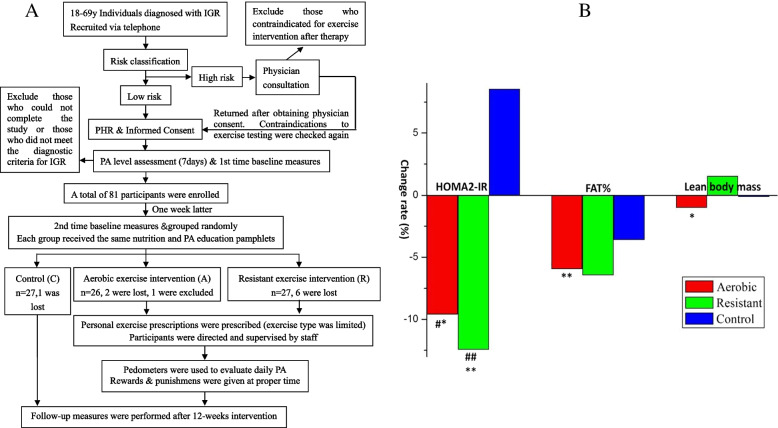
Single-blind randomized controlled trial. Participants were recruited from Southwest Hospital between February 2016 and May 2017 and randomly divided into three groups using stratified randomization: aerobic exercise (A), resistance exercise (R), and control (C). The effects of each group were analyzed, and the relationship with obesity was investigated following a 12-week intervention.
Eighty participants were enrolled (9 were lost, and 1 was excluded). Finally, 26 participants were included in group A, 23 in group R, and 21 in group C. In groups A and R, FPG, OGTT 2-h PG, and HOMA2-IR decreased by 6.17% (P = 0.001) and 4.81% (P = 0.019), 20.39% (P < 0.001) and 16.50% (P < 0.001), and 8.34% (P = 0.026) and 18.31% (P = 0.001, superior to that in group A), respectively (all P < 0.001 compared with group C, with no significant differences between groups A and R). The ratio of reversal to euglycemia was 69.2% (P = 0.003 compared with group C) in group A and 43.5% (P = 0.213 compared with group C) in group R. The decreased ratio of GSP in group R was greater (65.2%, P = 0.008 compared with group C) compared with group A (38.5%, P = 0.355 compared with group C). Decreases in the parameters BMI (3.1 ± 3.2% P < 0.001, moderately positive correlation with the decreased FPG level, r = 0.498, P = 0.010, two-tailed) and waist circumference (3.1 ± 2.7% P < 0.001) were noted in group A, but no significant correlations were noted between other indicators in group R.
Both resistance and aerobic exercise can control and reverse IGR. Compared with aerobic exercise, resistance exercise may be superior in terms of GSP and IR improvement. Aerobic exercise decreases blood glucose levels through weight loss. However, the effect of resistance exercise might not be mediated via weight loss and obesity control.
Chinese Clinical Trial Registry ChiCTR2000038304. Registered on September 17, 2020.
本研究旨在评估有氧运动和抗阻运动干预对糖尿病前期的不同影响及其可能的影响因素(肥胖),以确定哪种运动干预模式更有利于糖尿病前期患者控制血糖水平。
单盲随机对照试验。参与者于 2016 年 2 月至 2017 年 5 月期间从西南医院招募,并采用分层随机化方法分为三组:有氧运动(A)、抗阻运动(R)和对照组(C)。分析了每组的效果,并在 12 周干预后调查了与肥胖的关系。
共纳入 80 名参与者(9 名失访,1 名排除)。最终,A 组纳入 26 名参与者,R 组纳入 23 名参与者,C 组纳入 21 名参与者。A 组和 R 组的 FPG、OGTT 2hPG 和 HOMA2-IR 分别降低了 6.17%(P=0.001)和 4.81%(P=0.019)、20.39%(P<0.001)和 16.50%(P<0.001)、8.34%(P=0.026)和 18.31%(P=0.001,均优于 A 组)(与 C 组比较,均 P<0.001)。A 组的逆转率为 69.2%(P=0.003 与 C 组比较),R 组为 43.5%(P=0.213 与 C 组比较)。R 组 GSP 的降低比例(65.2%,P=0.008 与 C 组比较)大于 A 组(38.5%,P=0.355 与 C 组比较)。A 组的 BMI(3.1±3.2%,P<0.001,与 FPG 水平降低呈中度正相关,r=0.498,P=0.010,双侧)和腰围(3.1±2.7%,P<0.001)均有降低,但 R 组各指标之间无显著相关性。
抗阻运动和有氧运动均可控制和逆转 IGR。与有氧运动相比,抗阻运动可能在 GSP 和 IR 改善方面更具优势。有氧运动通过减轻体重来降低血糖水平。然而,抗阻运动的效果可能不是通过减轻体重和控制肥胖来介导的。
中国临床试验注册中心 ChiCTR2000038304。于 2020 年 9 月 17 日注册。