ADAPT Lab, Research Department of Clinical, Educational and Health Psychology, University College London, London, UK
ADAPT Lab, Research Department of Clinical, Educational and Health Psychology, University College London, London, UK.
BMJ Ment Health. 2023 Feb;26(1). doi: 10.1136/bmjment-2022-300555. Epub 2023 Feb 7.
Dementia incidence is increasing across the globe and currently there are no disease-modifying pharmaceutical treatments. The Lancet Commission on dementia identified 12 modifiable risk factors which explain 40% of dementia incidence. However, whether these associations are causal in nature is unclear.
To examine the modifiable risk factors for dementia as identified in the Lancet Commission review using Mendelian randomisation (MR) to establish if, based on genetic evidence, these associations with different dementia subtypes are causal in nature.
Publicly available genome-wide association study data were used for 10 risk factors and Alzheimer's disease (AD), frontotemporal dementia and dementia with Lewy bodies. Two-sample MR using the inverse varianceweighted method was conducted to test for causal relationships. Weighted median MR and MR-Egger were used to test for pleiotropic effects.
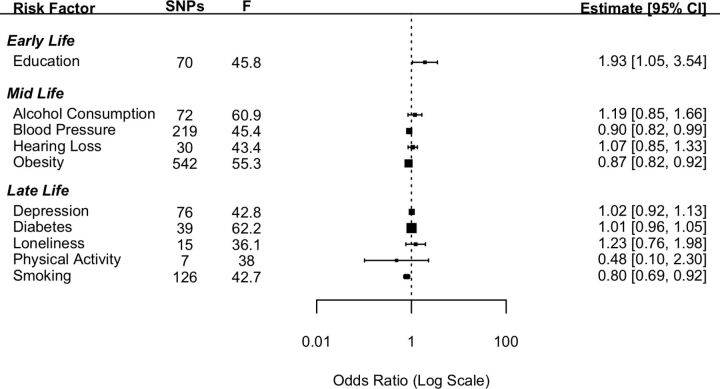
Genetic proxied risk for higher levels of smoking (OR: 0.80 (95% CI: 0.69; 0.92), p=0.002), obesity (OR: 0.87 (95% CI: 0.82; 0.92), p<0.001) and blood pressure (OR: 0.90 (95% CI: 0.82; 0.99), p=0.035) appeared to be protective against the risk of AD. Post hoc analyses indicated these associations had pleiotropic effects with the risk of coronary artery disease. Genetic proxied risk of educational attainment was found to be inconsistently associated with the risk of AD.
Post hoc analysis indicated that the apparent protective effects of smoking, obesity and blood pressure were a result of survivor bias. The findings from this study did not support those presented by the Lancet Commission. Evidence from causal inference studies should be considered alongside evidence from epidemiological studies and incorporated into reviews of the literature.
痴呆症在全球范围内的发病率正在上升,目前尚无针对这种疾病的治疗方法。柳叶刀痴呆症委员会确定了 12 个可改变的风险因素,这些因素可以解释 40%的痴呆症发病率。然而,这些关联是否具有因果关系尚不清楚。
使用孟德尔随机化(MR)来检验柳叶刀痴呆症委员会审查中确定的可改变的痴呆症风险因素,以确定基于遗传证据,这些与不同痴呆症亚型的关联是否具有因果关系。
使用 10 个风险因素和阿尔茨海默病(AD)、额颞叶痴呆和路易体痴呆的全基因组关联研究数据,进行两样本 MR 分析,采用逆方差加权法检验因果关系。加权中位数 MR 和 MR-Egger 用于检验多效性效应。
遗传上与更高水平的吸烟(OR:0.80(95%CI:0.69;0.92),p=0.002)、肥胖(OR:0.87(95%CI:0.82;0.92),p<0.001)和血压(OR:0.90(95%CI:0.82;0.99),p=0.035)相关的风险因素似乎对 AD 的发病风险有保护作用。事后分析表明,这些关联与冠心病的发病风险存在多效性效应。遗传上与教育程度相关的风险因素与 AD 的发病风险不一致。
事后分析表明,吸烟、肥胖和血压的明显保护作用是幸存者偏差的结果。本研究的结果与柳叶刀委员会提出的结果不一致。应将因果关系研究的证据与流行病学研究的证据结合起来,并纳入文献综述。