Department of Medicine, University of Washington, Seattle, WA, USA.
Department of Epidemiology, University of Washington, Seattle, WA, USA.
J Gen Intern Med. 2023 May;38(6):1484-1492. doi: 10.1007/s11606-023-08076-9. Epub 2023 Feb 16.
Little is known about whether diabetes increases the risk of COVID-19 infection and whether measures of diabetes severity are related to COVID-19 outcomes.
Investigate diabetes severity measures as potential risk factors for COVID-19 infection and COVID-19 outcomes.
DESIGN, PARTICIPANTS, MEASURES: In integrated healthcare systems in Colorado, Oregon, and Washington, we identified a cohort of adults on February 29, 2020 (n = 1,086,918) and conducted follow-up through February 28, 2021. Electronic health data and death certificates were used to identify markers of diabetes severity, covariates, and outcomes. Outcomes were COVID-19 infection (positive nucleic acid antigen test, COVID-19 hospitalization, or COVID-19 death) and severe COVID-19 (invasive mechanical ventilation or COVID-19 death). Individuals with diabetes (n = 142,340) and categories of diabetes severity measures were compared with a referent group with no diabetes (n = 944,578), adjusting for demographic variables, neighborhood deprivation index, body mass index, and comorbidities.
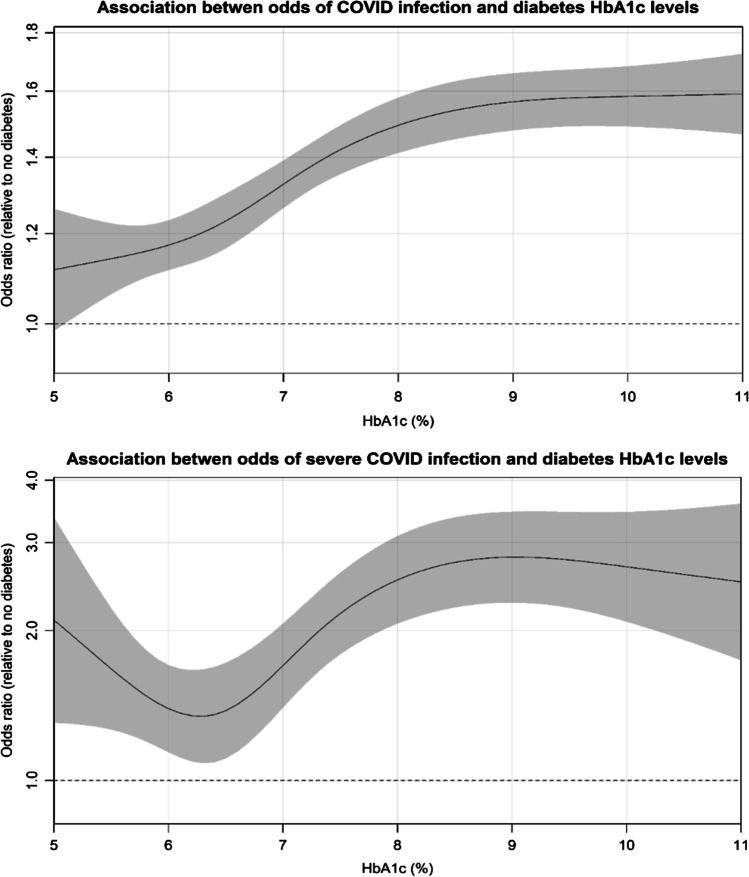
Of 30,935 patients with COVID-19 infection, 996 met the criteria for severe COVID-19. Type 1 (odds ratio [OR] 1.41, 95% CI 1.27-1.57) and type 2 diabetes (OR 1.27, 95% CI 1.23-1.31) were associated with increased risk of COVID-19 infection. Insulin treatment was associated with greater COVID-19 infection risk (OR 1.43, 95% CI 1.34-1.52) than treatment with non-insulin drugs (OR 1.26, 95% 1.20-1.33) or no treatment (OR 1.24; 1.18-1.29). The relationship between glycemic control and COVID-19 infection risk was dose-dependent: from an OR of 1.21 (95% CI 1.15-1.26) for hemoglobin A1c (HbA1c) < 7% to an OR of 1.62 (95% CI 1.51-1.75) for HbA1c ≥ 9%. Risk factors for severe COVID-19 were type 1 diabetes (OR 2.87; 95% CI 1.99-4.15), type 2 diabetes (OR 1.80; 95% CI 1.55-2.09), insulin treatment (OR 2.65; 95% CI 2.13-3.28), and HbA1c ≥ 9% (OR 2.61; 95% CI 1.94-3.52).
Diabetes and greater diabetes severity were associated with increased risks of COVID-19 infection and worse COVID-19 outcomes.
目前对于糖尿病是否会增加感染 COVID-19 的风险,以及糖尿病严重程度的衡量标准是否与 COVID-19 结局相关,人们知之甚少。
调查糖尿病严重程度指标是否为 COVID-19 感染和 COVID-19 结局的潜在危险因素。
设计、参与者、措施:在科罗拉多州、俄勒冈州和华盛顿州的综合医疗系统中,我们于 2020 年 2 月 29 日确定了一个成年人队列(n = 1,086,918),并随访至 2021 年 2 月 28 日。使用电子健康数据和死亡证明来确定糖尿病严重程度的标志物、协变量和结局。结局为 COVID-19 感染(核酸抗原检测阳性、COVID-19 住院或 COVID-19 死亡)和严重 COVID-19(有创机械通气或 COVID-19 死亡)。将患有糖尿病的个体(n = 142,340)和糖尿病严重程度衡量标准的类别与无糖尿病的参照组(n = 944,578)进行比较,调整了人口统计学变量、社区贫困指数、体重指数和合并症。
在 30,935 例 COVID-19 感染患者中,996 例符合严重 COVID-19 的标准。1 型(比值比 [OR] 1.41,95%CI 1.27-1.57)和 2 型糖尿病(OR 1.27,95%CI 1.23-1.31)与 COVID-19 感染风险增加相关。胰岛素治疗与更高的 COVID-19 感染风险相关(OR 1.43,95%CI 1.34-1.52),而非胰岛素药物(OR 1.26,95%CI 1.20-1.33)或无治疗(OR 1.24;1.18-1.29)。血糖控制与 COVID-19 感染风险之间存在剂量依赖性关系:从血红蛋白 A1c(HbA1c)<7%的比值比(OR)1.21(95%CI 1.15-1.26)到 HbA1c≥9%的比值比(OR)1.62(95%CI 1.51-1.75)。严重 COVID-19 的危险因素包括 1 型糖尿病(OR 2.87;95%CI 1.99-4.15)、2 型糖尿病(OR 1.80;95%CI 1.55-2.09)、胰岛素治疗(OR 2.65;95%CI 2.13-3.28)和 HbA1c≥9%(OR 2.61;95%CI 1.94-3.52)。
糖尿病和更严重的糖尿病与 COVID-19 感染风险增加和 COVID-19 结局恶化相关。