• 文献检索
  • 文档翻译
  • 深度研究
  • 学术资讯
  • Suppr Zotero 插件Zotero 插件
  • 邀请有礼
  • 套餐&价格
  • 历史记录
应用&插件
Suppr Zotero 插件Zotero 插件浏览器插件Mac 客户端Windows 客户端微信小程序
定价
高级版会员购买积分包购买API积分包
服务
文献检索文档翻译深度研究API 文档MCP 服务
关于我们
关于 Suppr公司介绍联系我们用户协议隐私条款
关注我们

Suppr 超能文献

核心技术专利:CN118964589B侵权必究
粤ICP备2023148730 号-1Suppr @ 2026

文献检索

告别复杂PubMed语法,用中文像聊天一样搜索,搜遍4000万医学文献。AI智能推荐,让科研检索更轻松。

立即免费搜索

文件翻译

保留排版,准确专业,支持PDF/Word/PPT等文件格式,支持 12+语言互译。

免费翻译文档

深度研究

AI帮你快速写综述,25分钟生成高质量综述,智能提取关键信息,辅助科研写作。

立即免费体验

(为什么)假信息是一个问题?

(Why) Is Misinformation a Problem?

机构信息

Department of Linguistics, School of Languages, Linguistics and Film, Queen Mary University London.

Centre for Science and Policy, University of Cambridge.

出版信息

Perspect Psychol Sci. 2023 Nov;18(6):1436-1463. doi: 10.1177/17456916221141344. Epub 2023 Feb 16.

DOI:10.1177/17456916221141344
PMID:36795592
原文链接:https://pmc.ncbi.nlm.nih.gov/articles/PMC10623619/
Abstract

In the last decade there has been a proliferation of research on misinformation. One important aspect of this work that receives less attention than it should is exactly why misinformation is a problem. To adequately address this question, we must first look to its speculated causes and effects. We examined different disciplines (computer science, economics, history, information science, journalism, law, media, politics, philosophy, psychology, sociology) that investigate misinformation. The consensus view points to advancements in information technology (e.g., the Internet, social media) as a main cause of the proliferation and increasing impact of misinformation, with a variety of illustrations of the effects. We critically analyzed both issues. As to the effects, misbehaviors are not yet reliably demonstrated empirically to be the outcome of misinformation; correlation as causation may have a hand in that perception. As to the cause, advancements in information technologies enable, as well as reveal, multitudes of interactions that represent significant deviations from ground truths through people's new way of knowing (intersubjectivity). This, we argue, is illusionary when understood in light of historical epistemology. Both doubts we raise are used to consider the cost to established norms of liberal democracy that come from efforts to target the problem of misinformation.

摘要

在过去的十年中,关于错误信息的研究层出不穷。这项工作的一个重要方面得到的关注不如应有的那么多,那就是错误信息为什么是一个问题。为了充分解决这个问题,我们必须首先研究其推测的原因和影响。我们研究了不同的学科(计算机科学、经济学、历史学、信息科学、新闻学、法学、媒体学、政治学、哲学、心理学、社会学)对错误信息的研究。共识观点指出,信息技术的进步(例如互联网、社交媒体)是错误信息传播和影响日益增大的主要原因,并列举了各种影响的例子。我们对这两个问题进行了批判性分析。至于影响,错误行为还没有被可靠地证明是错误信息的结果;将相关性视为因果关系可能在这种认知中起了作用。至于原因,信息技术的进步既促成了大量的互动,也揭示了这些互动,这些互动通过人们新的认知方式(主体间性)代表了对事实真相的重大偏离。从历史认识论的角度来看,我们认为这是一种幻觉。我们提出的这两个疑问都被用来考虑针对错误信息问题的努力对自由民主的既定规范造成的代价。
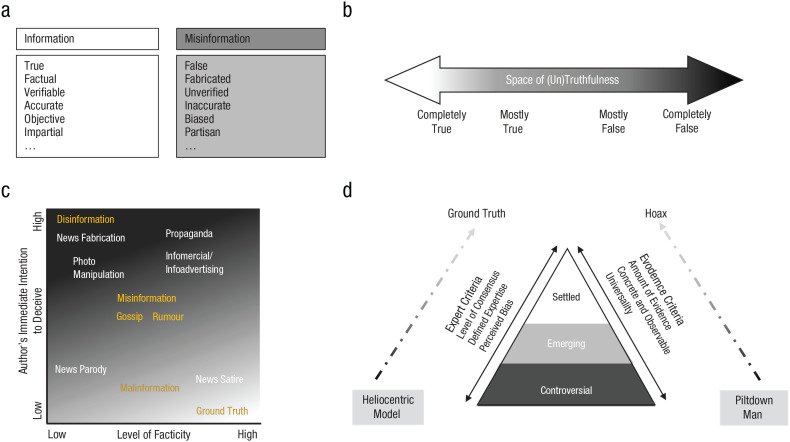
https://cdn.ncbi.nlm.nih.gov/pmc/blobs/5df3/10623619/f20a8a4204ca/10.1177_17456916221141344-fig1.jpg

相似文献

1
(Why) Is Misinformation a Problem?(为什么)假信息是一个问题?
Perspect Psychol Sci. 2023 Nov;18(6):1436-1463. doi: 10.1177/17456916221141344. Epub 2023 Feb 16.
2
The Online Misinformation Engagement Framework.网络错误信息参与框架
Curr Opin Psychol. 2024 Feb;55:101739. doi: 10.1016/j.copsyc.2023.101739. Epub 2023 Nov 14.
3
Fake news in the age of COVID-19: evolutional and psychobiological considerations.新冠疫情时代的假新闻:进化和心理生物学方面的考虑。
Psychiatriki. 2022 Sep 19;33(3):183-186. doi: 10.22365/jpsych.2022.087. Epub 2022 Jul 19.
4
Folic acid supplementation and malaria susceptibility and severity among people taking antifolate antimalarial drugs in endemic areas.在流行地区,服用抗叶酸抗疟药物的人群中,叶酸补充剂与疟疾易感性和严重程度的关系。
Cochrane Database Syst Rev. 2022 Feb 1;2(2022):CD014217. doi: 10.1002/14651858.CD014217.
5
Shifting attention to accuracy can reduce misinformation online.将注意力转移到准确性上可以减少网络上的错误信息。
Nature. 2021 Apr;592(7855):590-595. doi: 10.1038/s41586-021-03344-2. Epub 2021 Mar 17.
6
Resolving content moderation dilemmas between free speech and harmful misinformation.解决言论自由和有害错误信息之间的内容审核困境。
Proc Natl Acad Sci U S A. 2023 Feb 14;120(7):e2210666120. doi: 10.1073/pnas.2210666120. Epub 2023 Feb 7.
7
Science audiences, misinformation, and fake news.科学受众、错误信息和假新闻。
Proc Natl Acad Sci U S A. 2019 Apr 16;116(16):7662-7669. doi: 10.1073/pnas.1805871115. Epub 2019 Jan 14.
8
Meta-perception and misinformation.元知觉与错误信息。
Curr Opin Psychol. 2023 Dec;54:101717. doi: 10.1016/j.copsyc.2023.101717. Epub 2023 Oct 24.
9
Misinformation and the epistemic integrity of democracy.错误信息与民主的认知完整性。
Curr Opin Psychol. 2023 Dec;54:101711. doi: 10.1016/j.copsyc.2023.101711. Epub 2023 Oct 19.
10
[Mis- and disinformation in social media: mitigating risks in digital health communication].[社交媒体中的错误信息和虚假信息:减轻数字健康传播中的风险]
Bundesgesundheitsblatt Gesundheitsforschung Gesundheitsschutz. 2024 Mar;67(3):300-307. doi: 10.1007/s00103-024-03836-2. Epub 2024 Feb 8.

引用本文的文献

1
Advocating for a community-centred model for responding to potential information harms.倡导以社区为中心的模式来应对潜在的信息危害。
Nat Hum Behav. 2025 Jun 16. doi: 10.1038/s41562-025-02233-2.
2
["How to get your Doxy-PEP?": vulnerabilities and critical routes encountered by men in the therapeutic itinerary in Brazil].["如何获取你的多西环素暴露后预防药物?": 巴西男性在治疗过程中遇到的漏洞和关键途径]
Cad Saude Publica. 2025 Feb 7;40(12):e00058524. doi: 10.1590/0102-311XPT058524. eCollection 2025.
3
Bypassing versus correcting misinformation: Efficacy and fundamental processes.

本文引用的文献

1
The evolution of distorted beliefs vs. mistaken choices under asymmetric error costs.非对称误差成本下扭曲信念与错误选择的演变
Evol Hum Sci. 2020 May 20;2:e27. doi: 10.1017/ehs.2020.25. eCollection 2020.
2
Forming and updating vaccination beliefs: does the continued effect of misinformation depend on what we think we know?形成和更新疫苗接种信念:错误信息的持续影响是否取决于我们的认知?
Cogn Process. 2022 Aug;23(3):367-378. doi: 10.1007/s10339-022-01093-2. Epub 2022 May 18.
3
Accuracy prompts are a replicable and generalizable approach for reducing the spread of misinformation.
绕过与纠正错误信息:效果与基本过程。
J Exp Psychol Gen. 2024 Nov 18. doi: 10.1037/xge0001687.
4
Understanding and Combating Misinformation: An Evolutionary Perspective.理解与对抗错误信息:进化视角
JMIR Infodemiology. 2024 Dec 27;4:e65521. doi: 10.2196/65521.
5
Misinformation poses a bigger threat to democracy than you might think.错误信息对民主构成的威胁比你想象的更大。
Nature. 2024 Jun;630(8015):29-32. doi: 10.1038/d41586-024-01587-3.
6
Teaching epistemic integrity to promote reliable scientific communication.传授认知诚信以促进可靠的科学交流。
Front Psychol. 2024 Apr 5;15:1308304. doi: 10.3389/fpsyg.2024.1308304. eCollection 2024.
7
A novel approach to fake news classification using LSTM-based deep learning models.一种使用基于长短期记忆网络(LSTM)的深度学习模型进行假新闻分类的新方法。
Front Big Data. 2024 Jan 8;6:1320800. doi: 10.3389/fdata.2023.1320800. eCollection 2023.
准确性提示是一种可复制和可推广的方法,可以减少错误信息的传播。
Nat Commun. 2022 Apr 28;13(1):2333. doi: 10.1038/s41467-022-30073-5.
4
Exploring the Role of Trust in Scientists to Explain Health-Related Behaviors in Response to the COVID-19 Pandemic.探索科学家信任在解释应对新冠疫情的健康相关行为中的作用。
Sci Educ (Dordr). 2022;31(5):1281-1309. doi: 10.1007/s11191-022-00323-5. Epub 2022 Feb 5.
5
When the political is professional: Civil disobedience in psychology.当政治变得专业化:心理学中的公民抗命。
Am Psychol. 2021 Nov;76(8):1217-1231. doi: 10.1037/amp0000867.
6
Risk perception, decision-making, and risk communication in the time of COVID-19.新冠疫情时期的风险感知、决策和风险沟通。
J Exp Psychol Appl. 2021 Dec;27(4):579-583. doi: 10.1037/xap0000407.
7
Conspiracy mentality and political orientation across 26 countries.在 26 个国家的阴谋心态和政治倾向。
Nat Hum Behav. 2022 Mar;6(3):392-403. doi: 10.1038/s41562-021-01258-7. Epub 2022 Jan 17.
8
Conspiracy beliefs prospectively predict health behavior and well-being during a pandemic.阴谋论信仰可预测大流行期间的健康行为和幸福感。
Psychol Med. 2023 Apr;53(6):2514-2521. doi: 10.1017/S0033291721004438. Epub 2021 Oct 13.
9
Determinants of individuals' belief in fake news: A scoping review determinants of belief in fake news.虚假新闻信仰的决定因素:范围综述虚假新闻信仰的决定因素。
PLoS One. 2021 Jun 24;16(6):e0253717. doi: 10.1371/journal.pone.0253717. eCollection 2021.
10
Quantifying the effects of fake news on behavior: Evidence from a study of COVID-19 misinformation.量化假新闻对行为的影响:来自一项关于新冠疫情错误信息研究的证据。
J Exp Psychol Appl. 2021 Dec;27(4):773-784. doi: 10.1037/xap0000371. Epub 2021 Jun 10.