Wang Shaopan, He Jiezhou, He Xin, Liu Yuwen, Lin Xiang, Xu Changsheng, Zhu Linfangzi, Kang Jie, Wang Yuqian, Li Yong, Guo Shujia, Zhang Yunuo, Luo Zhiming, Liu Zuguo
Institute of Artificial Intelligence, Xiamen University, Xiamen, China.
Eye Institute of Xiamen University, School of Medicine, Xiamen University, Xiamen, China.
Ther Adv Chronic Dis. 2023 Feb 12;14:20406223221148266. doi: 10.1177/20406223221148266. eCollection 2023.
Corneal fluorescein sodium staining is a valuable diagnostic method for various ocular surface diseases. However, the examination results are highly dependent on the subjective experience of ophthalmologists.
To develop an artificial intelligence system based on deep learning to provide an accurate quantitative assessment of sodium fluorescein staining score and the size of cornea epithelial patchy defect.
A prospective study.
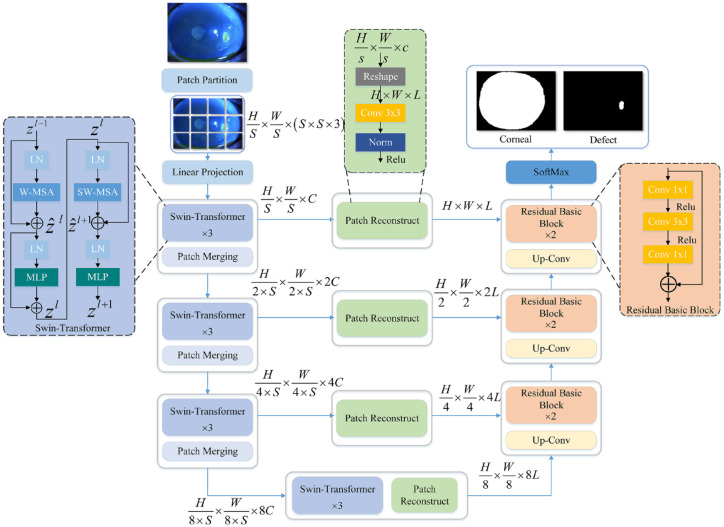
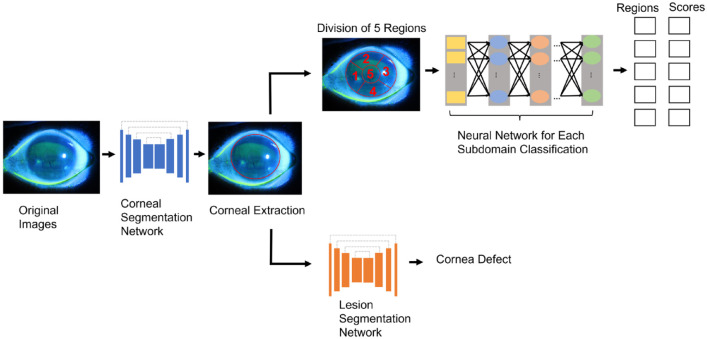
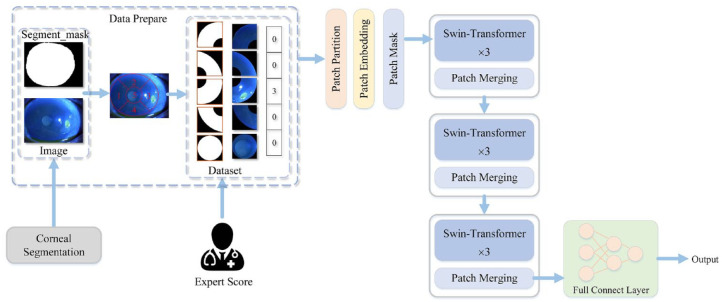
We proposed an artificial intelligence system for automatically evaluating corneal staining scores and accurately measuring patchy corneal epithelial defects based on corneal fluorescein sodium staining images. The design incorporates two segmentation models and a classification model to forecast and assess the stained images. Meanwhile, we compare the evaluation findings from the system with ophthalmologists with varying expertise.
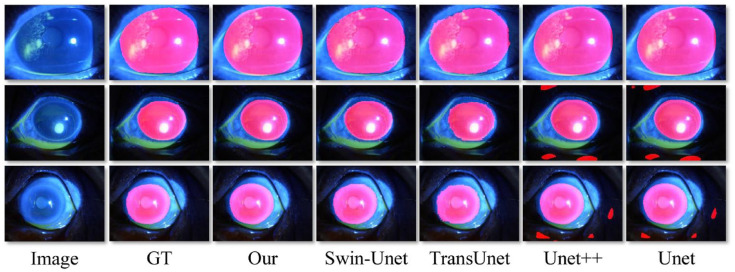
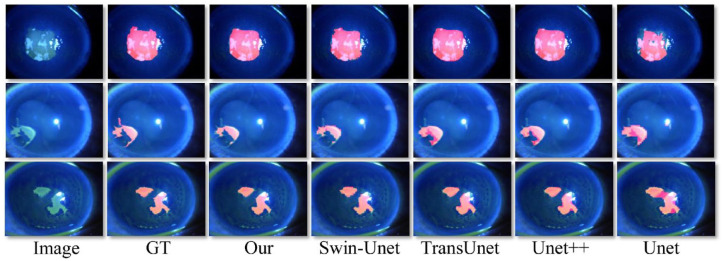
For the segmentation task of cornea boundary and cornea epithelial patchy defect area, our proposed method can achieve the performance of dice similarity coefficient (DSC) is 0.98/0.97 and Hausdorff distance (HD) is 3.60/8.39, respectively, when compared with the manually labeled gold standard. This method significantly outperforms the four leading algorithms (Unet, Unet++, Swin-Unet, and TransUnet). For the classification task, our algorithm achieves the best performance in accuracy, recall, and F1-score, which are 91.2%, 78.6%, and 79.2%, respectively. The performance of our developed system exceeds seven different approaches (Inception, ShuffleNet, Xception, EfficientNet_B7, DenseNet, ResNet, and VIT) in classification tasks. In addition, three ophthalmologists were selected to rate corneal staining images. The results showed that the performance of our artificial intelligence system significantly outperformed the junior doctors.
The system offers a promising automated assessment method for corneal fluorescein staining, decreasing incorrect evaluations caused by ophthalmologists' subjective variance and limited knowledge.
角膜荧光素钠染色是诊断多种眼表疾病的重要方法。然而,检查结果高度依赖眼科医生的主观经验。
开发一种基于深度学习的人工智能系统,以准确量化荧光素钠染色评分及角膜上皮片状缺损大小。
一项前瞻性研究。
我们提出了一种基于角膜荧光素钠染色图像自动评估角膜染色评分并精确测量角膜上皮片状缺损的人工智能系统。该设计包含两个分割模型和一个分类模型来预测和评估染色图像。同时,我们将系统的评估结果与不同专业水平的眼科医生的评估结果进行比较。
对于角膜边界和角膜上皮片状缺损区域的分割任务,与手动标注的金标准相比,我们提出的方法的骰子相似系数(DSC)分别为0.98/0.97,豪斯多夫距离(HD)分别为3.60/8.39。该方法显著优于四种领先算法(Unet、Unet++、Swin-Unet和TransUnet)。对于分类任务,我们的算法在准确率、召回率和F1分数方面取得了最佳性能,分别为91.2%、78.6%和79.2%。我们开发的系统在分类任务中的性能超过了七种不同的方法(Inception、ShuffleNet、Xception、EfficientNet_B7、DenseNet、ResNet和VIT)。此外,选择了三位眼科医生对角膜染色图像进行评分。结果表明,我们的人工智能系统的性能明显优于初级医生。
该系统为角膜荧光素钠染色提供了一种有前景的自动评估方法,减少了因眼科医生主观差异和知识局限导致的错误评估。