Center for Reproductive Medicine, First Affiliated Hospital of Xinjiang Medical University, Urumqi, China.
State Key Laboratory of Pathogenesis, Prevention and Treatment of High Incidence Diseases in Central Asia, Xinjiang Medical University, Urumqi, China.
Front Endocrinol (Lausanne). 2023 Jan 31;14:1027805. doi: 10.3389/fendo.2023.1027805. eCollection 2023.
A number of live birth predictive model during assisted reproductive technology treatment have been available in recent years, but few targeted evaluating the chances of live birth in poor ovarian response(POR) patients. The aim of this study was to develop a nomogram based on POSEIDON criteria to predict live birth in patients with expected POR.
This retrospective cohort study using clinical data from 657 patients in POSEIDON Groups 3 and 4 (antral follicle count [AFC] ≤5 and AMH <1.2 ng/ml) in the Center for Reproductive Medicine, First Affiliated Hospital of Xinjiang Medical University, and Construction a nomogram model t.
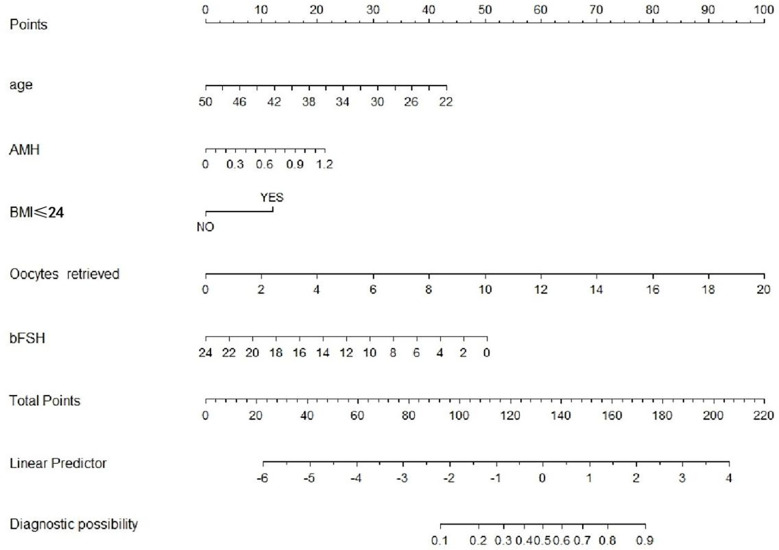
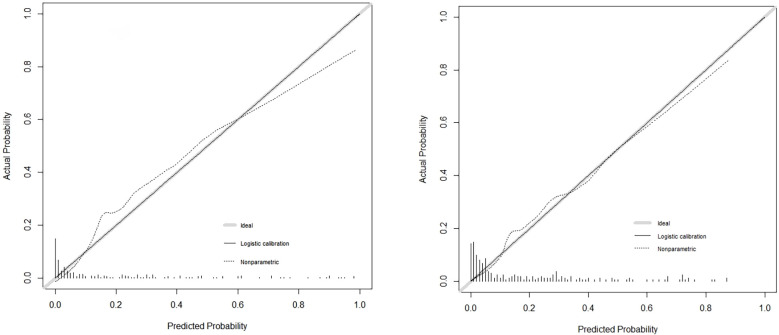
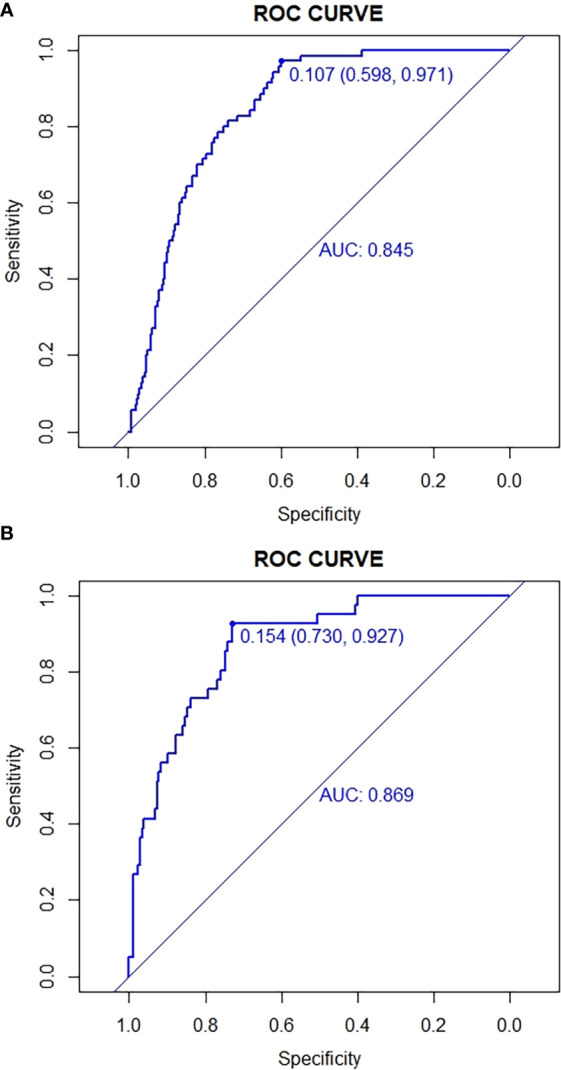
Among 657 expected POR patients, 111 (16.89%) had live births, and 546 (83.11%) did not have live births. These were divided into a training set(n=438) and a validation set (n=219). Multivariate logistic regression analysis showed that the age (OR = 0.91, 95% CI: 0.86-0.97), BMI (OR = 1.98, 95% CI: 1.09-3.67), AMH (OR = 3.48, 95% CI: 1.45-8.51), normal fertilized oocytes (OR = 1.40, 95% CI: 1.21-1.63), and the basal FSH (OR = 0.89, 95% CI: 0.80-0.98) of the female were independent factors predicting live birth in patients with expected POR. Then, an individualized nomogram prediction model was built from these five factors. The area under the ROC curve of the live birth prediction model was 0.820 in the training set and 0.879 in the validation set.
We have developed a nomogram combining clinical and laboratory factors to predict the probability of live birth in patients with an expected POR during IVF/ICSI, which can helpful for clinician in decision-making. However, the data comes from the same center, needs a prospective multicenter study for further in-depth evaluation and validation of this prediction model.
近年来,已有许多预测辅助生殖技术治疗中活产的预测模型,但针对卵巢反应不良(POR)患者活产机会的评估模型较少。本研究旨在基于 POSEIDON 标准建立一个预测模型,以预测预期 POR 患者的活产机会。
这是一项回顾性队列研究,使用了新疆医科大学第一附属医院生殖医学中心 POSEIDON 分组 3 和 4 组(窦卵泡计数 [AFC]≤5 和 AMH<1.2ng/ml)的 657 例患者的临床数据,建立预测模型。
在 657 例预期 POR 患者中,有 111 例(16.89%)活产,546 例(83.11%)未活产。这些患者被分为训练集(n=438)和验证集(n=219)。多因素 logistic 回归分析表明,年龄(OR=0.91,95%CI:0.86-0.97)、BMI(OR=1.98,95%CI:1.09-3.67)、AMH(OR=3.48,95%CI:1.45-8.51)、正常受精卵(OR=1.40,95%CI:1.21-1.63)和基础 FSH(OR=0.89,95%CI:0.80-0.98)是预测预期 POR 患者活产的独立因素。然后,从这五个因素中建立了一个个体化的列线图预测模型。该模型在训练集中的活产预测 ROC 曲线下面积为 0.820,在验证集中为 0.879。
我们建立了一个结合临床和实验室因素的列线图预测模型,以预测 IVF/ICSI 中预期 POR 患者的活产概率,这有助于临床医生做出决策。然而,该数据来自同一中心,需要进一步进行前瞻性多中心研究,以深入评估和验证该预测模型。