Department of Organismic and Evolutionary Biology, Harvard University, Cambridge, United States.
Department of Physics, Harvard University, Cambridge, United States.
Elife. 2023 Feb 21;12:e83442. doi: 10.7554/eLife.83442.
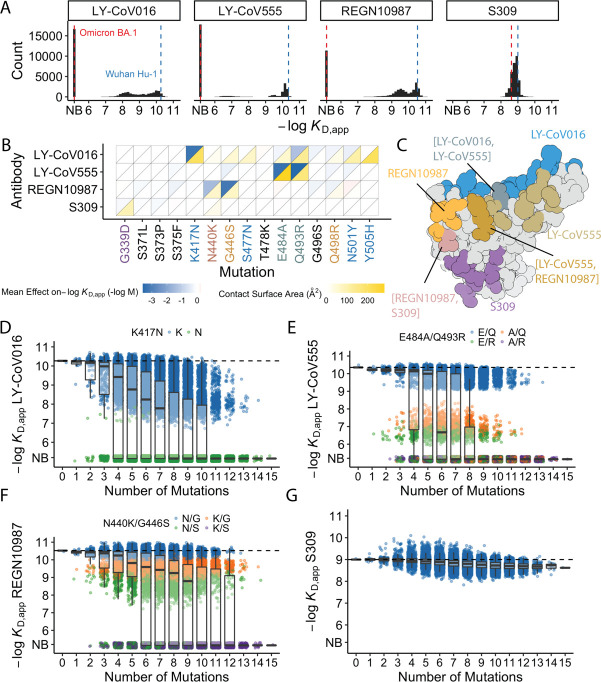
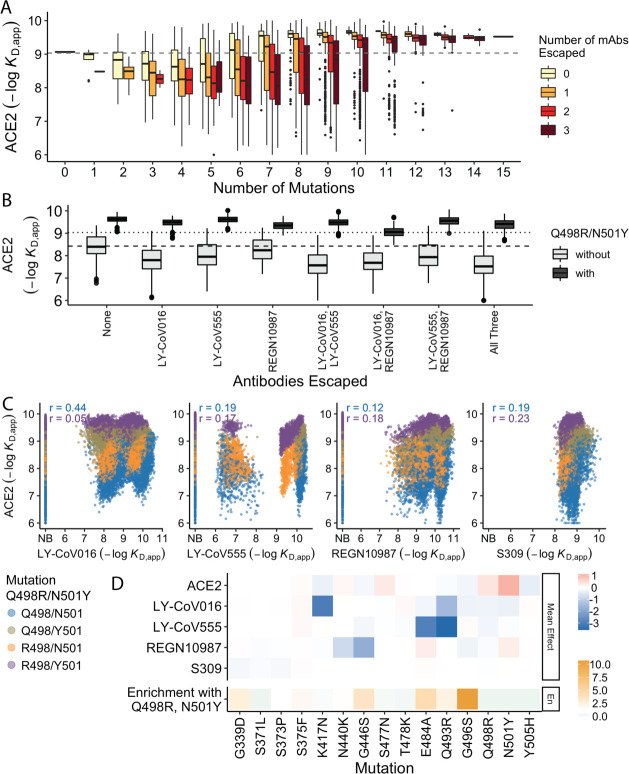
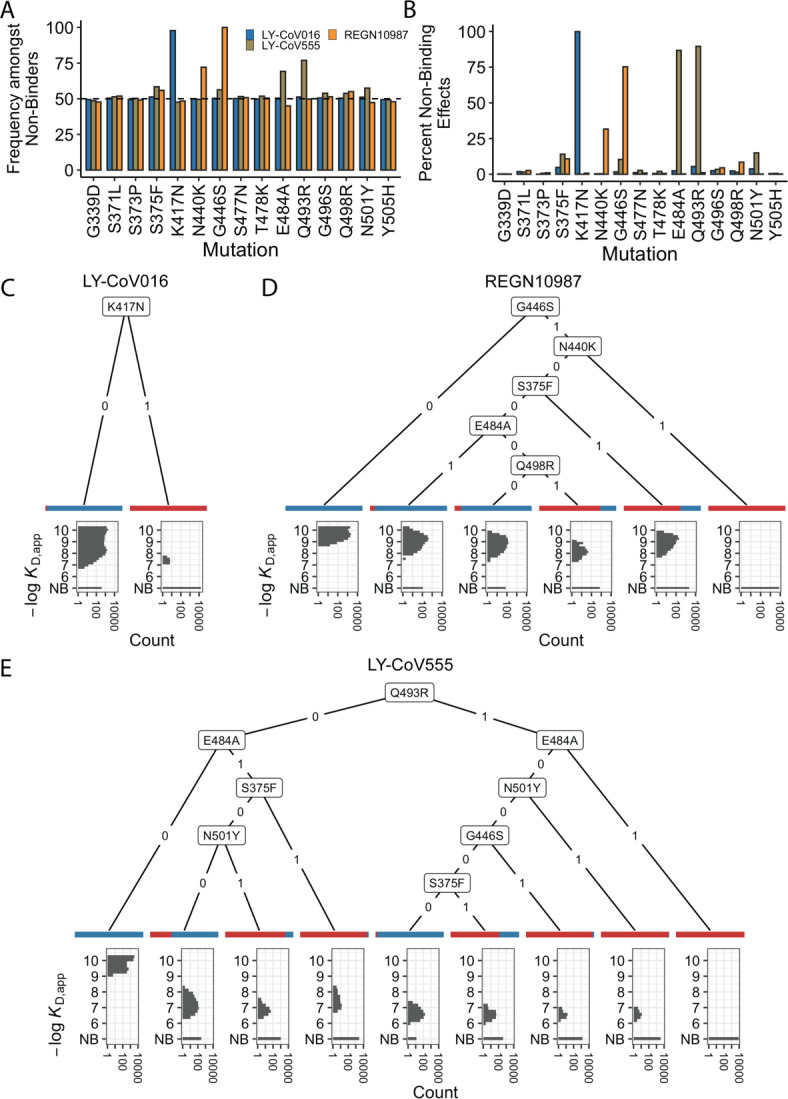
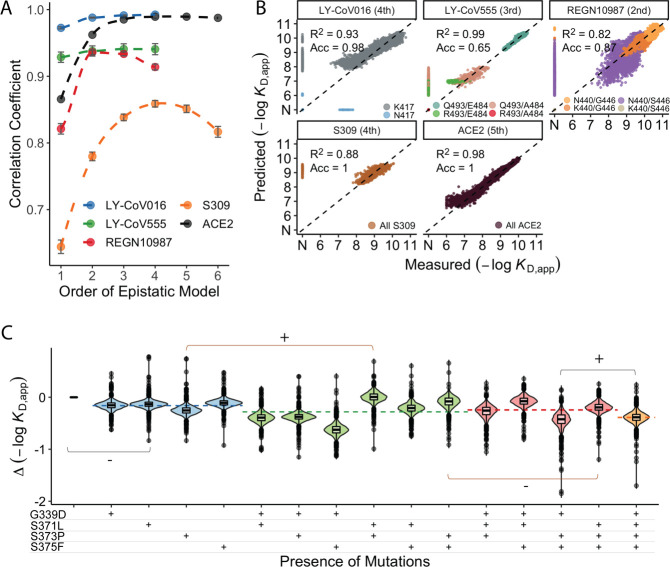
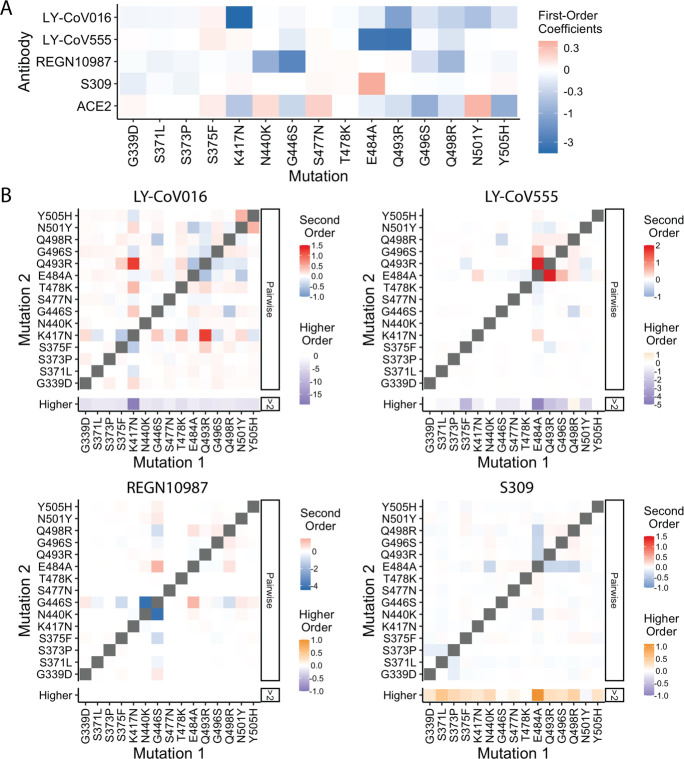
The Omicron BA.1 variant of SARS-CoV-2 escapes convalescent sera and monoclonal antibodies that are effective against earlier strains of the virus. This immune evasion is largely a consequence of mutations in the BA.1 receptor binding domain (RBD), the major antigenic target of SARS-CoV-2. Previous studies have identified several key RBD mutations leading to escape from most antibodies. However, little is known about how these escape mutations interact with each other and with other mutations in the RBD. Here, we systematically map these interactions by measuring the binding affinity of all possible combinations of these 15 RBD mutations (2=32,768 genotypes) to 4 monoclonal antibodies (LY-CoV016, LY-CoV555, REGN10987, and S309) with distinct epitopes. We find that BA.1 can lose affinity to diverse antibodies by acquiring a few large-effect mutations and can reduce affinity to others through several small-effect mutations. However, our results also reveal alternative pathways to antibody escape that does not include every large-effect mutation. Moreover, epistatic interactions are shown to constrain affinity decline in S309 but only modestly shape the affinity landscapes of other antibodies. Together with previous work on the ACE2 affinity landscape, our results suggest that the escape of each antibody is mediated by distinct groups of mutations, whose deleterious effects on ACE2 affinity are compensated by another distinct group of mutations (most notably Q498R and N501Y).
SARS-CoV-2 的奥密克戎 BA.1 变体逃避了对该病毒早期株有效的恢复期血清和单克隆抗体。这种免疫逃避在很大程度上是 BA.1 受体结合域(RBD)突变的结果,RBD 是 SARS-CoV-2 的主要抗原靶标。先前的研究已经确定了几个导致逃避大多数抗体的关键 RBD 突变。然而,对于这些逃逸突变如何相互作用以及与 RBD 中的其他突变相互作用,知之甚少。在这里,我们通过测量所有这些 15 个 RBD 突变(2=32,768 种基因型)与 4 种单克隆抗体(LY-CoV016、LY-CoV555、REGN10987 和 S309)的结合亲和力,系统地绘制了这些相互作用图谱,这些单克隆抗体具有不同的表位。我们发现,BA.1 可以通过获得少数几个大效应突变来丧失与多种抗体的亲和力,也可以通过几个小效应突变来降低与其他抗体的亲和力。然而,我们的结果也揭示了不包括每个大效应突变的抗体逃避的替代途径。此外,上位性相互作用被证明可以限制 S309 的亲和力下降,但对其他抗体的亲和力图谱的影响不大。与 ACE2 亲和力图谱的先前工作一起,我们的结果表明,每种抗体的逃逸都由不同的突变群介导,这些突变对 ACE2 亲和力的有害影响由另一组不同的突变(尤其是 Q498R 和 N501Y)所补偿。