School of Applied Science (FCA), State University of Campinas, Limeira, SP, Brazil.
Applied Physiology & Nutrition Research Group, Rheumatology Division, Faculdade de Medicina FMUSP, University of São Paulo, São Paulo, SP, Brazil.
Adv Nutr. 2023 Jan;14(1):115-127. doi: 10.1016/j.advnut.2022.11.005. Epub 2022 Dec 24.
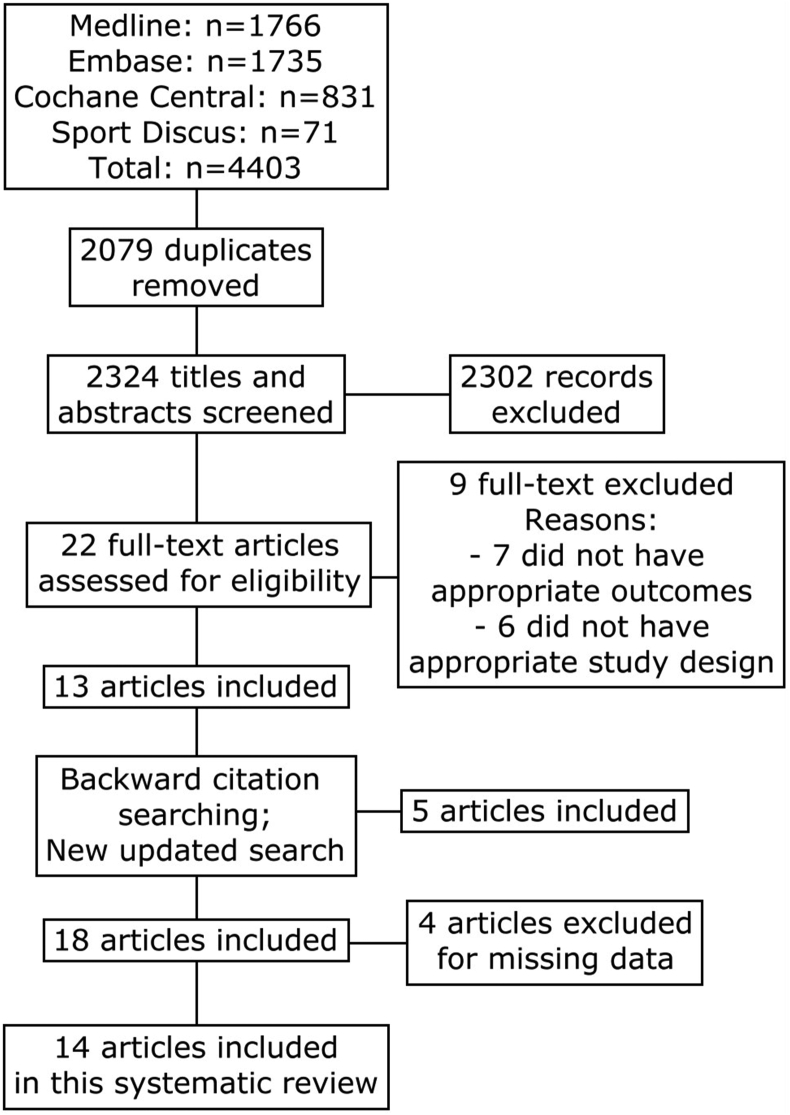
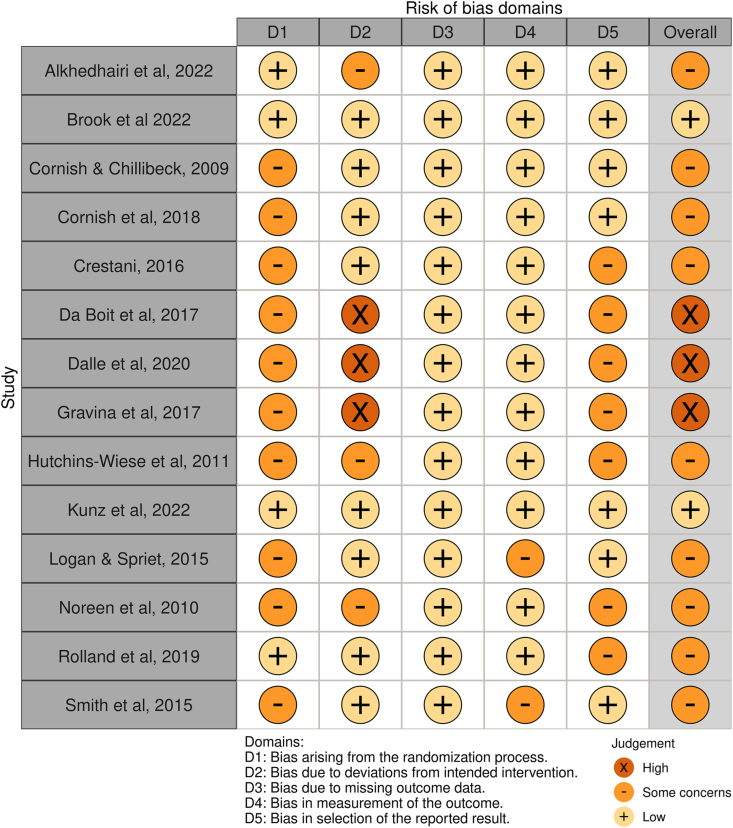
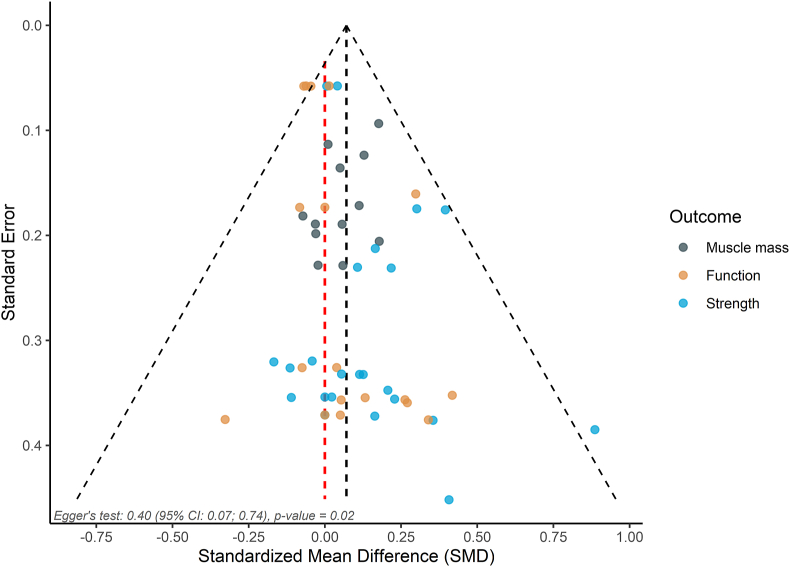
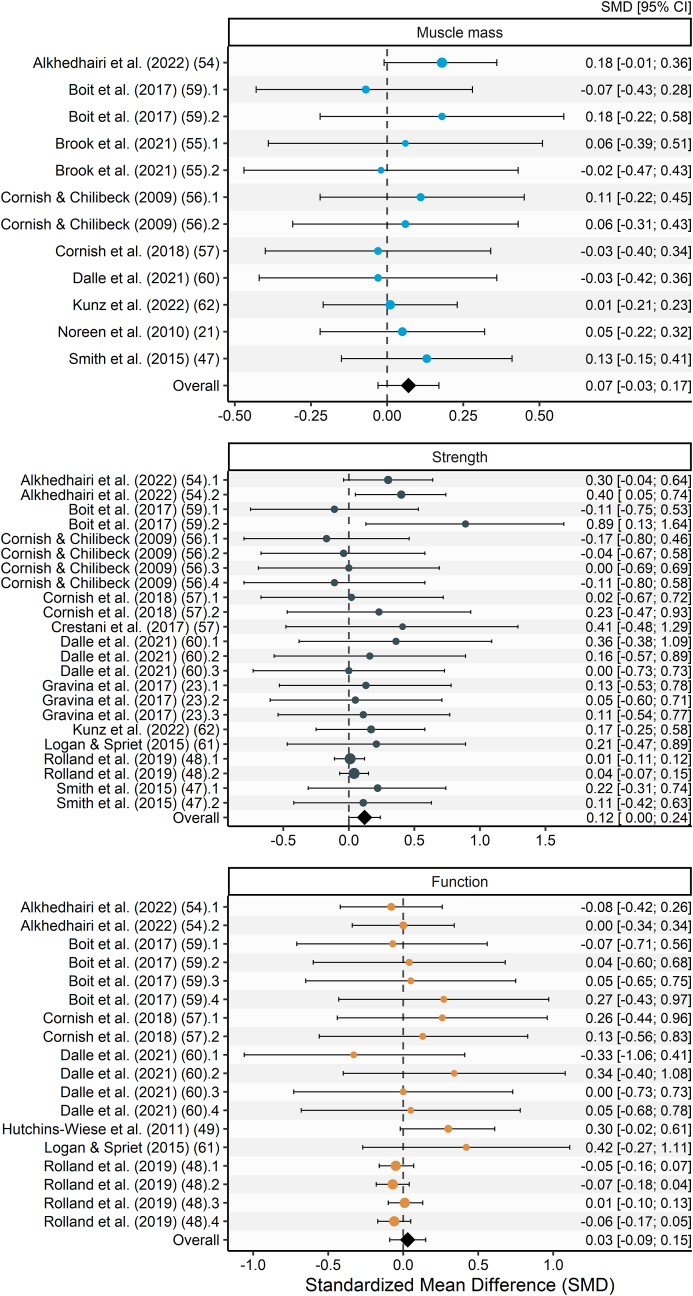
The effects of omega 3 polyunsaturated fatty acids (n-3PUFA) supplementation on skeletal muscle are currently unclear. The purpose of this systematic review was to synthesize all available evidence regarding the influence of n-3PUFA supplementation on muscle mass, strength, and function in healthy young and older adults. Four databases were searched (Medline, Embase, Cochrane CENTRAL, and SportDiscus). Predefined eligibility criteria were determined according to Population, Intervention, Comparator, Outcomes, and Study Design. Only peer-reviewed studies were included. The Cochrane RoB2 Tool and the NutriGrade approach were used to access risk of bias and certainty in evidence. Effect sizes were calculated using pre-post scores and analyzed using a three-level, random-effects meta-analysis. When sufficient studies were available, subanalyses were performed in the muscle mass, strength, and function outcomes according to participant's age (<60 or ≥60 years), supplementation dosage (<2 or ≥2 g/day), and training intervention ("resistance training" vs. "none or other"). Overall, 14 individual studies were included, total 1443 participants (913 females; 520 males) and 52 outcomes measures. Studies had high overall risk of bias and consideration of all NutriGrade elements resulted in a certainty assessment of moderate meta-evidence for all outcomes. n-3PUFA supplementation had no significant effect on muscle mass (standard mean difference [SMD] = 0.07 [95% CI: -0.02, 0.17], P = 0.11) and muscle function (SMD = 0.03 [95% CI: -0.09, 0.15], P = 0.58), but it showed a very small albeit significant positive effect on muscle strength (SMD = 0.12 [95% CI: 0.006, 0.24], P = 0.04) in participants when compared with placebo. Subgroup analyses showed that age, supplementation dose, or cosupplementation alongside resistance training did not influence these responses. In conclusion, our analyses indicated that n-3PUFA supplementation may lead to very small increases in muscle strength but did not impact muscle mass and function in healthy young and older adults. To our knowledge, this is the first review and meta-analysis investigating whether n-3PUFA supplementation can lead to increases in muscle strength, mass, and function in healthy adults. Registered protocol: doi.org/10.17605/OSF.IO/2FWQT.
ω-3 多不饱和脂肪酸(n-3PUFA)补充对骨骼肌的影响目前尚不清楚。本系统评价的目的是综合所有关于 n-3PUFA 补充对健康年轻和老年成年人肌肉质量、力量和功能影响的现有证据。四个数据库(Medline、Embase、Cochrane CENTRAL 和 SportDiscus)进行了搜索。根据人群、干预措施、比较、结局和研究设计,确定了预先确定的入选标准。仅纳入同行评审的研究。使用 Cochrane RoB2 工具和 NutriGrade 方法评估偏倚风险和证据的确定性。使用前后评分计算效应大小,并使用三级随机效应荟萃分析进行分析。当有足够的研究时,根据参与者的年龄(<60 岁或≥60 岁)、补充剂量(<2 克/天或≥2 克/天)和训练干预(“抗阻训练”与“无或其他”)对肌肉质量、力量和功能结局进行亚组分析。总共纳入 14 项个体研究,共 1443 名参与者(913 名女性;520 名男性)和 52 项结局指标。研究的总体偏倚风险较高,考虑所有 NutriGrade 因素后,所有结局的综合证据确定性评估为中等。n-3PUFA 补充对肌肉质量(标准均数差 [SMD] = 0.07 [95% CI:-0.02,0.17],P = 0.11)和肌肉功能(SMD = 0.03 [95% CI:-0.09,0.15],P = 0.58)没有显著影响,但与安慰剂相比,它对肌肉力量有非常小但显著的积极影响(SMD = 0.12 [95% CI:0.006,0.24],P = 0.04)。亚组分析表明,年龄、补充剂量或与抗阻训练一起补充并不能影响这些反应。总之,我们的分析表明,n-3PUFA 补充可能导致肌肉力量的非常小的增加,但对健康年轻和老年成年人的肌肉质量和功能没有影响。据我们所知,这是第一项关于 n-3PUFA 补充是否能增加健康成年人肌肉力量、质量和功能的综述和荟萃分析。注册方案:doi.org/10.17605/OSF.IO/2FWQT。