Atri Afrah, Echabaane Mosaab, Bouzidi Amel, Harabi Imen, Soucase Bernabe Mari, Ben Chaâbane Rafik
Laboratory of Advanced Materials and Interfaces (LIMA), Faculty of Sciences of Monastir, University of Monastir, Avenue of the Environment, 5000 Monastir, Tunisia.
NANOMISENE Lab, LR16CRMN01, Centre for Research on Microelectronics and Nanotechnology CRMN of Technopark of Sousse, B.P. 334, Sahloul, 4034 Sousse, Tunisia.
Heliyon. 2023 Feb 4;9(2):e13484. doi: 10.1016/j.heliyon.2023.e13484. eCollection 2023 Feb.
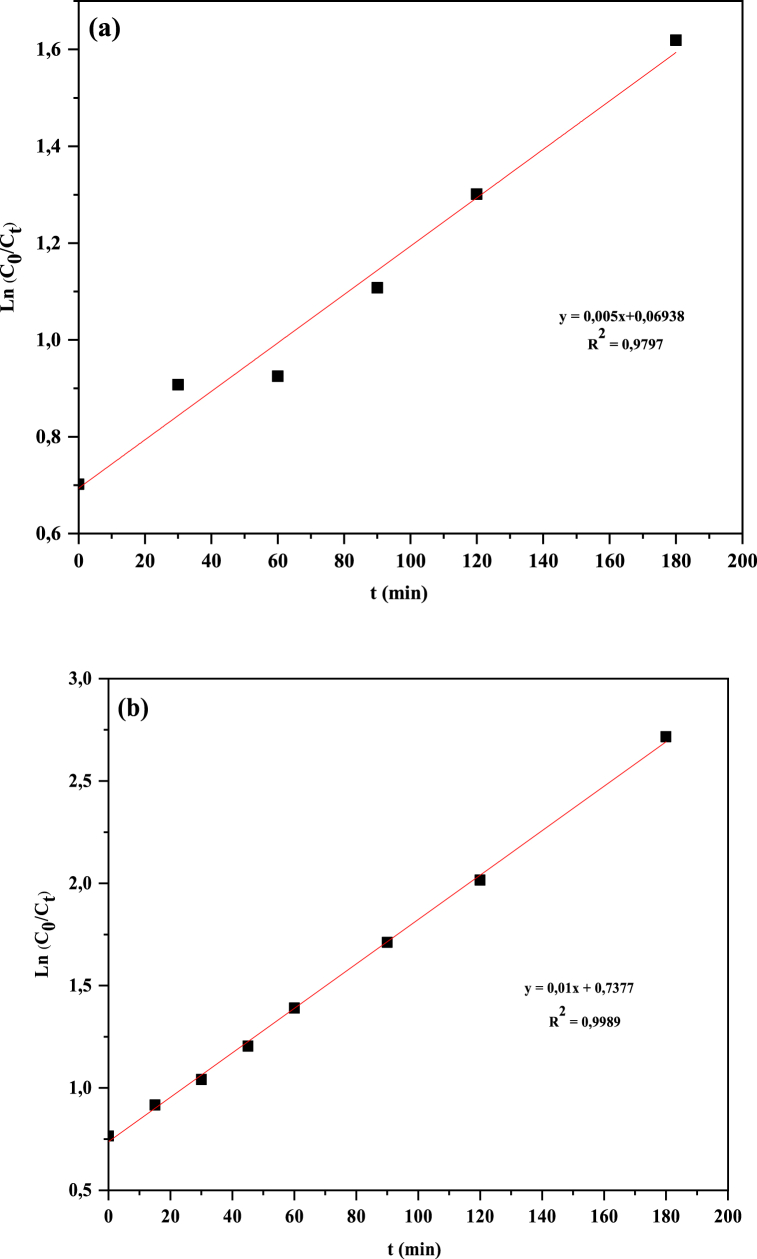
In the present work, copper oxide (CuO NPs) was synthesized by an eco-friendly, simple, low-cost, and economical synthesis method using aqueous plant extract as a reducing and capping agent. The biosynthesized CuO-NPs were compared with chemically obtained CuO-NPs to investigate the effect of the preparation method on the structural, optical, morphological, antibacterial, antifungal, and photocatalytic properties under solar irradiation. The CuO NPs were characterized using X-ray diffraction (XRD), UV-VIS spectroscopy, Fourier transform infrared spectrometer (FTIR) analysis, and field emission scanning electron microscopy with energy dispersive X-ray spectroscopy (FESEM-EDX). The photocatalytic activities of biosynthetic CuO-NPs and chemically prepared CuO-NPs were studied using methylene blue upon exposure to solar irradiation. The results showed that the biosynthesized CuO photocatalyst was more efficient than the chemically synthesized CuO-NPs for Methylene Blue (MB) degradation under solar irradiation, with MB degradation rates of 93.4% and 80.2%, respectively. In addition, antibacterial and antifungal activities were evaluated. The disk diffusion technique was used to test the biosynthesized CuO-NPs against gram-negative bacteria, and , as well as and . The biosynthesized CuO-NPs showed efficient antibacterial and antifungal activity. The obtained results revealed that the biosynthesized CuO-NPs can play a vital role in the destruction of pathogenic bacteria, the degradation of dyes, and the activity of antifungal agents in the bioremediation of industrial and domestic waste.
在本工作中,采用环保、简单、低成本且经济的合成方法,以植物水提取物作为还原剂和封端剂,合成了氧化铜(CuO NPs)。将生物合成的CuO-NPs与化学合成的CuO-NPs进行比较,以研究制备方法对其在太阳辐射下的结构、光学、形态、抗菌、抗真菌和光催化性能的影响。使用X射线衍射(XRD)、紫外-可见光谱、傅里叶变换红外光谱仪(FTIR)分析以及带能谱的场发射扫描电子显微镜(FESEM-EDX)对CuO NPs进行表征。在太阳辐射下,以亚甲基蓝为对象,研究了生物合成的CuO-NPs和化学合成的CuO-NPs的光催化活性。结果表明,在太阳辐射下,生物合成的CuO光催化剂对亚甲基蓝(MB)降解的效率高于化学合成的CuO-NPs,MB降解率分别为93.4%和80.2%。此外,还评估了其抗菌和抗真菌活性。采用纸片扩散法测试生物合成的CuO-NPs对革兰氏阴性菌以及的抗菌性能。生物合成的CuO-NPs表现出高效的抗菌和抗真菌活性。所得结果表明,生物合成的CuO-NPs在工业和生活废弃物生物修复中对病原菌的破坏、染料的降解以及抗真菌剂的活性方面可发挥重要作用。