Department of Chemistry, Wolaita Sodo University, Wolaita Sodo, P.O.BoX. 138, Soddo, Ethiopia.
Department of Biology, Wolaita Sodo University, Wolaita Sodo, P.O.BoX. 138, Soddo, Ethiopia.
Sci Rep. 2024 Oct 12;14(1):23870. doi: 10.1038/s41598-024-75296-2.
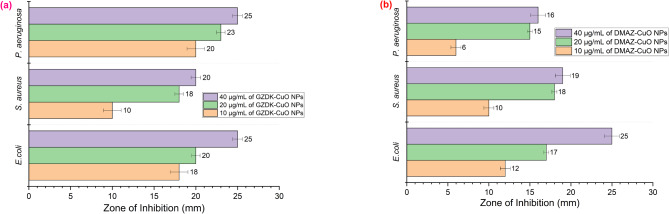
Nanotechnology is becoming a promise for scientific advancement nowadays in areas like medicine, consumer products, energy, materials, and manufacturing. Copper oxide nanoparticles (CuO NPs) were synthesized using Ocimum lamiifolium Hochst. ex Benth and Withana somnifera (L) Dunal leaf extract via green synthetic pathway. The leaf of O. lamiifolium and W. somnifera were known to have strong antibiotic and antioxidant properties arising due to the presence of various secondary metabolites, including, flavonoids, alkaloids, saponins, tannins, cardiac glycosides, and phenolic compounds which serve as reducing, stabilizing, and capping agents for the CuO-Nanoparticles (NPs) synthesized. The biosynthesized CuO NPs were characterized based on Fourier transform infrared spectroscopy, X-ray diffraction spectroscopy, and scanning electron microscopy. O. lamiifolium and W. somnifera leaf extract mediated synthesis could produce CuO NPs with average crystallite size of 15 nm and 19 nm, respectively. The biosynthesized CuO-NPs were further examined for antibacterial activity with Gram-positive (S. aureus) and Gram-negative bacteria (E. coli and P. aeruginosa). The GZDK-CuO NPs synthesized using W. somnifera leaf extract inhibited the growth of E. coli. and P. aeruginosa largely in comparison to S. aureus. Whereas the DMAZ-CuO NPs synthesized with the help of O. lamiifolium leaf extract showed higher bacterial inhibition on E. coli compared to S. aureus and P. aeruginosa. The minimum inhibitory concentration (MIC) values of both types of NPs are also assessed on all three pathogens. The newly biosynthesized nanoparticles, thus, were found to be optional materials for inhibiting the growth of drug- resistant bacterial pathogens.
纳米技术在医学、消费品、能源、材料和制造业等领域正成为科学进步的一个承诺。氧化铜纳米粒子 (CuO NPs) 是通过使用罗勒 (Ocimum lamiifolium Hochst. ex Benth) 和睡茄 (Withana somnifera (L) Dunal) 叶提取物的绿色合成途径合成的。罗勒和睡茄的叶子具有很强的抗生素和抗氧化特性,这是由于存在各种次生代谢物,包括黄酮类、生物碱、皂苷、单宁、强心苷和酚类化合物,这些物质作为还原剂、稳定剂和封端剂,用于合成氧化铜纳米粒子 (NPs)。所合成的 CuO NPs 基于傅里叶变换红外光谱、X 射线衍射光谱和扫描电子显微镜进行了表征。罗勒和睡茄叶提取物介导的合成可以分别产生平均晶粒尺寸为 15nm 和 19nm 的 CuO NPs。进一步研究了生物合成的 CuO-NPs 的抗菌活性,包括革兰氏阳性菌 (金黄色葡萄球菌) 和革兰氏阴性菌 (大肠杆菌和铜绿假单胞菌)。用睡茄叶提取物合成的 GZDK-CuO NPs 对大肠杆菌和铜绿假单胞菌的生长抑制作用明显大于金黄色葡萄球菌。而用罗勒叶提取物合成的 DMAZ-CuO NPs 对大肠杆菌的抑制作用明显高于金黄色葡萄球菌和铜绿假单胞菌。还评估了两种类型的 NPs 在所有三种病原体上的最小抑菌浓度 (MIC) 值。因此,新合成的纳米粒子被发现是抑制耐药性细菌病原体生长的可选材料。