Pang Shuo, Miao Guangrui, Zhou Yuanhang, Duan Mingxuan, Bai Linpeng, Zhao Xiaoyan
Department of Cardiology, The First Affiliated Hospital of Zhengzhou University, Zhengzhou, China.
Front Nutr. 2023 Feb 2;10:1075817. doi: 10.3389/fnut.2023.1075817. eCollection 2023.
We aimed to investigate the association between coffee consumption and frailty in older American adults. We focused on individuals at higher frailty risk, such as women, ethnic minorities, smokers, and those with obesity and insufficient physical activity.
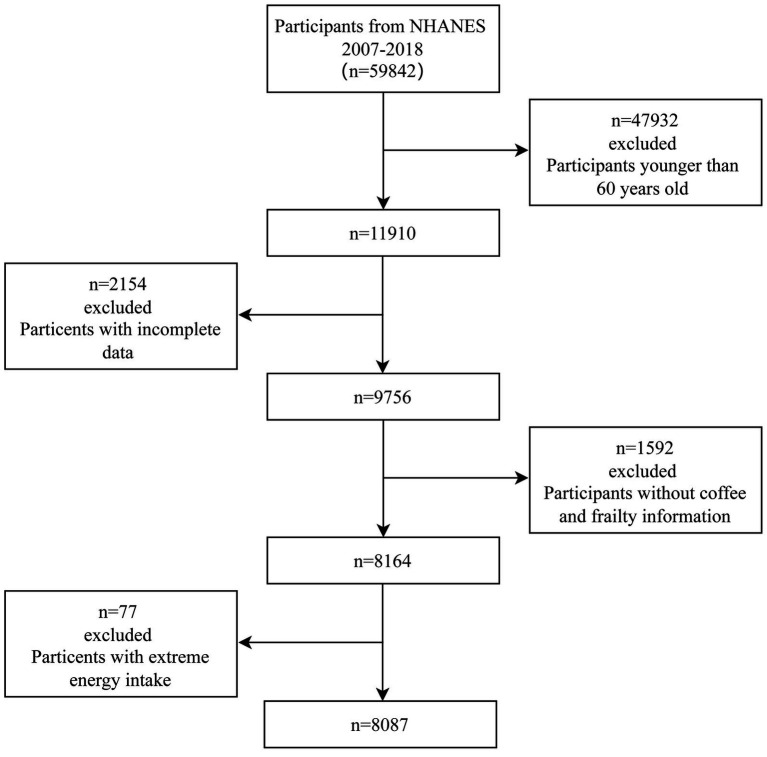
The data of 8,087 individuals aged over 60 years from the 2007-2018 National Health and Nutrition Examination Surveys were used for this cross-sectional study. The coffee drinks were classified into two categories: caffeinated and decaffeinated. Frailty was measured using the 53-item frailty index. Weighted binary logistic regression was used to evaluate the association between coffee intake and frailty risk. Restricted cubic spline models were used to assess the dose-response relationship between caffeinated coffee intake and frailty.
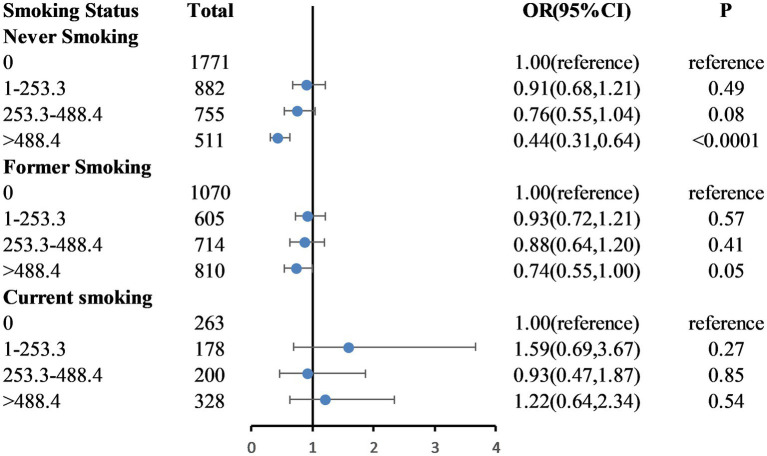
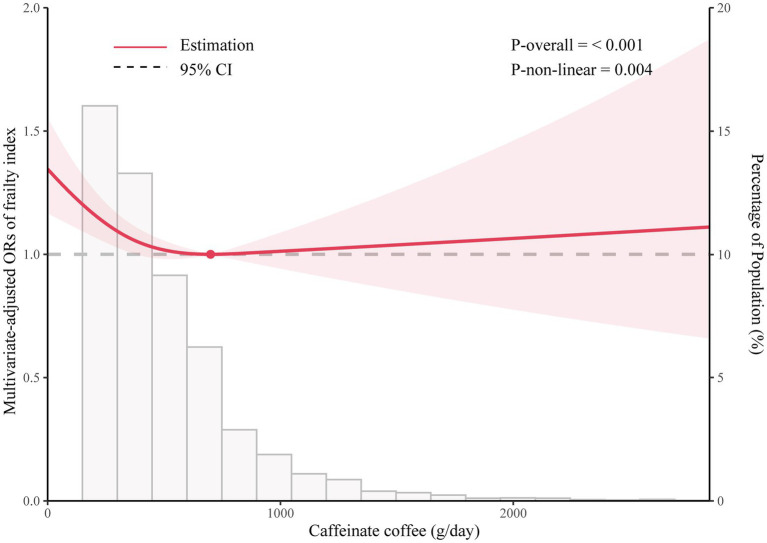
Among the 8,087 participants, 2,458 (30.4%) had frailty. Compared with those who reported no coffee consumption, the odds ratios [ORs; 95% confidence intervals (CIs)] of total coffee consumption > 498.9 (g/day) were 0.65 (0.52, 0.79) in the fully adjusted model. Compared with those who reported no caffeinated coffee consumption, the ORs (95% CIs) of total coffee consumption > 488.4 (g/day) were 0.68 (0.54, 0.85) in the fully adjusted model. Compared with those who reported no decaffeinated coffee consumption, the ORs (95% CIs) of total coffee consumption > 0 (g/day) were 0.87 (0.71, 1.06) in the fully adjusted model. Nonlinear associations were detected between total coffee and caffeinated coffee consumption and frailty. In the subgroup analyses by smoking status, the association between coffee consumption and the risk of frailty was more pronounced in non-smokers (P for interaction = 0.031).
Caffeinated coffee consumption was independently and nonlinearly associated with frailty, especially in non-smokers. However, decaffeinated coffee consumption was not associated with frailty.
我们旨在研究美国老年成年人咖啡摄入量与衰弱之间的关联。我们重点关注衰弱风险较高的个体,如女性、少数族裔、吸烟者以及肥胖和体力活动不足的人群。
本横断面研究使用了2007 - 2018年国家健康与营养检查调查中8087名60岁以上个体的数据。咖啡饮品分为两类:含咖啡因的和脱咖啡因的。使用包含53个项目的衰弱指数来衡量衰弱情况。采用加权二元逻辑回归来评估咖啡摄入量与衰弱风险之间的关联。使用受限立方样条模型来评估含咖啡因咖啡摄入量与衰弱之间的剂量反应关系。
在8087名参与者中,2458人(30.4%)存在衰弱。在完全调整模型中,与报告不喝咖啡的人相比,总咖啡摄入量>498.9(克/天)的优势比[ORs;95%置信区间(CIs)]为0.65(0.52,0.79)。与报告不喝含咖啡因咖啡的人相比,总咖啡摄入量>488.4(克/天)的ORs(95% CIs)在完全调整模型中为0.68(0.54,0.85)。与报告不喝脱咖啡因咖啡的人相比,总咖啡摄入量>0(克/天)的ORs(95% CIs)在完全调整模型中为0.87(0.71,1.06)。在总咖啡和含咖啡因咖啡摄入量与衰弱之间检测到非线性关联。在按吸烟状况进行的亚组分析中,咖啡摄入量与衰弱风险之间的关联在非吸烟者中更为明显(交互作用P = 0.031)。
饮用含咖啡因咖啡与衰弱呈独立且非线性关联,尤其是在非吸烟者中。然而,饮用脱咖啡因咖啡与衰弱无关。