Muthavarapu Neha, Mohan Anmol, Manga Sharanya, Sharma Palak, Bhanushali Aditi Kishor, Yadav Ashima, Damani Devanshi Narendra, Jais Pierre, Walton Richard D, Arunachalam Shivaram P, Kulkarni Kanchan
Department of Cardiovascular Diseases, Mayo Clinic, 200 First Street SW, Rochester, MN 55902, USA.
Department of Medicine, Karachi Medical & Dental College, W3V6+27P, Block M North Nazimabad Town, Karachi 74700, Pakistan.
J Cardiovasc Dev Dis. 2023 Jan 20;10(2):36. doi: 10.3390/jcdd10020036.
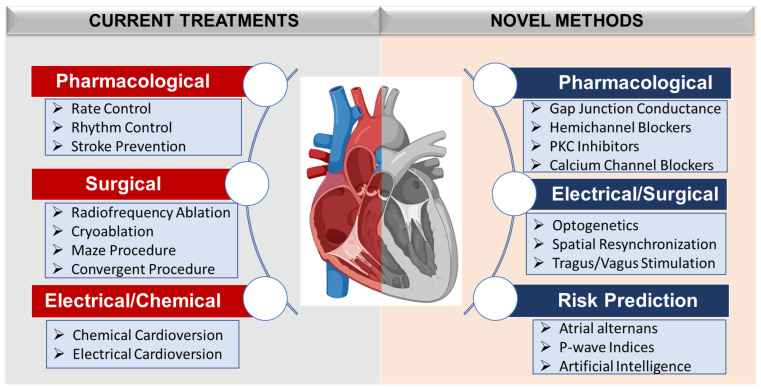
Atrial fibrillation (AF) is the most persistent arrhythmia today, with its prevalence increasing exponentially with the rising age of the population. Particularly at elevated heart rates, a functional abnormality known as cardiac alternans can occur prior to the onset of lethal arrhythmias. Cardiac alternans are a beat-to-beat oscillation of electrical activity and the force of cardiac muscle contraction. Extensive evidence has demonstrated that microvolt T-wave alternans can predict ventricular fibrillation vulnerability and the risk of sudden cardiac death. The majority of our knowledge of the mechanisms of alternans stems from studies of ventricular electrophysiology, although recent studies offer promising evidence of the potential of atrial alternans in predicting the risk of AF. Exciting preclinical and clinical studies have demonstrated a link between atrial alternans and the onset of atrial tachyarrhythmias. Here, we provide a comprehensive review of the clinical utility of atrial alternans in identifying the risk and guiding treatment of AF.
心房颤动(AF)是目前最常见的持续性心律失常,其患病率随着人口年龄的增长呈指数级上升。特别是在心率升高时,在致命性心律失常发作之前可能会出现一种称为心脏交替脉的功能异常。心脏交替脉是电活动和心肌收缩力的逐搏振荡。大量证据表明,微伏级T波交替脉可预测室颤易感性和心源性猝死风险。尽管最近的研究为心房交替脉在预测房颤风险方面的潜力提供了有前景的证据,但我们对交替脉机制的大多数认识源于心室电生理学研究。令人兴奋的临床前和临床研究已经证明了心房交替脉与房性快速性心律失常发作之间的联系。在此,我们全面综述心房交替脉在识别房颤风险和指导房颤治疗方面的临床应用。