Biology Department, Brigham Young University, Provo, Utah, USA.
Biology Department, Brigham Young University, Provo, Utah, USA.
Mol Cell Proteomics. 2023 Apr;22(4):100518. doi: 10.1016/j.mcpro.2023.100518. Epub 2023 Feb 23.
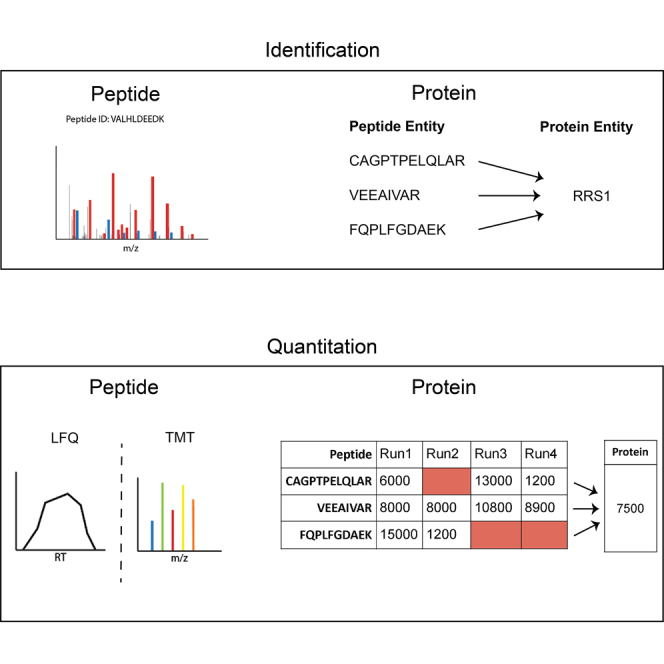
Single-cell proteomics is growing rapidly and has made several technological advancements. As most research has been focused on improving instrumentation and sample preparation methods, very little attention has been given to algorithms responsible for identifying and quantifying proteins. Given the inherent difference between bulk data and single-cell data, it is necessary to realize that current algorithms being employed on single-cell data were designed for bulk data and have underlying assumptions that may not hold true for single-cell data. In order to develop and optimize algorithms for single-cell data, we need to characterize the differences between single-cell data and bulk data and assess how current algorithms perform on single-cell data. Here, we present a review of algorithms responsible for identifying and quantifying peptides and proteins. We will give a review of how each type of algorithm works, assumptions it relies on, how it performs on single-cell data, and possible optimizations and solutions that could be used to address the differences in single-cell data.
单细胞蛋白质组学发展迅速,取得了多项技术进步。由于大多数研究都集中在改进仪器和样品制备方法上,因此很少关注负责识别和定量蛋白质的算法。鉴于批量数据和单细胞数据之间存在固有差异,有必要认识到,目前用于单细胞数据的算法是为批量数据设计的,并且具有一些假设,这些假设可能不适用于单细胞数据。为了开发和优化单细胞数据的算法,我们需要描述单细胞数据和批量数据之间的差异,并评估当前算法在单细胞数据上的表现。在这里,我们回顾了负责识别和定量肽和蛋白质的算法。我们将回顾每种类型的算法的工作原理、所依赖的假设、在单细胞数据上的表现,以及可能用于解决单细胞数据差异的优化和解决方案。