Marinas Ioana Cristina, Oprea Eliza, Gaboreanu Diana Madalina, Gradisteanu Pircalabioru Gratiela, Buleandra Mihaela, Nagoda Eugenia, Badea Irinel Adriana, Chifiriuc Mariana Carmen
Research Institute of the University of Bucharest-ICUB, 91-95 Spl. Independentei, 050095 Bucharest, Romania.
Research and Development Department of S.C. Sanimed International Impex SRL, Șos. București-Giurgiu (DN5), No. 6, 087040 Călugăreni, Romania.
Antibiotics (Basel). 2023 Feb 10;12(2):371. doi: 10.3390/antibiotics12020371.
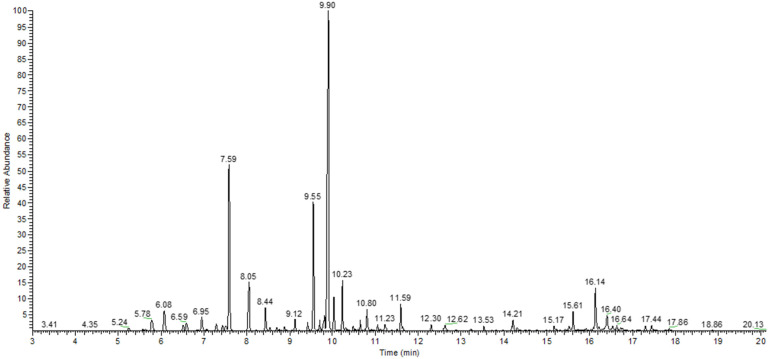
The essential oil of was isolated by hydrodistillation and characterized by GC-MS. The antioxidant and antimicrobial activity of essential oil was evaluated, as well as its biocompatibility (LDH and MTT methods). DPPH, FRAP, and CUPRAC methods were applied for antioxidant activity evaluation, while qualitative and quantitative assays (inhibition zone diameter, minimum inhibitory concentration, and minimum fungicidal concentration), NO release (by nitrite concentration determination), and microbial adhesion capacity to the inert substrate (the biofilm microtiter method) were used to investigate the antimicrobial potential. A total of 52 compounds were identified by GC-MS in essential oil, representing 97.43% of the total area. The major constituents were borneol (32.97%), 1,8-cineole (14.94%), camphor (10.13%), artemisia ketone (4.70%), α-terpineol (3.23%), and -eudesmol (3.23%). With MICs ranging from 0.78 to 30 μg/mL, the essential oil proved to inhibit the microbial adhesion and induce the NO release. To the best of our knowledge, the present study reports for the first time the antimicrobial activity of EO against clinically and biotechnologically important microbial strains, such as , , , , , , , , and , demonstrating its antimicrobial applications beyond the clinical field.
通过水蒸馏法分离出[植物名称]的精油,并采用气相色谱 - 质谱联用(GC - MS)对其进行表征。评估了[植物名称]精油的抗氧化和抗菌活性,以及其生物相容性(乳酸脱氢酶和MTT法)。采用二苯基苦味酰基自由基(DPPH)、铁离子还原抗氧化能力(FRAP)和铜离子还原抗氧化能力(CUPRAC)方法评估抗氧化活性,同时利用定性和定量测定法(抑菌圈直径、最低抑菌浓度和最低杀菌浓度)、一氧化氮释放(通过亚硝酸盐浓度测定)以及微生物对惰性底物的黏附能力(生物膜微量滴定法)来研究抗菌潜力。通过GC - MS在[植物名称]精油中总共鉴定出52种化合物,占总面积的97.43%。主要成分是冰片(32.97%)、1,8 - 桉叶素(14.94%)、樟脑(10.13%)、艾蒿酮(4.70%)、α - 松油醇(3.23%)和β - 桉叶醇(3.23%)。[植物名称]精油的最低抑菌浓度范围为0.78至30μg/mL,证明其能抑制微生物黏附并诱导一氧化氮释放。据我们所知,本研究首次报道了[植物名称]精油对临床和生物技术领域重要微生物菌株(如[列举的微生物名称])的抗菌活性,证明了其在临床领域之外的抗菌应用。