Foti Giovanni, Longo Chiara, Sorgato Claudia, Oliboni Eugenio Simone, Mazzi Cristina, Motta Leonardo, Bertoli Giulia, Marocco Stefania
Department of Radiology, IRCCS Sacro Cuore Don Calabria Hospital, Negrar di Valpolicella, 37042 Verona, Italy.
Department of Diabetology, IRCCS Sacro Cuore Don Calabria Hospital, Negrar di Valpolicella, 37042 Verona, Italy.
Diagnostics (Basel). 2023 Feb 13;13(4):703. doi: 10.3390/diagnostics13040703.
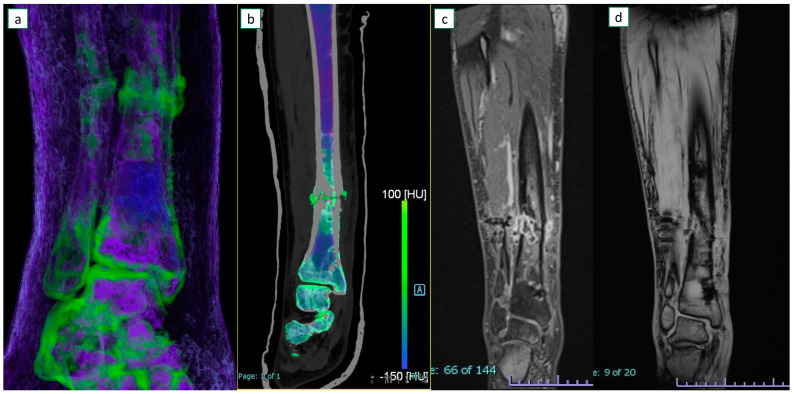
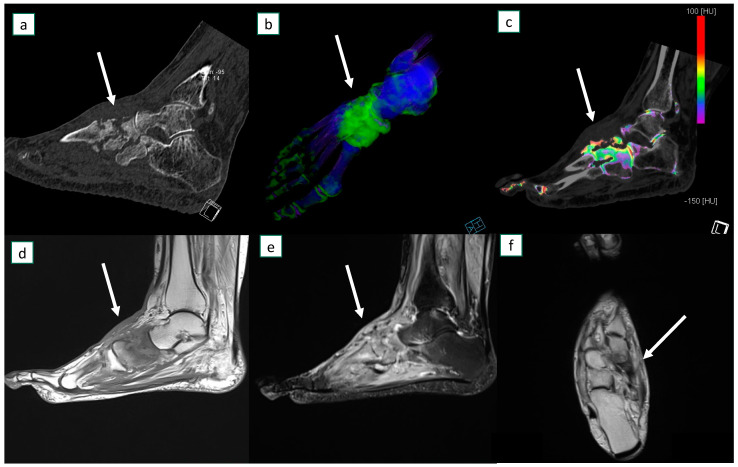
MRI is the preferred imaging technique for the identification of osteomyelitis. The key element for diagnosis is the presence of bone marrow edema (BME). Dual-energy CT (DECT) is an alternative tool which is able to identify BME in the lower limb.
To compare the diagnostic performance of DECT and MRI for osteomyelitis, using clinical, microbiological, and imaging data as reference standards.
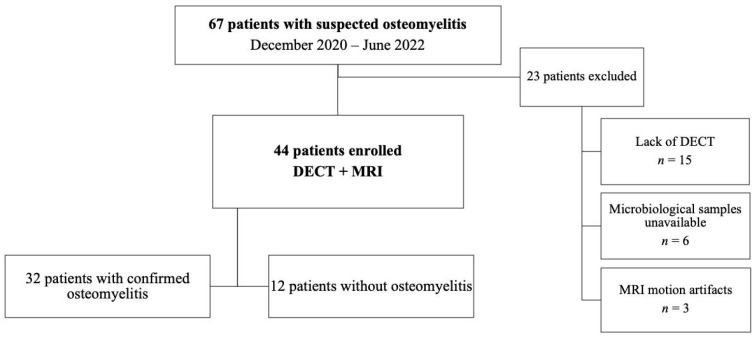
This prospective single-center study enrolled consecutive patients with suspected bone infections undergoing DECT and MRI imaging from December 2020 to June 2022. Four blinded radiologists with various experience levels (range of 3-21 years) evaluated the imaging findings. Osteomyelitis was diagnosed in the presence of BMEs, abscesses, sinus tracts, bone reabsorption, or gaseous elements. The sensitivity, specificity, and AUC values of each method were determined and compared using a multi-reader multi-case analysis. A value < 0.05 was considered significant.
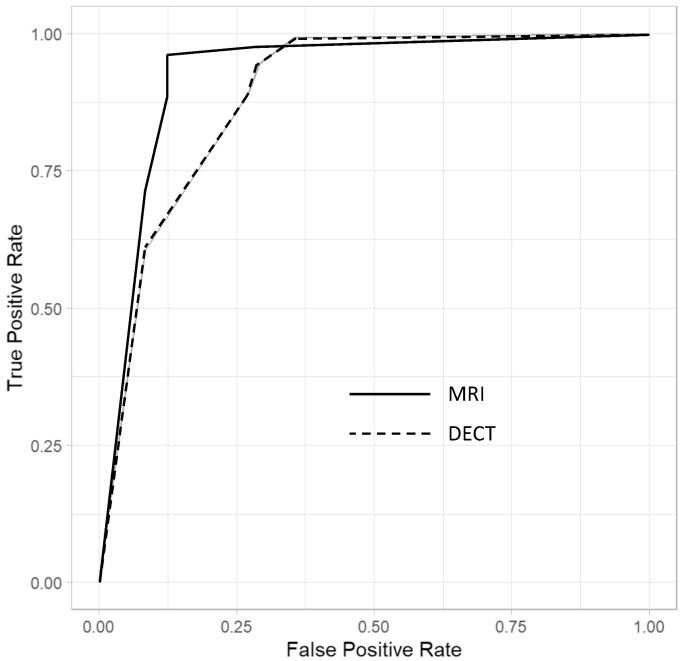
In total, 44 study participants (mean age 62.5 years ± 16.5 [SD], 32 men) were evaluated. Osteomyelitis was diagnosed in 32 participants. For the MRI, the mean sensitivity and specificity were 89.1% and 87.5%, while for the DECT they were 89.0% and 72.9%, respectively. The DECT demonstrated a good diagnostic performance (AUC = 0.88), compared with the MRI (AUC = 0.92) ( = 0.12). When considering each imaging finding alone, the best accuracy was achieved by considering BME (AUC for DECT 0.85 versus AUC of MRI of 0.93, with = 0.07), followed by the presence of bone erosions (AUC 0.77 for DECT and 0.53 for MRI, with = 0.02). The inter-reader agreement of the DECT (k = 88) was similar to that of the MRI (k = 90).
Dual-energy CT demonstrated a good diagnostic performance in detecting osteomyelitis.
磁共振成像(MRI)是用于识别骨髓炎的首选成像技术。诊断的关键要素是骨髓水肿(BME)的存在。双能CT(DECT)是一种能够识别下肢BME的替代工具。
以临床、微生物学和影像学数据作为参考标准,比较DECT和MRI对骨髓炎的诊断性能。
这项前瞻性单中心研究纳入了2020年12月至2022年6月期间连续接受DECT和MRI检查的疑似骨感染患者。四位经验水平各异(3 - 21年)的放射科医生对影像学结果进行了盲法评估。当存在BME、脓肿、窦道、骨质吸收或气体成分时诊断为骨髓炎。使用多阅片者多病例分析确定并比较每种方法的敏感性、特异性和AUC值。P值<0.05被认为具有统计学意义。
总共评估了44名研究参与者(平均年龄62.5岁±16.5[标准差],32名男性)。32名参与者被诊断为骨髓炎。对于MRI,平均敏感性和特异性分别为89.1%和87.5%,而对于DECT,分别为89.0%和72.9%。与MRI(AUC = 0.92)相比,DECT显示出良好的诊断性能(AUC = 0.88)(P = 0.12)。单独考虑每个影像学表现时,通过考虑BME获得了最佳准确性(DECT的AUC为0.85,MRI的AUC为0.93,P = 0.07),其次是骨质侵蚀的存在(DECT的AUC为0.77,MRI的AUC为0.53,P = 0.02)。DECT的阅片者间一致性(k = 88)与MRI的相似(k = 90)。
双能CT在检测骨髓炎方面显示出良好的诊断性能。