• 文献检索
  • 文档翻译
  • 深度研究
  • 学术资讯
  • Suppr Zotero 插件Zotero 插件
  • 邀请有礼
  • 套餐&价格
  • 历史记录
应用&插件
Suppr Zotero 插件Zotero 插件浏览器插件Mac 客户端Windows 客户端微信小程序
定价
高级版会员购买积分包购买API积分包
服务
文献检索文档翻译深度研究API 文档MCP 服务
关于我们
关于 Suppr公司介绍联系我们用户协议隐私条款
关注我们

Suppr 超能文献

核心技术专利:CN118964589B侵权必究
粤ICP备2023148730 号-1Suppr @ 2026

文献检索

告别复杂PubMed语法,用中文像聊天一样搜索,搜遍4000万医学文献。AI智能推荐,让科研检索更轻松。

立即免费搜索

文件翻译

保留排版,准确专业,支持PDF/Word/PPT等文件格式,支持 12+语言互译。

免费翻译文档

深度研究

AI帮你快速写综述,25分钟生成高质量综述,智能提取关键信息,辅助科研写作。

立即免费体验

深度学习为高级别浆液性卵巢癌复发预测提供了一种基于磁共振成像的新型预后生物标志物。

Deep Learning Provides a New Magnetic Resonance Imaging-Based Prognostic Biomarker for Recurrence Prediction in High-Grade Serous Ovarian Cancer.

作者信息

Liu Lili, Wan Haoming, Liu Li, Wang Jie, Tang Yibo, Cui Shaoguo, Li Yongmei

机构信息

Department of Radiology, The First Affiliated Hospital of Chongqing Medical University, No. 1 Youyi Road, Yuzhong District, Chongqing 400016, China.

Department of Radiology, Chongqing General Hospital, Chongqing 401120, China.

出版信息

Diagnostics (Basel). 2023 Feb 16;13(4):748. doi: 10.3390/diagnostics13040748.

DOI:10.3390/diagnostics13040748
PMID:36832236
原文链接:https://pmc.ncbi.nlm.nih.gov/articles/PMC9954966/
Abstract

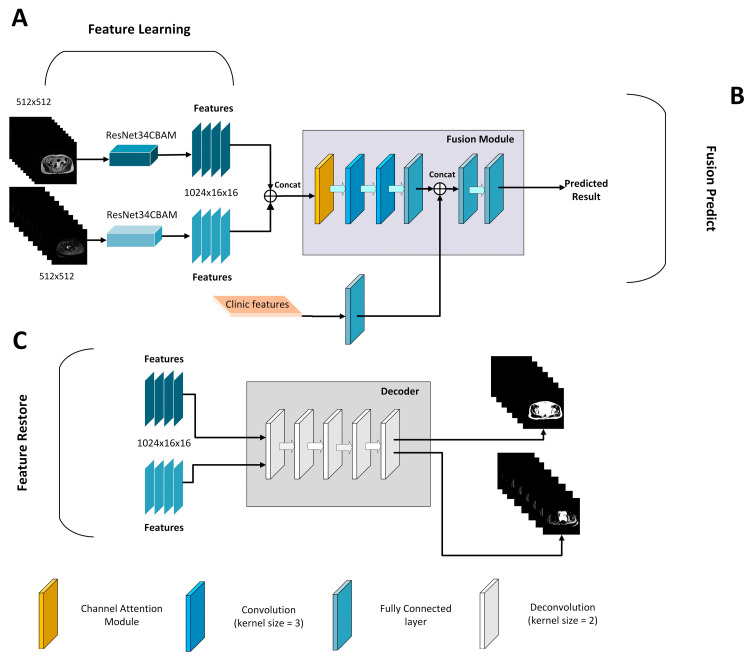
This study aims to use a deep learning method to develop a signature extract from preoperative magnetic resonance imaging (MRI) and to evaluate its ability as a non-invasive recurrence risk prognostic marker in patients with advanced high-grade serous ovarian cancer (HGSOC). Our study comprises a total of 185 patients with pathologically confirmed HGSOC. A total of 185 patients were randomly assigned in a 5:3:2 ratio to a training cohort (n = 92), validation cohort 1 (n = 56), and validation cohort 2 (n = 37). We built a new deep learning network from 3839 preoperative MRI images (T2-weighted images and diffusion-weighted images) to extract HGSOC prognostic indicators. Following that, a fusion model including clinical and deep learning features is developed to predict patients' individual recurrence risk and 3-year recurrence likelihood. In the two validation cohorts, the consistency index of the fusion model was higher than both the deep learning model and the clinical feature model (0.752, 0.813 vs. 0.625, 0.600 vs. 0.505, 0.501). Among the three models, the fusion model had a higher AUC than either the deep learning model or the clinical model in validation cohorts 1 or 2 (AUC = was 0.986, 0.961 vs. 0.706, 0.676/0.506, 0.506). Using the DeLong method, the difference between them was statistically significant ( < 0.05). The Kaplan-Meier analysis distinguished two patient groups with high and low recurrence risk ( = 0.0008 and 0.0035, respectively). Deep learning may be a low-cost, non-invasive method for predicting risk for advanced HGSOC recurrence. Deep learning based on multi-sequence MRI serves as a prognostic biomarker for advanced HGSOC, which provides a preoperative model for predicting recurrence in HGSOC. Additionally, using the fusion model as a new prognostic analysis means that can use MRI data can be used without the need to follow-up the prognostic biomarker.

摘要

本研究旨在使用深度学习方法从术前磁共振成像(MRI)中提取特征,并评估其作为晚期高级别浆液性卵巢癌(HGSOC)患者非侵入性复发风险预后标志物的能力。我们的研究共纳入185例经病理证实的HGSOC患者。185例患者按5:3:2的比例随机分配至训练队列(n = 92)、验证队列1(n = 56)和验证队列2(n = 37)。我们从3839张术前MRI图像(T2加权图像和扩散加权图像)构建了一个新的深度学习网络,以提取HGSOC预后指标。在此之后,开发了一个包括临床和深度学习特征的融合模型,以预测患者的个体复发风险和3年复发可能性。在两个验证队列中,融合模型的一致性指数高于深度学习模型和临床特征模型(分别为0.752、0.813与0.625、0.600与0.505、0.501)。在这三个模型中,融合模型在验证队列1或2中的AUC高于深度学习模型或临床模型(AUC分别为0.986、0.961与0.706、0.676/0.506、0.506)。使用DeLong方法,它们之间的差异具有统计学意义(<0.05)。Kaplan-Meier分析区分出了复发风险高和低的两组患者(分别为= 0.0008和0.0035)。深度学习可能是一种低成本、非侵入性的预测晚期HGSOC复发风险的方法。基于多序列MRI的深度学习可作为晚期HGSOC的预后生物标志物,为HGSOC复发预测提供术前模型。此外,使用融合模型作为一种新的预后分析方法意味着无需对预后生物标志物进行随访即可使用MRI数据。

https://cdn.ncbi.nlm.nih.gov/pmc/blobs/cb93/9954966/33686aee08c7/diagnostics-13-00748-g005.jpg
https://cdn.ncbi.nlm.nih.gov/pmc/blobs/cb93/9954966/4a3778586d94/diagnostics-13-00748-g001.jpg
https://cdn.ncbi.nlm.nih.gov/pmc/blobs/cb93/9954966/2c5a7dd34faa/diagnostics-13-00748-g002.jpg
https://cdn.ncbi.nlm.nih.gov/pmc/blobs/cb93/9954966/0509e50f6063/diagnostics-13-00748-g003.jpg
https://cdn.ncbi.nlm.nih.gov/pmc/blobs/cb93/9954966/3e63e6bd1071/diagnostics-13-00748-g004.jpg
https://cdn.ncbi.nlm.nih.gov/pmc/blobs/cb93/9954966/33686aee08c7/diagnostics-13-00748-g005.jpg
https://cdn.ncbi.nlm.nih.gov/pmc/blobs/cb93/9954966/4a3778586d94/diagnostics-13-00748-g001.jpg
https://cdn.ncbi.nlm.nih.gov/pmc/blobs/cb93/9954966/2c5a7dd34faa/diagnostics-13-00748-g002.jpg
https://cdn.ncbi.nlm.nih.gov/pmc/blobs/cb93/9954966/0509e50f6063/diagnostics-13-00748-g003.jpg
https://cdn.ncbi.nlm.nih.gov/pmc/blobs/cb93/9954966/3e63e6bd1071/diagnostics-13-00748-g004.jpg
https://cdn.ncbi.nlm.nih.gov/pmc/blobs/cb93/9954966/33686aee08c7/diagnostics-13-00748-g005.jpg

相似文献

1
Deep Learning Provides a New Magnetic Resonance Imaging-Based Prognostic Biomarker for Recurrence Prediction in High-Grade Serous Ovarian Cancer.深度学习为高级别浆液性卵巢癌复发预测提供了一种基于磁共振成像的新型预后生物标志物。
Diagnostics (Basel). 2023 Feb 16;13(4):748. doi: 10.3390/diagnostics13040748.
2
Deep learning provides a new computed tomography-based prognostic biomarker for recurrence prediction in high-grade serous ovarian cancer.深度学习为高级别浆液性卵巢癌的复发预测提供了一种新的基于计算机断层扫描的预后生物标志物。
Radiother Oncol. 2019 Mar;132:171-177. doi: 10.1016/j.radonc.2018.10.019. Epub 2018 Nov 1.
3
Preoperative CT-based deep learning model for predicting overall survival in patients with high-grade serous ovarian cancer.基于术前CT的深度学习模型预测高级别浆液性卵巢癌患者的总生存期
Front Oncol. 2022 Sep 9;12:986089. doi: 10.3389/fonc.2022.986089. eCollection 2022.
4
Development of MRI-Based Radiomics Model to Predict the Risk of Recurrence in Patients With Advanced High-Grade Serous Ovarian Carcinoma.基于 MRI 的放射组学模型预测晚期高级别浆液性卵巢癌患者复发风险的研究
AJR Am J Roentgenol. 2021 Sep;217(3):664-675. doi: 10.2214/AJR.20.23195. Epub 2021 Jul 14.
5
A Computed Tomography-Based Radiomic Prognostic Marker of Advanced High-Grade Serous Ovarian Cancer Recurrence: A Multicenter Study.基于计算机断层扫描的高级别浆液性卵巢癌复发的放射组学预后标志物:一项多中心研究
Front Oncol. 2019 Apr 9;9:255. doi: 10.3389/fonc.2019.00255. eCollection 2019.
6
Noninvasive prediction of residual disease for advanced high-grade serous ovarian carcinoma by MRI-based radiomic-clinical nomogram.基于 MRI 的影像组学-临床列线图无创预测晚期高级别浆液性卵巢癌的残留病灶。
Eur Radiol. 2021 Oct;31(10):7855-7864. doi: 10.1007/s00330-021-07902-0. Epub 2021 Apr 16.
7
Development and Validation of an Immune-Related Gene-Pair Model of High-Grade Serous Ovarian Cancer After Platinum-Based Chemotherapy.铂类化疗后高级别浆液性卵巢癌免疫相关基因对模型的开发与验证
Front Oncol. 2021 Feb 10;10:626555. doi: 10.3389/fonc.2020.626555. eCollection 2020.
8
Radiomics Analysis of PET and CT Components of F-FDG PET/CT Imaging for Prediction of Progression-Free Survival in Advanced High-Grade Serous Ovarian Cancer.用于预测晚期高级别浆液性卵巢癌无进展生存期的¹⁸F-FDG PET/CT成像中PET与CT成分的影像组学分析
Front Oncol. 2021 Apr 13;11:638124. doi: 10.3389/fonc.2021.638124. eCollection 2021.
9
Development and validation of MRI-based deep learning models for prediction of microsatellite instability in rectal cancer.基于 MRI 的深度学习模型在预测直肠癌微卫星不稳定性中的开发和验证。
Cancer Med. 2021 Jun;10(12):4164-4173. doi: 10.1002/cam4.3957. Epub 2021 May 8.
10
Predicting Neoadjuvant Chemotherapy Response and High-Grade Serous Ovarian Cancer From CT Images in Ovarian Cancer with Multitask Deep Learning: A Multicenter Study.基于多任务深度学习的 CT 图像预测卵巢癌新辅助化疗反应和高级别浆液性卵巢癌:一项多中心研究。
Acad Radiol. 2023 Sep;30 Suppl 2:S192-S201. doi: 10.1016/j.acra.2023.04.036. Epub 2023 Jun 17.

引用本文的文献

1
An enhanced deep learning model for accurate classification of ovarian cancer from histopathological images.一种用于从组织病理学图像中准确分类卵巢癌的增强深度学习模型。
Sci Rep. 2025 Jul 1;15(1):21860. doi: 10.1038/s41598-025-07903-9.
2
mpMRI-based habitat analysis for predicting prognoses in patients with high-grade serous ovarian cancer: a multicenter study.基于多参数磁共振成像的栖息地分析预测高级别浆液性卵巢癌患者的预后:一项多中心研究
Abdom Radiol (NY). 2025 May 29. doi: 10.1007/s00261-025-05004-9.
3
Artificial intelligence radiomics in the diagnosis, treatment, and prognosis of gynecological cancer: a literature review.

本文引用的文献

1
Multiparameter MRI Radiomics Model Predicts Preoperative Peritoneal Carcinomatosis in Ovarian Cancer.多参数MRI影像组学模型预测卵巢癌术前腹膜癌转移
Front Oncol. 2021 Oct 21;11:765652. doi: 10.3389/fonc.2021.765652. eCollection 2021.
2
Development of MRI-Based Radiomics Model to Predict the Risk of Recurrence in Patients With Advanced High-Grade Serous Ovarian Carcinoma.基于 MRI 的放射组学模型预测晚期高级别浆液性卵巢癌患者复发风险的研究
AJR Am J Roentgenol. 2021 Sep;217(3):664-675. doi: 10.2214/AJR.20.23195. Epub 2021 Jul 14.
3
Development of a Novel Multiparametric MRI Radiomic Nomogram for Preoperative Evaluation of Early Recurrence in Resectable Pancreatic Cancer.
人工智能影像组学在妇科癌症诊断、治疗及预后中的应用:文献综述
Transl Cancer Res. 2025 Apr 30;14(4):2508-2532. doi: 10.21037/tcr-2025-618. Epub 2025 Apr 27.
4
Foundation model-driven multimodal prognostic prediction in patients undergoing primary surgery for high-grade serous ovarian cancer.基于基础模型的高级别浆液性卵巢癌原发手术患者多模态预后预测
NPJ Precis Oncol. 2025 Apr 20;9(1):114. doi: 10.1038/s41698-025-00900-1.
5
Comparing the Effectiveness of Artificial Intelligence Models in Predicting Ovarian Cancer Survival: A Systematic Review.比较人工智能模型预测卵巢癌生存率的有效性:一项系统评价
Cancer Rep (Hoboken). 2025 Mar;8(3):e70138. doi: 10.1002/cnr2.70138.
6
Radiomics and radiogenomics: extracting more information from medical images for the diagnosis and prognostic prediction of ovarian cancer.放射组学和放射基因组学:从医学影像中提取更多信息用于卵巢癌的诊断和预后预测。
Mil Med Res. 2024 Dec 14;11(1):77. doi: 10.1186/s40779-024-00580-1.
7
[A lightweight recurrence prediction model for high grade serous ovarian cancer based on hierarchical transformer fusion metadata].基于分层变压器融合元数据的高级别浆液性卵巢癌轻量级复发预测模型
Sheng Wu Yi Xue Gong Cheng Xue Za Zhi. 2024 Aug 25;41(4):807-817. doi: 10.7507/1001-5515.202308009.
8
Deep learning in ovarian cancer diagnosis: a comprehensive review of various imaging modalities.深度学习在卵巢癌诊断中的应用:对各种成像方式的全面综述
Pol J Radiol. 2024 Jan 22;89:e30-e48. doi: 10.5114/pjr.2024.134817. eCollection 2024.
9
Advances in artificial intelligence for the diagnosis and treatment of ovarian cancer (Review).人工智能在卵巢癌诊断和治疗中的进展(综述)。
Oncol Rep. 2024 Mar;51(3). doi: 10.3892/or.2024.8705. Epub 2024 Jan 19.
开发一种新型多参数 MRI 放射组学列线图,用于术前评估可切除胰腺癌的早期复发。
J Magn Reson Imaging. 2020 Jul;52(1):231-245. doi: 10.1002/jmri.27024. Epub 2019 Dec 23.
4
Olaparib plus Bevacizumab as First-Line Maintenance in Ovarian Cancer.奥拉帕利联合贝伐珠单抗作为卵巢癌一线维持治疗。
N Engl J Med. 2019 Dec 19;381(25):2416-2428. doi: 10.1056/NEJMoa1911361.
5
Niraparib in Patients with Newly Diagnosed Advanced Ovarian Cancer.尼拉帕利治疗新诊断的晚期卵巢癌患者。
N Engl J Med. 2019 Dec 19;381(25):2391-2402. doi: 10.1056/NEJMoa1910962. Epub 2019 Sep 28.
6
Antitumor activity and safety of pembrolizumab in patients with advanced recurrent ovarian cancer: results from the phase II KEYNOTE-100 study.帕博利珠单抗治疗晚期复发性卵巢癌患者的抗肿瘤活性和安全性:来自 II 期 KEYNOTE-100 研究的结果。
Ann Oncol. 2019 Jul 1;30(7):1080-1087. doi: 10.1093/annonc/mdz135.
7
Radiomics of Multiparametric MRI for Pretreatment Prediction of Pathologic Complete Response to Neoadjuvant Chemotherapy in Breast Cancer: A Multicenter Study.多参数 MRI 放射组学预测乳腺癌新辅助化疗病理完全缓解的价值:一项多中心研究。
Clin Cancer Res. 2019 Jun 15;25(12):3538-3547. doi: 10.1158/1078-0432.CCR-18-3190. Epub 2019 Mar 6.
8
Development and Application of a Machine Learning Approach to Assess Short-term Mortality Risk Among Patients With Cancer Starting Chemotherapy.开发和应用机器学习方法评估开始化疗的癌症患者的短期死亡风险。
JAMA Netw Open. 2018 Jul 6;1(3):e180926. doi: 10.1001/jamanetworkopen.2018.0926.
9
Cancer statistics, 2019.癌症统计数据,2019 年。
CA Cancer J Clin. 2019 Jan;69(1):7-34. doi: 10.3322/caac.21551. Epub 2019 Jan 8.
10
A guide to deep learning in healthcare.深度学习在医疗保健中的应用指南。
Nat Med. 2019 Jan;25(1):24-29. doi: 10.1038/s41591-018-0316-z. Epub 2019 Jan 7.