Yu Xiao Yu, Ren Jialiang, Jia Yushan, Wu Hui, Niu Guangming, Liu Aishi, Gao Yang, Hao Fene, Xie Lizhi
Affiliated Hospital, Inner Mongolia Medical University, Hohhot, China.
Department of Pharmaceuticals Diagnosis, GE Healthcare (China), Shanghai, China.
Front Oncol. 2021 Oct 21;11:765652. doi: 10.3389/fonc.2021.765652. eCollection 2021.
To evaluate the predictive value of radiomics features based on multiparameter magnetic resonance imaging (MP-MRI) for peritoneal carcinomatosis (PC) in patients with ovarian cancer (OC).
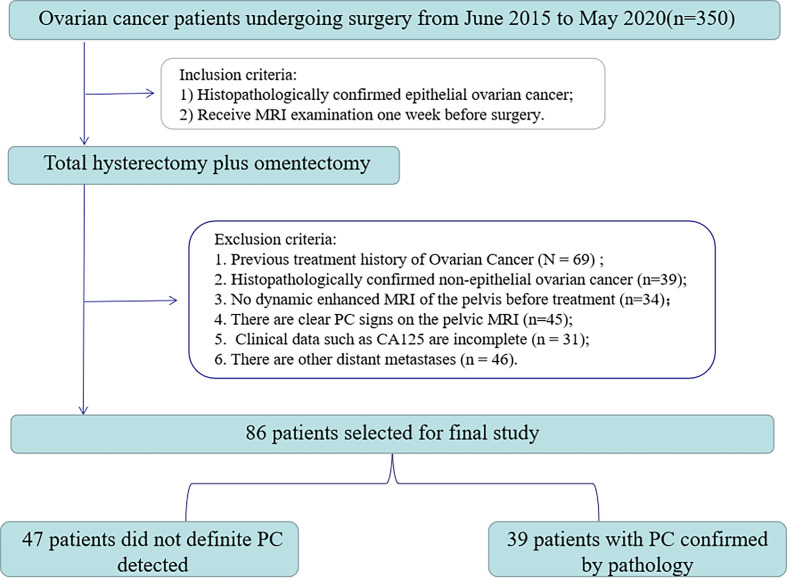
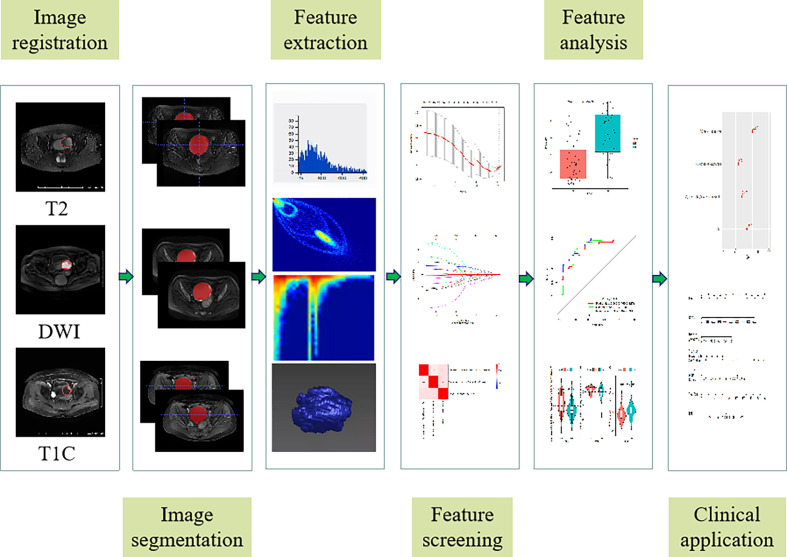
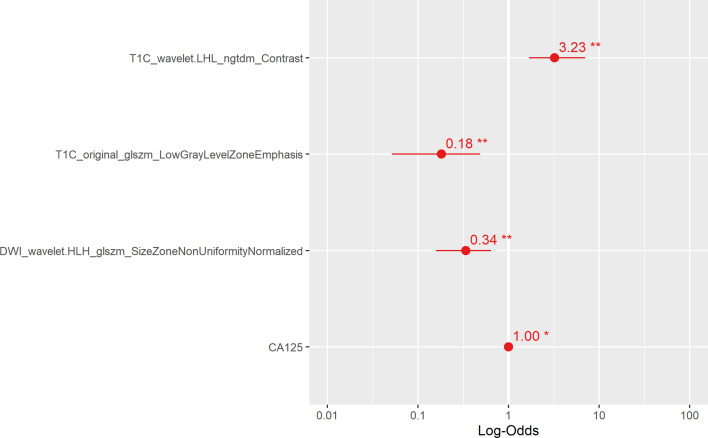
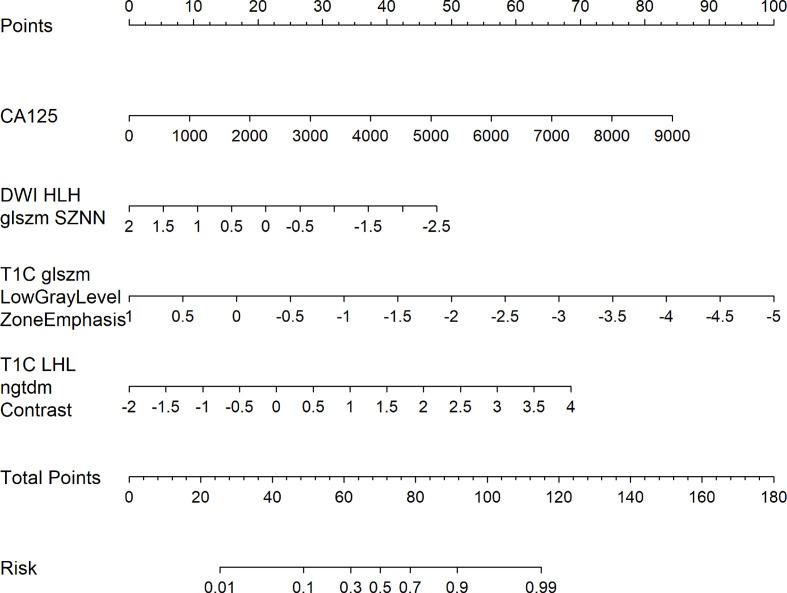
A total of 86 patients with epithelial OC were included in this retrospective study. All patients underwent FS-T2WI, DWI, and DCE-MRI scans, followed by total hysterectomy plus omentectomy. Quantitative imaging features were extracted from preoperative FS-T2WI, DWI, and DCE-MRI images, and feature screening was performed using a minimum redundancy maximum correlation (mRMR) and least absolute shrinkage selection operator (LASSO) methods. Four radiomics models were constructed based on three MRI sequences. Then, combined with radiomics characteristics and clinicopathological risk factors, a multi-factor Logistic regression method was used to construct a radiomics nomogram, and the performance of the radiomics nomogram was evaluated by receiver operating characteristic curve (ROC) curve, calibration curve, and decision curve analysis.
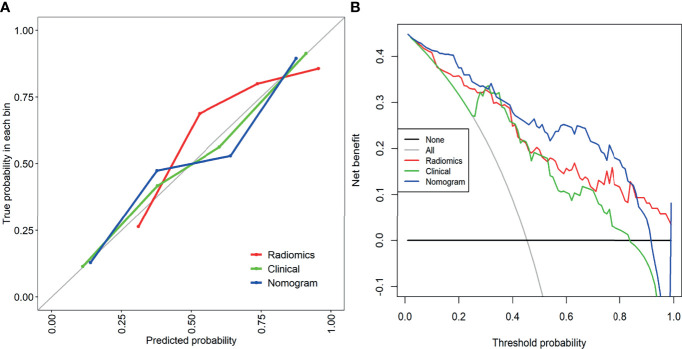
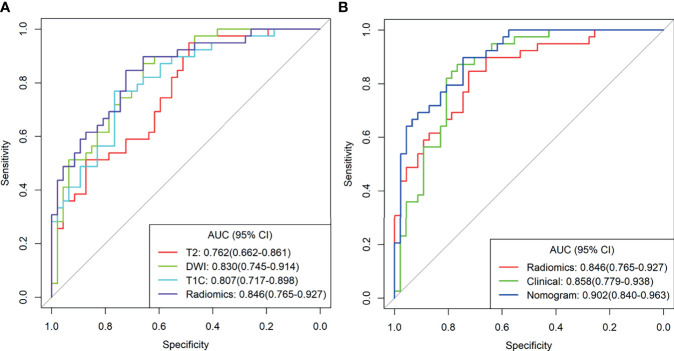
The radiomics model from the MP-MRI combined sequence showed a higher area under the curve (AUC) than the model from FS-T2WI, DWI, and DCE-MRI alone (0.846 . 0.762, 0.830, 0.807, respectively). The radiomics nomogram (AUC=0.902) constructed by combining radiomics characteristics and clinicopathological risk factors showed a better diagnostic effect than the clinical model (AUC=0.858) and the radiomics model (AUC=0.846). The decision curve analysis shows that the radiomics nomogram has good clinical application value, and the calibration curve also proves that it has good stability.
Radiomics nomogram based on MP-MRI combined sequence showed good predictive accuracy for PC in patients with OC. This tool can be used to identify peritoneal carcinomatosis in OC patients before surgery.
评估基于多参数磁共振成像(MP-MRI)的影像组学特征对卵巢癌(OC)患者腹膜癌转移(PC)的预测价值。
本回顾性研究共纳入86例上皮性OC患者。所有患者均接受脂肪抑制T2加权成像(FS-T2WI)、扩散加权成像(DWI)和动态对比增强磁共振成像(DCE-MRI)扫描,随后行全子宫切除术加网膜切除术。从术前FS-T2WI、DWI和DCE-MRI图像中提取定量影像特征,并采用最小冗余最大相关(mRMR)和最小绝对收缩选择算子(LASSO)方法进行特征筛选。基于三个MRI序列构建了四个影像组学模型。然后,结合影像组学特征和临床病理危险因素,采用多因素Logistic回归方法构建影像组学列线图,并通过受试者操作特征曲线(ROC)、校准曲线和决策曲线分析评估影像组学列线图的性能。
MP-MRI联合序列的影像组学模型曲线下面积(AUC)高于单独的FS-T2WI、DWI和DCE-MRI模型(分别为0.846、0.762、0.830、0.807)。结合影像组学特征和临床病理危险因素构建的影像组学列线图(AUC=0.902)比临床模型(AUC=0.858)和影像组学模型(AUC=0.846)具有更好的诊断效果。决策曲线分析表明影像组学列线图具有良好的临床应用价值,校准曲线也证明其具有良好的稳定性。
基于MP-MRI联合序列的影像组学列线图对OC患者的PC具有良好的预测准确性。该工具可用于术前识别OC患者的腹膜癌转移。