Vijayan Midhula, S Venkatakrishnan
Forus Health Private Limited, Bengaluru 560070, Karnataka, India.
Diagnostics (Basel). 2023 Feb 17;13(4):774. doi: 10.3390/diagnostics13040774.
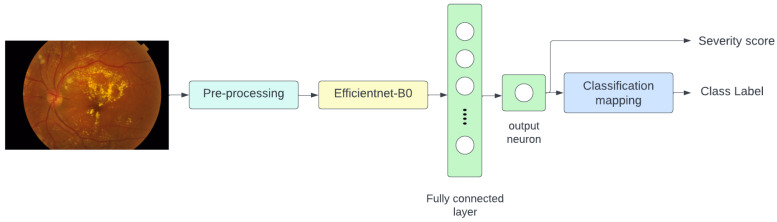
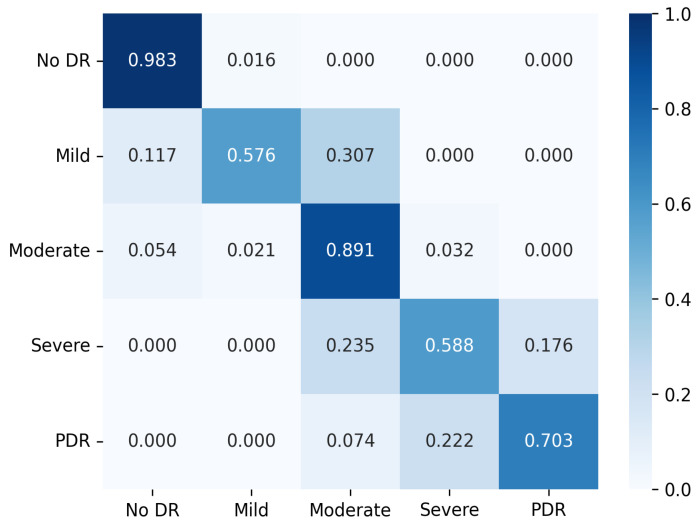
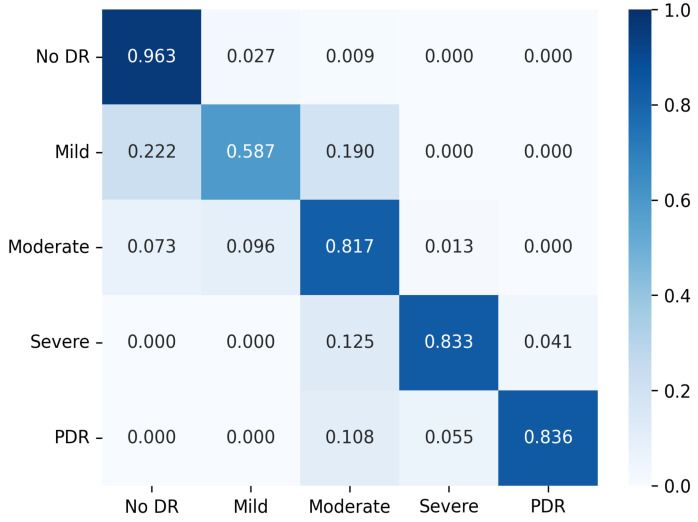
The aim of this study is to develop a computer-assisted solution for the efficient and effective detection of diabetic retinopathy (DR), a complication of diabetes that can damage the retina and cause vision loss if not treated in a timely manner. Manually diagnosing DR through color fundus images requires a skilled clinician to spot lesions, but this can be challenging, especially in areas with a shortage of trained experts. As a result, there is a push to create computer-aided diagnosis systems for DR to help reduce the time it takes to diagnose the condition. The detection of diabetic retinopathy through automation is challenging, but convolutional neural networks (CNNs) play a vital role in achieving success. CNNs have been proven to be more effective in image classification than methods based on handcrafted features. This study proposes a CNN-based approach for the automated detection of DR using Efficientnet-B0 as the backbone network. The authors of this study take a unique approach by viewing the detection of diabetic retinopathy as a regression problem rather than a traditional multi-class classification problem. This is because the severity of DR is often rated on a continuous scale, such as the international clinical diabetic retinopathy (ICDR) scale. This continuous representation provides a more nuanced understanding of the condition, making regression a more suitable approach for DR detection compared to multi-class classification. This approach has several benefits. Firstly, it allows for more fine-grained predictions as the model can assign a value that falls between the traditional discrete labels. Secondly, it allows for better generalization. The model was tested on the APTOS and DDR datasets. The proposed model demonstrated improved efficiency and accuracy in detecting DR compared to traditional methods. This method has the potential to enhance the efficiency and accuracy of DR diagnosis, making it a valuable tool for healthcare professionals. The model has the potential to aid in the rapid and accurate diagnosis of DR, leading to the improved early detection, and management, of the disease.
本研究的目的是开发一种计算机辅助解决方案,用于高效且有效地检测糖尿病视网膜病变(DR),这是一种糖尿病并发症,如果不及时治疗,会损害视网膜并导致视力丧失。通过彩色眼底图像手动诊断DR需要熟练的临床医生来发现病变,但这可能具有挑战性,尤其是在缺乏训练有素的专家的地区。因此,人们迫切希望创建用于DR的计算机辅助诊断系统,以帮助减少诊断该疾病所需的时间。通过自动化检测糖尿病视网膜病变具有挑战性,但卷积神经网络(CNN)在取得成功方面发挥着至关重要的作用。事实证明,CNN在图像分类方面比基于手工特征的方法更有效。本研究提出了一种基于CNN的方法,使用Efficientnet - B0作为骨干网络来自动检测DR。本研究的作者采用了一种独特的方法,将糖尿病视网膜病变的检测视为一个回归问题,而不是传统的多类分类问题。这是因为DR的严重程度通常是在一个连续的量表上进行评定的,例如国际临床糖尿病视网膜病变(ICDR)量表。这种连续表示方式能够对病情有更细微的理解,使得回归相比多类分类更适合用于DR检测。这种方法有几个优点。首先,它允许进行更细粒度的预测,因为模型可以分配一个介于传统离散标签之间的值。其次,它具有更好的泛化能力。该模型在APTOS和DDR数据集上进行了测试。与传统方法相比,所提出的模型在检测DR方面展示出了更高的效率和准确性。这种方法有可能提高DR诊断的效率和准确性,使其成为医疗保健专业人员的一个有价值的工具。该模型有可能有助于快速准确地诊断DR,从而改善该疾病的早期检测和管理。