Post-Graduation Program in Cardiovascular Sciences, Fluminense Federal University, Niterói, Rio de Janiero 24033-900, Brazil.
Department of Clinical Sciences and Community Health, University of Milan, 20122 Milan, Italy.
Int J Environ Res Public Health. 2023 Feb 13;20(4):3238. doi: 10.3390/ijerph20043238.
Post-menopausal women have impaired cardiorespiratory responses to exercise compared to young women. Exercise training may counterbalance impairments, but the time-dependent effects of exercise training remain unclear. The current study aims to investigate the effects of rowing training on maximal aerobic capacity and time-course cardiorespiratory adaptations in older women.
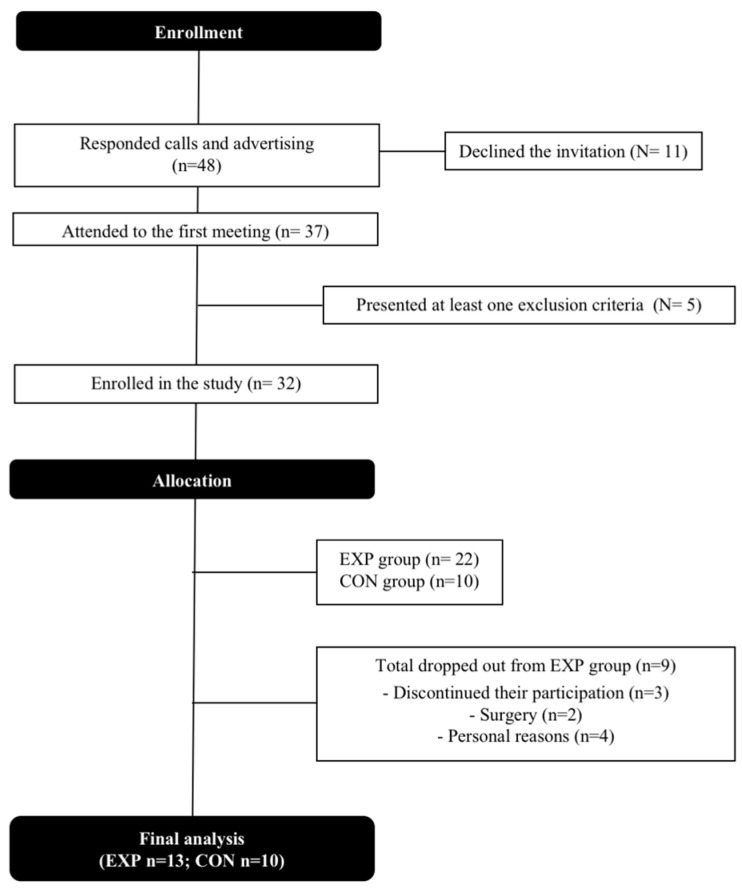
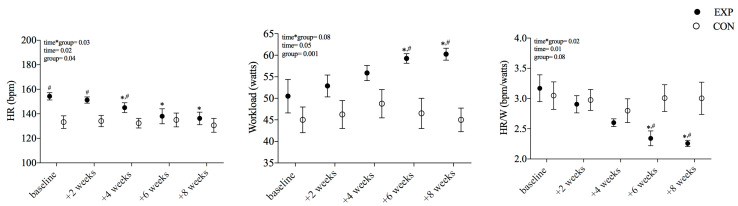
Female participants ( = 23) were randomly allocated to the experimental group (EXP; = 23; 66 ± 5 years old) enrolled in rowing exercise training and control group (CON; = 10; 64 ± 4 years old). The cardiopulmonary exercise test (CET) was performed in a cycle ergometer pre- and post-interventions. Oxygen uptake (VO), stroke volume (SV), cardiac output (CO), and HR were recorded during CET and analyzed at the peak of the exercise. HR was monitored during exercise recovery, and the index of HRR was calculated by ΔHRR (HR-HR one-minute recovery). Every two weeks, Rowing Stepwise Exercise (RSE) in a rowing machine was performed to track specific adaptations to the exercise modality. HR was continuously recorded during RSE and corrected for the average power of each step (HR/watts). The rowing training protocol consisted of three weekly sessions of 30 min at an intensity corresponding to 60-80% of peak HR for ten weeks.
Rowing exercise training increased VO, SV, and CO at the peak of the CET, and ΔHRR. Increased workload (W) and reduced HR response to a greater achieved workload (HR/W) during RSE were observed after six weeks of training.
Rowing exercise training is a feasible method to improve cardiorespiratory performance, vagal reactivation and heart rate adjustments to exercise in older women.
与年轻女性相比,绝经后女性在运动时心肺反应受损。运动训练可能会抵消这些损伤,但运动训练的时程效应仍不清楚。本研究旨在探讨划船训练对老年女性最大有氧能力和心肺适应的时程影响。
将女性参与者(n=23)随机分为实验组(EXP;n=23;66±5 岁)和对照组(CON;n=10;64±4 岁)。所有参与者在干预前后均在功率自行车上进行心肺运动测试(CET)。在 CET 过程中记录耗氧量(VO)、每搏量(SV)、心输出量(CO)和心率(HR),并在运动峰值时进行分析。在运动恢复期监测 HR,并通过 HRR(HR-恢复期一分钟的 HR)计算 HRR 指数。每两周,在划船机上进行划船逐步运动(RSE),以跟踪对运动方式的特定适应。在 RSE 过程中连续记录 HR,并对每个步骤的平均功率进行校正(HR/瓦特)。划船训练方案包括每周 3 次、每次 30 分钟,强度对应于峰值 HR 的 60-80%,持续 10 周。
划船运动训练可提高 CET 峰值时的 VO、SV 和 CO,以及 ΔHRR。在训练 6 周后,RSE 期间观察到工作负荷(W)增加,达到更大工作负荷时 HR 反应减少(HR/W)。
划船运动训练是一种可行的方法,可以提高老年女性的心肺功能、迷走神经再激活和心率对运动的调节。