• 文献检索
  • 文档翻译
  • 深度研究
  • 学术资讯
  • Suppr Zotero 插件Zotero 插件
  • 邀请有礼
  • 套餐&价格
  • 历史记录
应用&插件
Suppr Zotero 插件Zotero 插件浏览器插件Mac 客户端Windows 客户端微信小程序
定价
高级版会员购买积分包购买API积分包
服务
文献检索文档翻译深度研究API 文档MCP 服务
关于我们
关于 Suppr公司介绍联系我们用户协议隐私条款
关注我们

Suppr 超能文献

核心技术专利:CN118964589B侵权必究
粤ICP备2023148730 号-1Suppr @ 2026

文献检索

告别复杂PubMed语法,用中文像聊天一样搜索,搜遍4000万医学文献。AI智能推荐,让科研检索更轻松。

立即免费搜索

文件翻译

保留排版,准确专业,支持PDF/Word/PPT等文件格式,支持 12+语言互译。

免费翻译文档

深度研究

AI帮你快速写综述,25分钟生成高质量综述,智能提取关键信息,辅助科研写作。

立即免费体验

开发一种强化学习算法以优化脓毒症重症患者的皮质类固醇治疗

Development of a Reinforcement Learning Algorithm to Optimize Corticosteroid Therapy in Critically Ill Patients with Sepsis.

作者信息

Bologheanu Razvan, Kapral Lorenz, Laxar Daniel, Maleczek Mathias, Dibiasi Christoph, Zeiner Sebastian, Agibetov Asan, Ercole Ari, Thoral Patrick, Elbers Paul, Heitzinger Clemens, Kimberger Oliver

机构信息

Department of Anaesthesia, Intensive Care Medicine and Pain Medicine, Medical University of Vienna, 1090 Vienna, Austria.

Ludwig Boltzmann Institute for Digital Health and Patient Safety, 1090 Vienna, Austria.

出版信息

J Clin Med. 2023 Feb 14;12(4):1513. doi: 10.3390/jcm12041513.

DOI:10.3390/jcm12041513
PMID:36836046
原文链接:https://pmc.ncbi.nlm.nih.gov/articles/PMC9961939/
Abstract

BACKGROUND

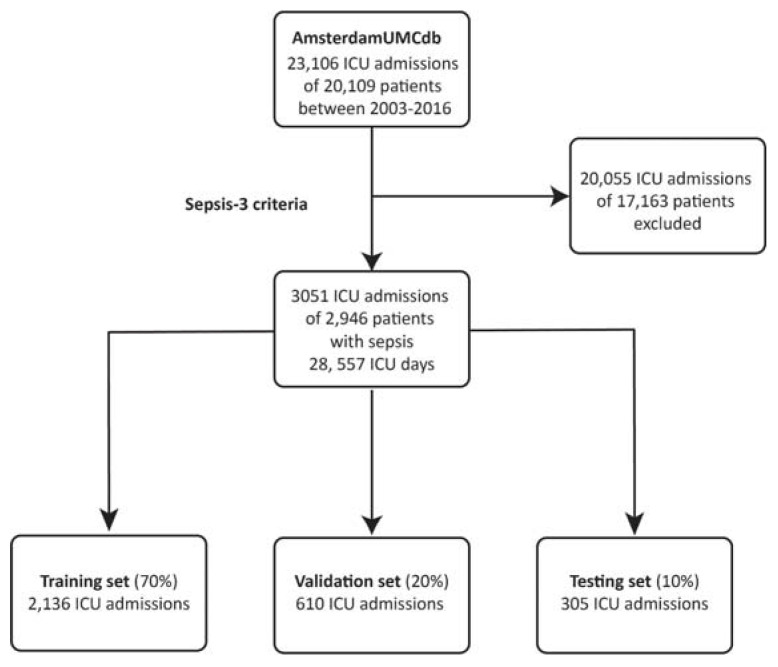
The optimal indication, dose, and timing of corticosteroids in sepsis is controversial. Here, we used reinforcement learning to derive the optimal steroid policy in septic patients based on data on 3051 ICU admissions from the AmsterdamUMCdb intensive care database.

METHODS

We identified septic patients according to the 2016 consensus definition. An actor-critic RL algorithm using ICU mortality as a reward signal was developed to determine the optimal treatment policy from time-series data on 277 clinical parameters. We performed off-policy evaluation and testing in independent subsets to assess the algorithm's performance.

RESULTS

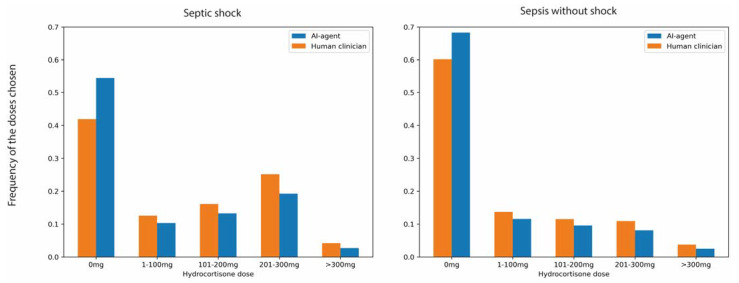
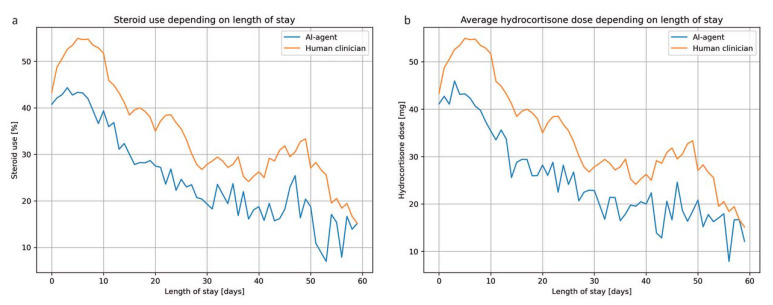
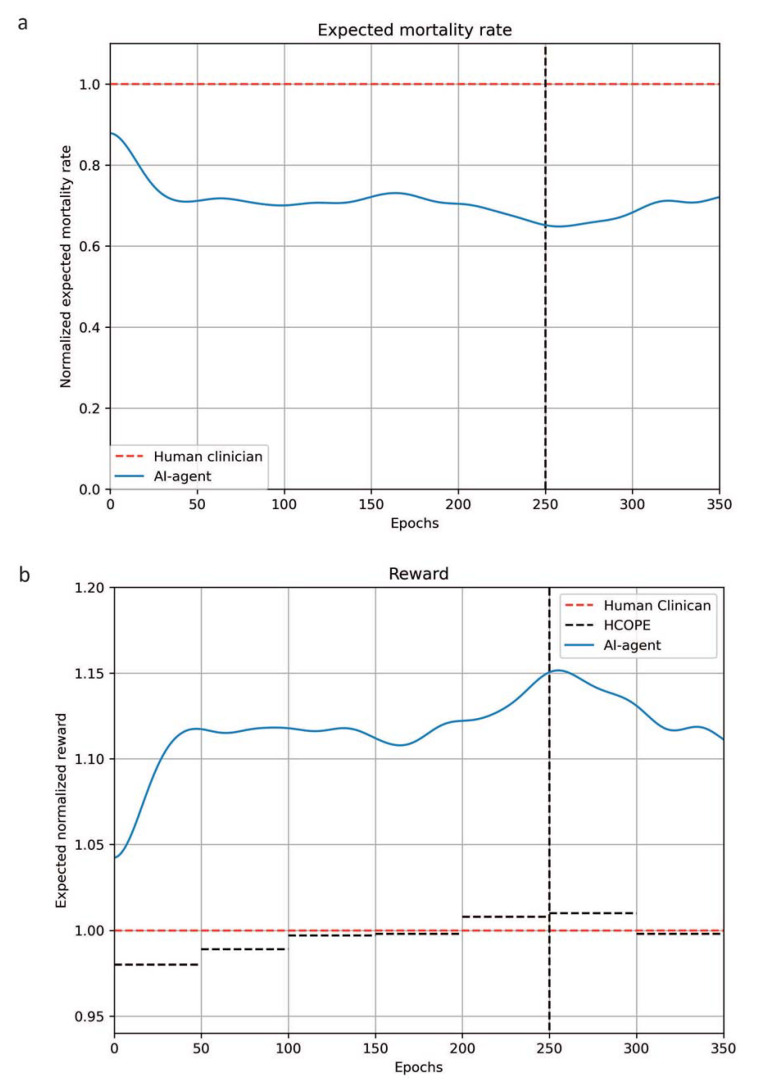
Agreement between the RL agent's policy and the actual documented treatment reached 59%. Our RL agent's treatment policy was more restrictive compared to the actual clinician behavior: our algorithm suggested withholding corticosteroids in 62% of the patient states, versus 52% according to the physicians' policy. The 95% lower bound of the expected reward was higher for the RL agent than clinicians' historical decisions. ICU mortality after concordant action in the testing dataset was lower both when corticosteroids had been withheld and when corticosteroids had been prescribed by the virtual agent. The most relevant variables were vital parameters and laboratory values, such as blood pressure, heart rate, leucocyte count, and glycemia.

CONCLUSIONS

Individualized use of corticosteroids in sepsis may result in a mortality benefit, but optimal treatment policy may be more restrictive than the routine clinical practice. Whilst external validation is needed, our study motivates a 'precision-medicine' approach to future prospective controlled trials and practice.

摘要

背景

脓毒症中皮质类固醇的最佳适应症、剂量和使用时机存在争议。在此,我们基于阿姆斯特丹大学医学中心数据库中3051例重症监护病房入院患者的数据,运用强化学习得出脓毒症患者的最佳类固醇治疗策略。

方法

我们根据2016年的共识定义确定脓毒症患者。开发了一种以重症监护病房死亡率作为奖励信号的演员-评论家强化学习算法,以从277个临床参数的时间序列数据中确定最佳治疗策略。我们在独立子集中进行了离策略评估和测试,以评估该算法的性能。

结果

强化学习智能体的策略与实际记录的治疗之间的一致性达到59%。与实际临床医生的行为相比,我们的强化学习智能体的治疗策略更为严格:我们的算法建议在62%的患者状态下停用皮质类固醇,而根据医生的策略这一比例为52%。强化学习智能体的预期奖励的95%下限高于临床医生的历史决策。在测试数据集中,当停用皮质类固醇以及当虚拟智能体开具皮质类固醇时,一致行动后的重症监护病房死亡率均较低。最相关的变量是生命体征参数和实验室值,如血压、心率、白细胞计数和血糖。

结论

脓毒症中皮质类固醇的个体化使用可能带来死亡率益处,但最佳治疗策略可能比常规临床实践更为严格。虽然需要外部验证,但我们的研究推动了未来前瞻性对照试验和实践采用“精准医学”方法。
https://cdn.ncbi.nlm.nih.gov/pmc/blobs/be3d/9961939/44d4a1dc4c22/jcm-12-01513-g005.jpg
https://cdn.ncbi.nlm.nih.gov/pmc/blobs/be3d/9961939/ef9db115ff9e/jcm-12-01513-g001.jpg
https://cdn.ncbi.nlm.nih.gov/pmc/blobs/be3d/9961939/f13e5a08dd97/jcm-12-01513-g002.jpg
https://cdn.ncbi.nlm.nih.gov/pmc/blobs/be3d/9961939/7be16f9b8659/jcm-12-01513-g003.jpg
https://cdn.ncbi.nlm.nih.gov/pmc/blobs/be3d/9961939/b5f31904b187/jcm-12-01513-g004.jpg
https://cdn.ncbi.nlm.nih.gov/pmc/blobs/be3d/9961939/44d4a1dc4c22/jcm-12-01513-g005.jpg
https://cdn.ncbi.nlm.nih.gov/pmc/blobs/be3d/9961939/ef9db115ff9e/jcm-12-01513-g001.jpg
https://cdn.ncbi.nlm.nih.gov/pmc/blobs/be3d/9961939/f13e5a08dd97/jcm-12-01513-g002.jpg
https://cdn.ncbi.nlm.nih.gov/pmc/blobs/be3d/9961939/7be16f9b8659/jcm-12-01513-g003.jpg
https://cdn.ncbi.nlm.nih.gov/pmc/blobs/be3d/9961939/b5f31904b187/jcm-12-01513-g004.jpg
https://cdn.ncbi.nlm.nih.gov/pmc/blobs/be3d/9961939/44d4a1dc4c22/jcm-12-01513-g005.jpg

相似文献

1
Development of a Reinforcement Learning Algorithm to Optimize Corticosteroid Therapy in Critically Ill Patients with Sepsis.开发一种强化学习算法以优化脓毒症重症患者的皮质类固醇治疗
J Clin Med. 2023 Feb 14;12(4):1513. doi: 10.3390/jcm12041513.
2
Transatlantic transferability of a new reinforcement learning model for optimizing haemodynamic treatment for critically ill patients with sepsis.用于优化脓毒症危重症患者血液动力学治疗的新型强化学习模型的大西洋转移能力。
Artif Intell Med. 2021 Feb;112:102003. doi: 10.1016/j.artmed.2020.102003. Epub 2020 Dec 15.
3
A dosing strategy model of deep deterministic policy gradient algorithm for sepsis patients.败血症患者深度确定性策略梯度算法的给药策略模型。
BMC Med Inform Decis Mak. 2023 May 4;23(1):81. doi: 10.1186/s12911-023-02175-7.
4
Continuous action deep reinforcement learning for propofol dosing during general anesthesia.全身麻醉期间丙泊酚给药的连续动作深度强化学习
Artif Intell Med. 2022 Jan;123:102227. doi: 10.1016/j.artmed.2021.102227. Epub 2021 Dec 2.
5
Reinforcement learning for intensive care medicine: actionable clinical insights from novel approaches to reward shaping and off-policy model evaluation.重症医学中的强化学习:奖励塑造和离策略模型评估新方法带来的可操作临床见解。
Intensive Care Med Exp. 2024 Mar 25;12(1):32. doi: 10.1186/s40635-024-00614-x.
6
The value-complexity trade-off for reinforcement learning based brain-computer interfaces.基于强化学习的脑机接口的价值-复杂性权衡。
J Neural Eng. 2021 Feb 13;17(6):066011. doi: 10.1088/1741-2552/abc8d8.
7
Learning dynamic treatment strategies for coronary heart diseases by artificial intelligence: real-world data-driven study.通过人工智能学习冠心病的动态治疗策略:基于真实世界数据的研究。
BMC Med Inform Decis Mak. 2022 Feb 15;22(1):39. doi: 10.1186/s12911-022-01774-0.
8
The development an artificial intelligence algorithm for early sepsis diagnosis in the intensive care unit.开发一种用于重症监护病房早期脓毒症诊断的人工智能算法。
Int J Med Inform. 2020 Sep;141:104176. doi: 10.1016/j.ijmedinf.2020.104176. Epub 2020 May 21.
9
An Interpretable Machine Learning Model for Accurate Prediction of Sepsis in the ICU.一种用于 ICU 中脓毒症准确预测的可解释机器学习模型。
Crit Care Med. 2018 Apr;46(4):547-553. doi: 10.1097/CCM.0000000000002936.
10
Reinforcement Learning Assisted Oxygen Therapy for COVID-19 Patients Under Intensive Care.强化学习辅助的新冠肺炎重症监护患者氧疗
ArXiv. 2021 May 19:arXiv:2105.08923v2.

引用本文的文献

1
Reinforcement Learning and Its Clinical Applications Within Healthcare: A Systematic Review of Precision Medicine and Dynamic Treatment Regimes.强化学习及其在医疗保健领域的临床应用:精准医学与动态治疗方案的系统综述
Healthcare (Basel). 2025 Jul 19;13(14):1752. doi: 10.3390/healthcare13141752.
2
Improving AI-Based Clinical Decision Support Systems and Their Integration Into Care From the Perspective of Experts: Interview Study Among Different Stakeholders.从专家视角看基于人工智能的临床决策支持系统的改进及其在医疗中的整合:不同利益相关者访谈研究
JMIR Med Inform. 2025 Jul 7;13:e69688. doi: 10.2196/69688.
3
Reinforcement Learning in Personalized Medicine: A Comprehensive Review of Treatment Optimization Strategies.

本文引用的文献

1
Surviving sepsis campaign: international guidelines for management of sepsis and septic shock 2021.拯救脓毒症运动:2021年脓毒症和脓毒性休克国际管理指南
Intensive Care Med. 2021 Nov;47(11):1181-1247. doi: 10.1007/s00134-021-06506-y. Epub 2021 Oct 2.
2
Descriptors of Sepsis Using the Sepsis-3 Criteria: A Cohort Study in Critical Care Units Within the U.K. National Institute for Health Research Critical Care Health Informatics Collaborative.使用 Sepsis-3 标准描述脓毒症:英国国家卫生研究院重症监护健康信息学合作研究中的重症监护病房队列研究。
Crit Care Med. 2021 Nov 1;49(11):1883-1894. doi: 10.1097/CCM.0000000000005169.
3
个性化医疗中的强化学习:治疗优化策略的全面综述
Cureus. 2025 Apr 21;17(4):e82756. doi: 10.7759/cureus.82756. eCollection 2025 Apr.
4
Early identification of high-risk patients admitted to emergency departments using vital signs and machine learning.利用生命体征和机器学习对急诊科收治的高危患者进行早期识别。
World J Emerg Med. 2025;16(2):113-120. doi: 10.5847/wjem.j.1920-8642.2025.031.
5
Artificial intelligence and machine learning's role in sepsis-associated acute kidney injury.人工智能和机器学习在脓毒症相关急性肾损伤中的作用。
Kidney Res Clin Pract. 2024 Jul;43(4):417-432. doi: 10.23876/j.krcp.23.298. Epub 2024 Jun 20.
6
Can Machine Learning Personalize Cardiovascular Therapy in Sepsis?机器学习能否个性化脓毒症心血管治疗?
Crit Care Explor. 2024 May 6;6(5):e1087. doi: 10.1097/CCE.0000000000001087. eCollection 2024 May 1.
7
Glucocorticoid therapy for sepsis in the AI era: a survey on current and future approaches.人工智能时代脓毒症的糖皮质激素治疗:当前及未来方法的调查
Comput Struct Biotechnol J. 2024 Apr 12;24:292-305. doi: 10.1016/j.csbj.2024.04.020. eCollection 2024 Dec.
8
[Artificial intelligence in intensive care medicine].[重症医学中的人工智能]
Med Klin Intensivmed Notfmed. 2024 Apr;119(3):189-198. doi: 10.1007/s00063-024-01117-z. Epub 2024 Mar 28.
9
The ESICM datathon and the ESICM and ICMx data science strategy.欧洲重症监护医学学会数据马拉松以及欧洲重症监护医学学会与国际重症监护医学联合会的数据科学战略。
Intensive Care Med Exp. 2024 Mar 12;12(1):29. doi: 10.1186/s40635-024-00615-w.
Moving from bytes to bedside: a systematic review on the use of artificial intelligence in the intensive care unit.
从字节到床边:人工智能在重症监护病房中的应用的系统评价。
Intensive Care Med. 2021 Jul;47(7):750-760. doi: 10.1007/s00134-021-06446-7. Epub 2021 Jun 5.
4
Sharing ICU Patient Data Responsibly Under the Society of Critical Care Medicine/European Society of Intensive Care Medicine Joint Data Science Collaboration: The Amsterdam University Medical Centers Database (AmsterdamUMCdb) Example.在重症医学学会/欧洲危重病医学学会联合数据科学协作下负责任地共享 ICU 患者数据:阿姆斯特丹大学医学中心数据库(AmsterdamUMCdb)示例。
Crit Care Med. 2021 Jun 1;49(6):e563-e577. doi: 10.1097/CCM.0000000000004916.
5
Assessment of Machine Learning to Estimate the Individual Treatment Effect of Corticosteroids in Septic Shock.评估机器学习在脓毒性休克中估计皮质类固醇个体治疗效果的应用。
JAMA Netw Open. 2020 Dec 1;3(12):e2029050. doi: 10.1001/jamanetworkopen.2020.29050.
6
Reinforcement Learning for Clinical Decision Support in Critical Care: Comprehensive Review.强化学习在重症监护临床决策支持中的应用:全面综述。
J Med Internet Res. 2020 Jul 20;22(7):e18477. doi: 10.2196/18477.
7
Validation of automated sepsis surveillance based on the Sepsis-3 clinical criteria against physician record review in a general hospital population: observational study using electronic health records data.基于 Sepsis-3 临床标准的自动化脓毒症监测在综合医院人群中对医师记录审查的验证:使用电子健康记录数据的观察性研究。
BMJ Qual Saf. 2020 Sep;29(9):735-745. doi: 10.1136/bmjqs-2019-010123. Epub 2020 Feb 6.
8
Global, regional, and national sepsis incidence and mortality, 1990-2017: analysis for the Global Burden of Disease Study.全球、地区和国家脓毒症发病率和死亡率,1990-2017 年:全球疾病负担研究分析。
Lancet. 2020 Jan 18;395(10219):200-211. doi: 10.1016/S0140-6736(19)32989-7.
9
Should Health Care Demand Interpretable Artificial Intelligence or Accept "Black Box" Medicine?医疗保健应该要求可解释的人工智能还是接受“黑箱”医学?
Ann Intern Med. 2020 Jan 7;172(1):59-60. doi: 10.7326/M19-2548. Epub 2019 Dec 17.
10
The SOFA score-development, utility and challenges of accurate assessment in clinical trials.SOFA 评分的发展、在临床试验中准确评估的效用和挑战。
Crit Care. 2019 Nov 27;23(1):374. doi: 10.1186/s13054-019-2663-7.