Department of Biomedical Informatics, Emory University School of Medicine, Atlanta, GA.
Division of Pulmonary, Critical Care, Allergy and Sleep Medicine, Department of Medicine, Emory University School of Medicine, Atlanta, GA.
Crit Care Med. 2018 Apr;46(4):547-553. doi: 10.1097/CCM.0000000000002936.
Sepsis is among the leading causes of morbidity, mortality, and cost overruns in critically ill patients. Early intervention with antibiotics improves survival in septic patients. However, no clinically validated system exists for real-time prediction of sepsis onset. We aimed to develop and validate an Artificial Intelligence Sepsis Expert algorithm for early prediction of sepsis.
Observational cohort study.
Academic medical center from January 2013 to December 2015.
Over 31,000 admissions to the ICUs at two Emory University hospitals (development cohort), in addition to over 52,000 ICU patients from the publicly available Medical Information Mart for Intensive Care-III ICU database (validation cohort). Patients who met the Third International Consensus Definitions for Sepsis (Sepsis-3) prior to or within 4 hours of their ICU admission were excluded, resulting in roughly 27,000 and 42,000 patients within our development and validation cohorts, respectively.
None.
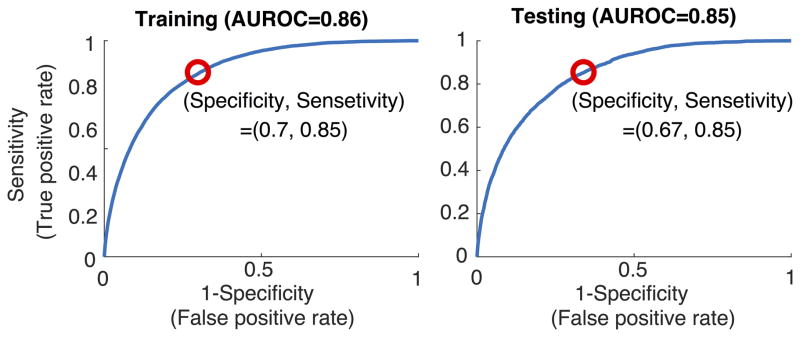
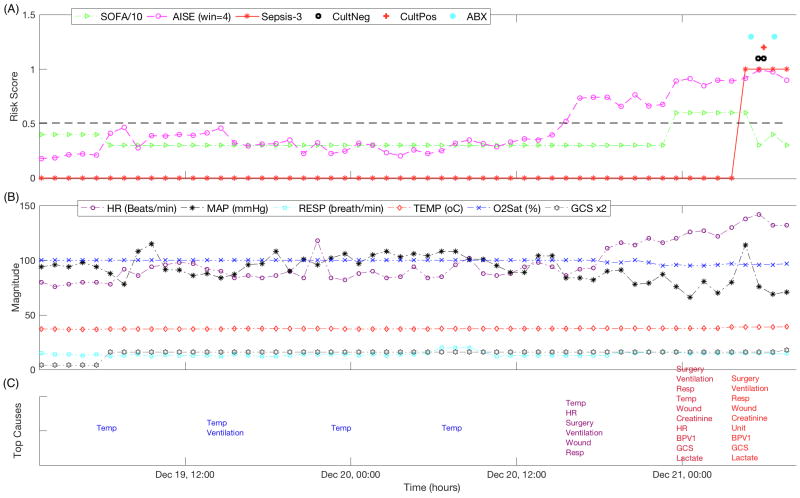
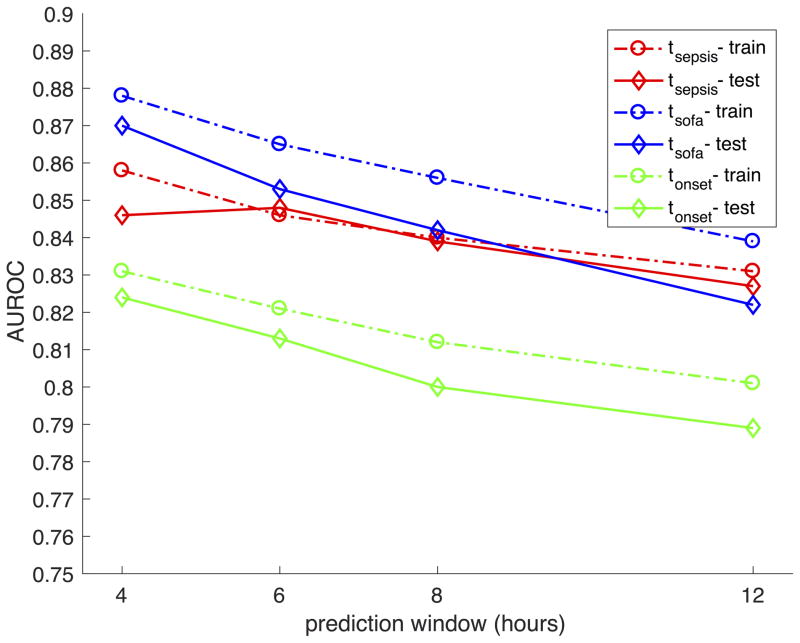
High-resolution vital signs time series and electronic medical record data were extracted. A set of 65 features (variables) were calculated on hourly basis and passed to the Artificial Intelligence Sepsis Expert algorithm to predict onset of sepsis in the proceeding T hours (where T = 12, 8, 6, or 4). Artificial Intelligence Sepsis Expert was used to predict onset of sepsis in the proceeding T hours and to produce a list of the most significant contributing factors. For the 12-, 8-, 6-, and 4-hour ahead prediction of sepsis, Artificial Intelligence Sepsis Expert achieved area under the receiver operating characteristic in the range of 0.83-0.85. Performance of the Artificial Intelligence Sepsis Expert on the development and validation cohorts was indistinguishable.
Using data available in the ICU in real-time, Artificial Intelligence Sepsis Expert can accurately predict the onset of sepsis in an ICU patient 4-12 hours prior to clinical recognition. A prospective study is necessary to determine the clinical utility of the proposed sepsis prediction model.
脓毒症是危重病患者发病率、死亡率和成本超支的主要原因之一。早期使用抗生素干预可提高脓毒症患者的生存率。然而,目前尚无用于实时预测脓毒症发作的临床验证系统。我们旨在开发和验证一种人工智能脓毒症专家算法,用于早期预测脓毒症。
观察性队列研究。
2013 年 1 月至 2015 年 12 月,在埃默里大学的两家医院的 ICU 进行。
来自埃默里大学两所医院 ICU 的超过 31000 例住院患者(开发队列),以及来自公开的医疗信息集市重症监护 III ICU 数据库的超过 52000 例 ICU 患者(验证队列)。排除了在 ICU 入院前或入院后 4 小时内符合第三次国际脓毒症定义(Sepsis-3)的患者,因此分别在开发队列和验证队列中大约有 27000 例和 42000 例患者。
无。
提取高分辨率生命体征时间序列和电子病历数据。每小时计算一组 65 个特征(变量),并将其传递给人工智能脓毒症专家算法,以预测接下来 T 小时内脓毒症的发作(其中 T = 12、8、6 或 4)。人工智能脓毒症专家用于预测接下来 T 小时内脓毒症的发作,并生成最显著影响因素的列表。对于脓毒症的 12、8、6 和 4 小时前预测,人工智能脓毒症专家在接受者操作特征曲线下的面积在 0.83-0.85 之间。人工智能脓毒症专家在开发和验证队列中的性能无差异。
使用 ICU 中实时可用的数据,人工智能脓毒症专家可以在临床识别前 4-12 小时准确预测 ICU 患者脓毒症的发作。需要前瞻性研究来确定所提出的脓毒症预测模型的临床实用性。