Fukasawa Hirotaka, Furuya Ryuichi, Kaneko Mai, Nakagami Daisuke, Ishino Yuri, Kitamoto Shuhei, Omata Kyosuke, Yasuda Hideo
Renal Division, Department of Internal Medicine, Iwata City Hospital, Iwata 438-8550, Shizuoka, Japan.
First Department of Medicine, Hamamatsu University School of Medicine, Hamamatsu 431-3192, Shizuoka, Japan.
J Clin Med. 2023 Feb 20;12(4):1667. doi: 10.3390/jcm12041667.
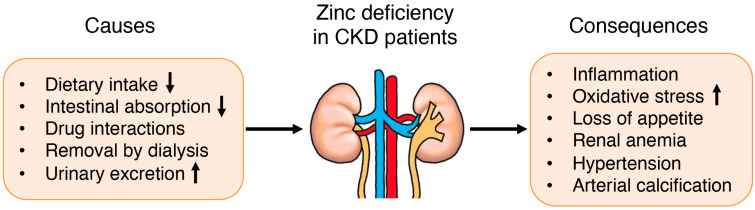
The trace element zinc is essential for diverse physiological processes in humans. Zinc deficiency can impair growth, skin reproduction, immune function, maintenance of taste, glucose metabolism, and neurological function. Patients with chronic kidney disease (CKD) are susceptible to zinc deficiency, which is associated with erythropoiesis-stimulating agent (ESA) hypo-responsive anemia, nutritional problems, and cardiovascular diseases as well as non-specific symptoms such as dermatitis, prolonged wound healing, taste disturbance, appetite loss, or cognitive decline. Thus, zinc supplementation may be useful for the treatment of its deficiency, although it often causes copper deficiency, which is characterized by several severe disorders including cytopenia and myelopathy. In this review article, we mainly discuss the significant roles of zinc and the association between zinc deficiency and the pathogenesis of complications in patients with CKD.
微量元素锌对人类多种生理过程至关重要。锌缺乏会损害生长、皮肤再生、免疫功能、味觉维持、葡萄糖代谢和神经功能。慢性肾脏病(CKD)患者易患锌缺乏,这与促红细胞生成素(ESA)低反应性贫血、营养问题、心血管疾病以及皮炎、伤口愈合延长、味觉障碍、食欲减退或认知能力下降等非特异性症状有关。因此,补充锌可能对治疗锌缺乏有用,尽管它常常导致铜缺乏,铜缺乏的特征是包括血细胞减少和脊髓病在内的几种严重病症。在这篇综述文章中,我们主要讨论锌的重要作用以及锌缺乏与CKD患者并发症发病机制之间的关联。