GDOT Research Group, Faculty of Sport, Universidad Católica de Murcia, 30107 Murcia, Spain.
School of Sport Sciences, Universidad Europea de Madrid, 28670 Madrid, Spain.
Sensors (Basel). 2021 Jan 27;21(3):850. doi: 10.3390/s21030850.
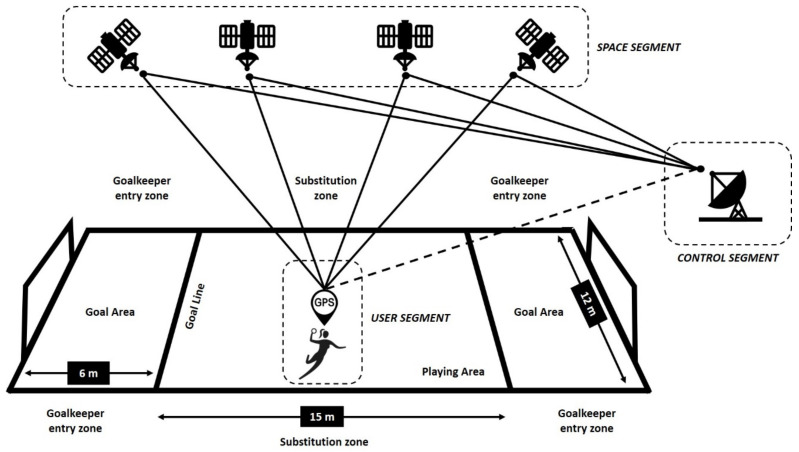
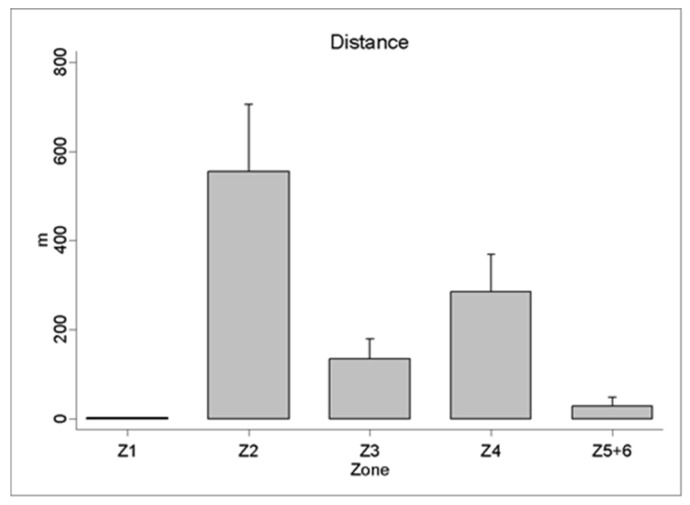
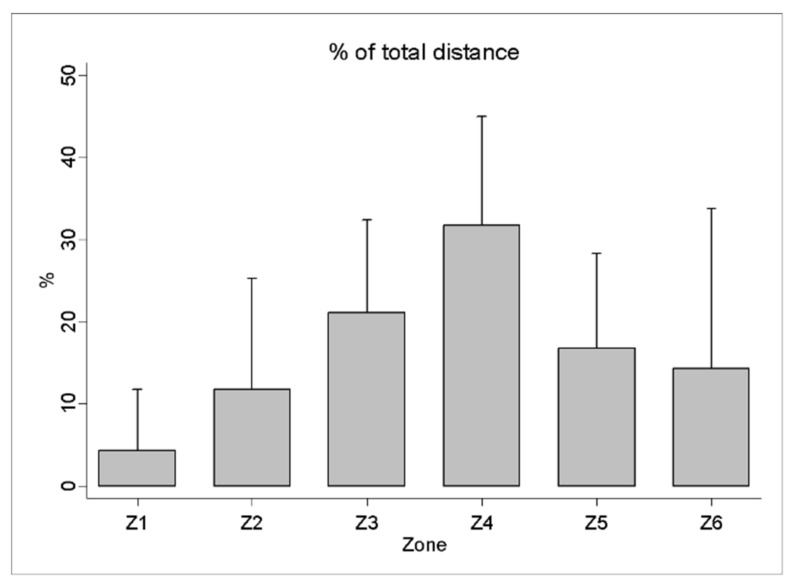
This cross-sectional study aims to analyze the physical demands of elite beach handball players during an official competition. Nine elite female (mean age: 24.6 ± 4.0 years; body weight: 62.4 ± 4.6 kg; body height: 1.68 ± 0.059 m; training experience: 5 years; training: 6 h/week) beach handball players of the Spanish National Team were recruited for this study. A Global Positioning System was incorporated on each player's back to analyze their movement patterns. Speed and distance were recorded at a sampling frequency of 15 Hz, whereas acceleration was recorded at 100 Hz by means of a built-in triaxial accelerometer. The main finding of the study is that 53% of the distance travelled is done at speeds between 1.5 and 5 km/h and 30% of the distance is between 9 and 13 km/h (83% of the total distance covered), which shows the intermittent efforts that beach handball involves at high intensity, as reflected in the analysis of the internal load with 62.82 ± 14.73% of the game time above 80% of the maximum heart rate. These data help to orientate training objectives to the physical demands required by the competition in order to optimize the players' performance.
本横断面研究旨在分析沙滩手球精英运动员在正式比赛中的身体需求。九名西班牙国家队的精英女性沙滩手球运动员(平均年龄:24.6 ± 4.0 岁;体重:62.4 ± 4.6 公斤;身高:1.68 ± 0.059 米;训练经验:5 年;训练:每周 6 小时)被招募参与本研究。在每个运动员的背部安装了全球定位系统以分析他们的运动模式。速度和距离以 15 Hz 的采样频率记录,而加速度通过内置三轴加速度计以 100 Hz 的频率记录。该研究的主要发现是,运动员所行进的距离有 53%是在 1.5 至 5 公里/小时的速度范围内完成的,30%的距离是在 9 至 13 公里/小时(总距离的 83%),这表明沙滩手球涉及高强度的间歇性努力,如内部负荷分析所示,62.82 ± 14.73%的比赛时间超过最大心率的 80%。这些数据有助于确定与比赛要求相符的训练目标,从而优化运动员的表现。