Departamento de Microbiología e Inmunología, Facultad de Ciencias Exactas, Físico-Químicas y Naturales, Instituto de Investigación en Micología y Micotoxicología (IMICO-CONICET), Universidad Nacional de Río Cuarto, Ruta Nacional Nº 36 Km 601 (5800) Río Cuarto, Córdoba, Argentina.
Fellowship of CONICET, Córdoba, Argentina.
Biodegradation. 2023 Jun;34(3):199-214. doi: 10.1007/s10532-023-10022-9. Epub 2023 Feb 25.
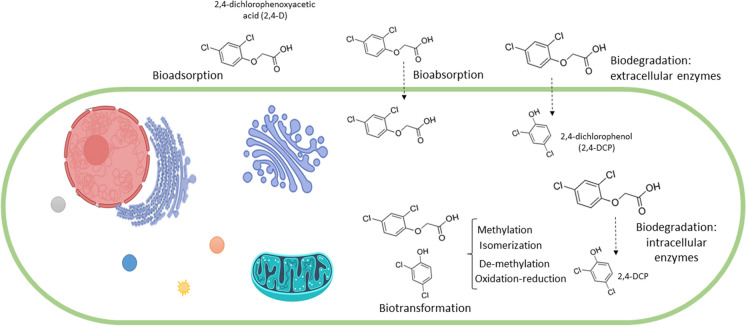
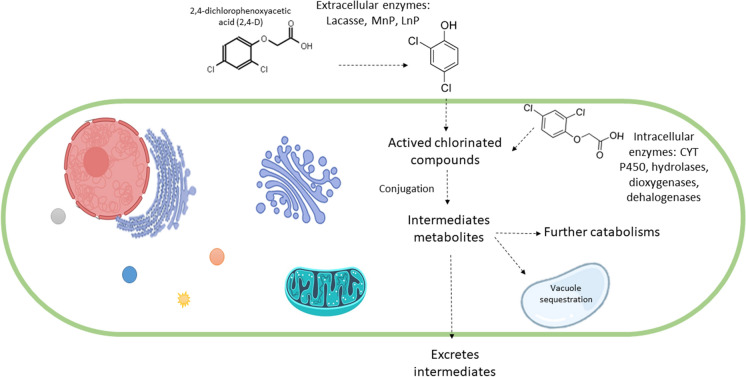
Chlorinated herbicides are one of the main types of pesticide used in agriculture. In Argentina, 2,4-dichlorophenoxyacetic acid (2,4-D) is the most applied herbicide for the control of broadleaf weeds, but the risks it poses for the environment and human health are cause for great concern. A promising technology to remove this kind of pollutants, or neutralize them in such a way that they become less or non-toxic, is the use of degrading or detoxifying microorganisms from contaminated sites. Filamentous fungi can bioremediate xenobiotics thanks to their efficient enzymatic machinery. However, most studies on the degradation of 2,4-D have been carried out with bacteria, and little is known about whether it can be efficiently biodegraded by fungi. In the environment, fungal strains and native microbiota may detoxify contaminants through mechanisms like biosorption, bioabsortion, biotransformation, and/or degradation. Whether these processes occur separately or simultaneously depends on the metabolic ability of the strains that conform the microbial community. Another important concern when attempting to introduce detoxifying microorganisms into a contaminated environment is the GRAS ("Generally Recognized As Safe") assessment or status. These are studies that help predict a biodegrading microorganism's pathogenicity, toxicity, and infectivity before in situ application. This application, moreover, is regulated by different legal frameworks. The present review aims to outline the main aspects of 2,4-D degradation by fungi, and to summarize the current state of research on the topic in Argentina.
氯代除草剂是农业中使用的主要农药类型之一。在阿根廷,2,4-二氯苯氧乙酸(2,4-D)是用于控制阔叶杂草的最常用除草剂,但它对环境和人类健康构成的风险令人高度关注。一种有前途的去除这类污染物的技术,或者以使其毒性降低或无毒的方式对其进行中和的技术,是使用来自污染地点的降解或解毒微生物。丝状真菌可以通过其高效的酶机制来生物修复外来化合物。然而,大多数关于 2,4-D 降解的研究都是用细菌进行的,对于真菌是否可以有效地进行生物降解知之甚少。在环境中,真菌菌株和本地微生物群落可能通过生物吸附、生物吸收、生物转化和/或降解等机制来解毒污染物。这些过程是单独发生还是同时发生,取决于构成微生物群落的菌株的代谢能力。在尝试将解毒微生物引入污染环境时,另一个重要的关注点是 GRAS(“通常被认为是安全的”)评估或状态。这些研究有助于在原位应用之前预测生物降解微生物的致病性、毒性和感染力。此外,该应用受到不同法律框架的监管。本综述旨在概述真菌降解 2,4-D 的主要方面,并总结阿根廷在该主题上的研究现状。